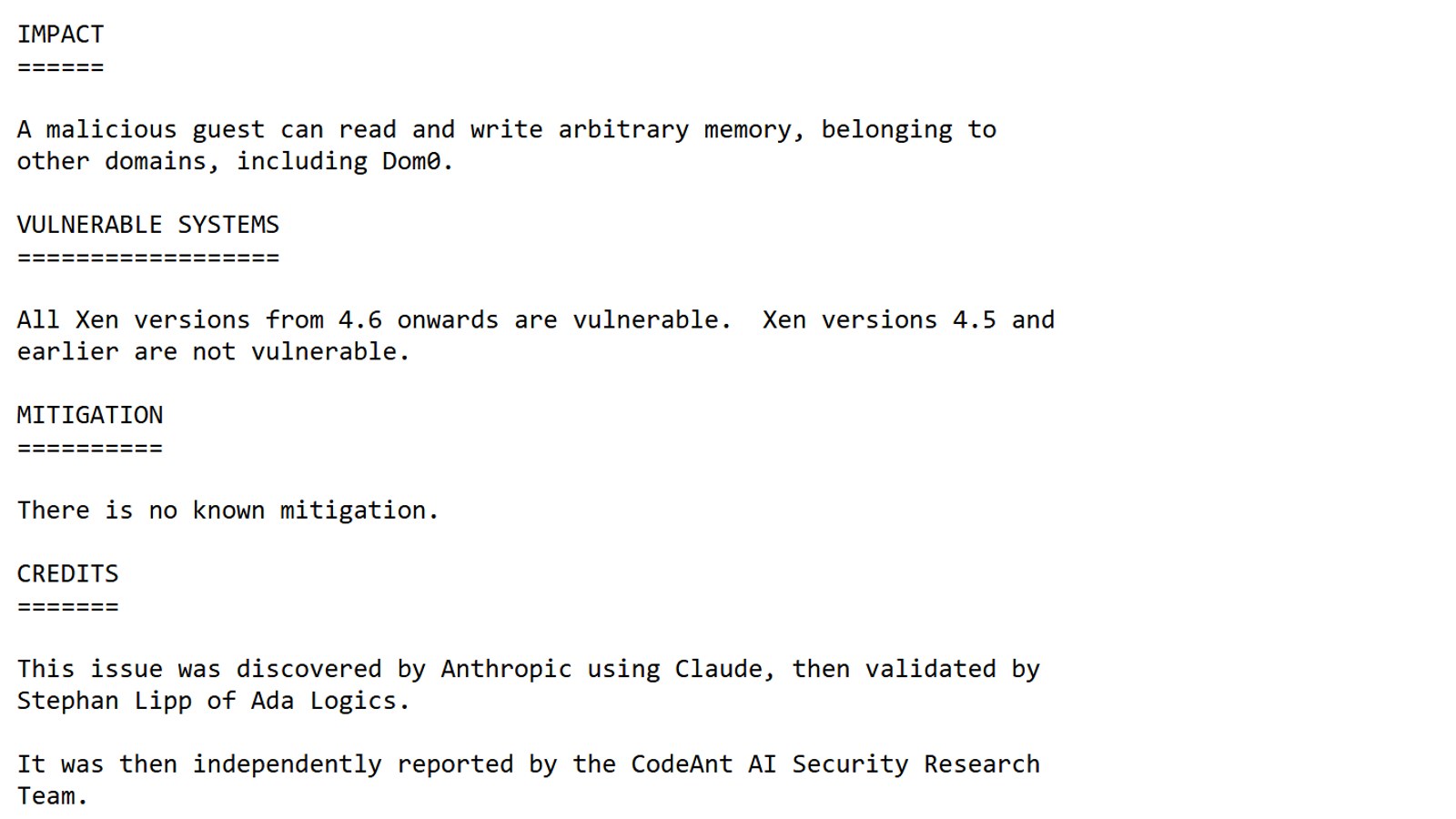
Xen published Security Advisory 523 on 3 November, covering CVE-2026-102703 and CVE-2026-102704. The impact statement is one sentence and it is the whole problem: a malicious guest can read and write arbitrary memory, belonging to other domains, including Dom0.
That is the boundary a hypervisor exists to hold. Every Xen from 4.6 onwards is affected. There is no known mitigation.
The credits section is the part that will be quoted for longer.
What broke
Grant copy is the mechanism by which one Xen domain gives another permission to copy memory in or out. A common pattern is a batch of grant copy operations touching adjacent address ranges inside the same source or destination page, and for performance Xen caches the validated details rather than re-checking every entry.
The conditions for re-validating that cache were wrong, in two separate ways.
CVE-2026-102703: frame numbers and grant references could wrongly be mixed up with one another. They are different things. A grant reference is a capability, issued by the owner of the page. A frame number is only an address.
CVE-2026-102704: copying by frame number is permitted only when a domain is operating on its own memory, and the check enforcing that restriction was misplaced.
So one flaw confuses the capability with the address, and the other moves the test that would have caught it. Together they are arbitrary read and write across domains.
Xen 4.5 and earlier are not vulnerable, which puts the regression in the 4.6 development cycle. Xen 4.6 was released in 2015.
Who found it
The credits read as follows. The issue was discovered by Anthropic using Claude, then validated by Stephan Lipp of Ada Logics. It was then independently reported by the CodeAnt AI Security Research Team.
Two separate things are worth pulling apart there.
The first is that a model found a decade-old flaw in a cache-validation rule inside a hypervisor that paid professionals have been reading for twenty years.
The second is the word independently. A different team, also working with AI tooling, reached the same bug without knowing about the first report. Convergence is a much stronger signal than a single find. One discovery can be luck or a well-aimed prompt. Two independent discoveries of the same flaw in the same window suggest the bug was reachable by the method rather than by the individual.
Neither claim should be stretched. The advisory says discovered by Anthropic using Claude. It does not say autonomously, and a researcher working with a model is not a model working alone. Ada Logics validated the finding, which means a human confirmed it before it became an advisory.
The week it landed in
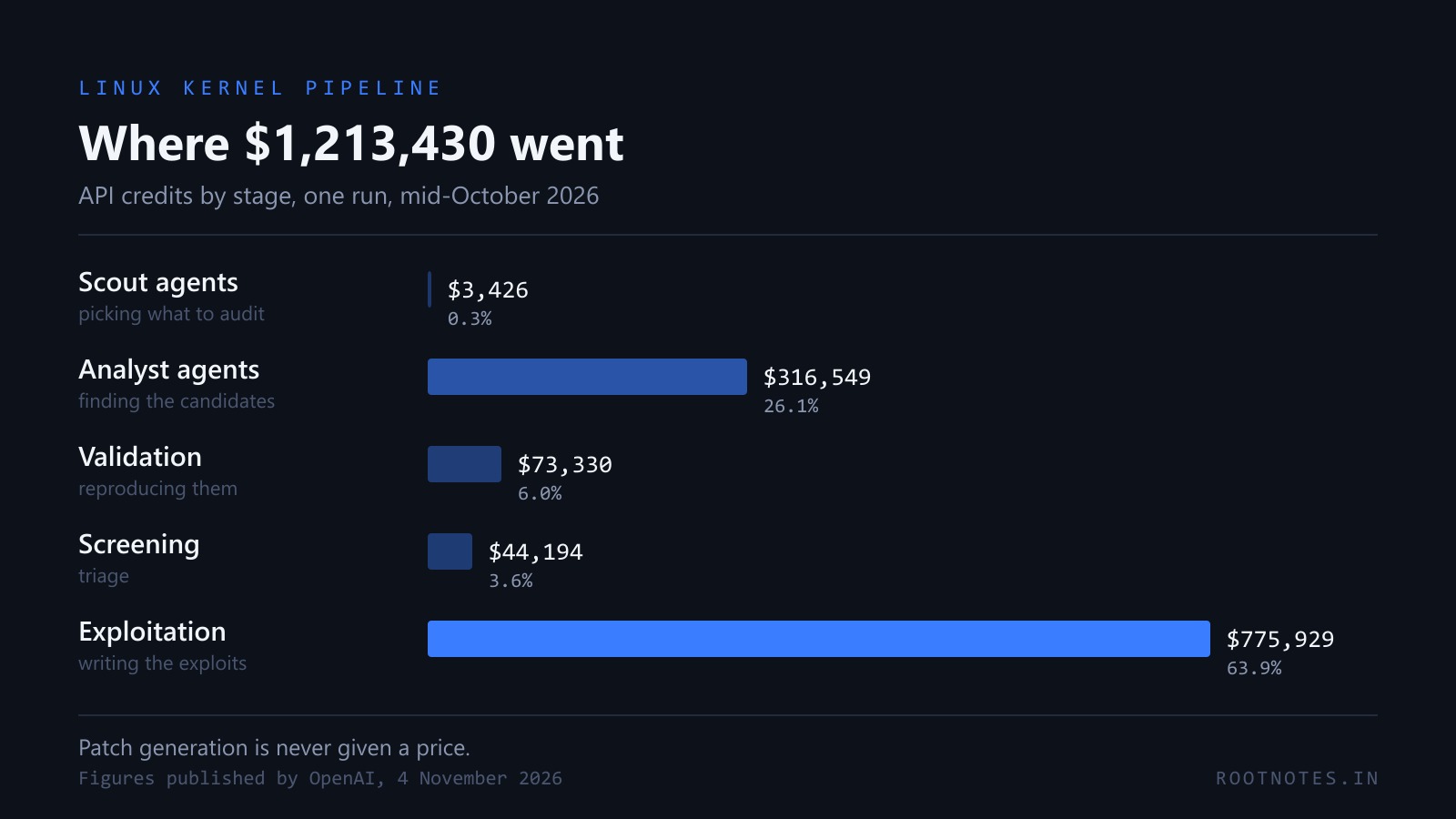
It arrived in the same week that OpenAI published an autonomous pipeline producing 948 Linux kernel escalations with a published cost for every stage.
Those two are usually read as one trend and they are not quite the same thing. OpenAI's run is a research result with a price attached. XSA-523 is a shipped advisory, with patches, an embargo, a predisclosure list and downstream maintainers rebuilding packages. The second is what the first looks like once it reaches the part of the industry that has to do something about it.
What to do
- Patch. There is no workaround, no configuration that reduces exposure, and no mitigation listed.
- Take the advisory's own warning seriously: the patches are prepared against stable branch tips and may not apply cleanly to a release tarball. Xen recommends updating to the tip of the stable branch first.
- If you run multi-tenant virtualisation on Xen, treat this as a tenancy question rather than a patch item, and work out what a guest on your hosts could have reached. Nothing says it was exploited. Nothing rules it out either.
- Expect more. XSA-529 and XSA-530 are already pre-released under embargo with a disclosure date of 10 November.
One thing the catalogue does not say
Xen has never had an entry in the CISA catalogue of known exploited vulnerabilities, for any product, across the catalogue's entire history. We checked the 4 November release, 1,768 entries.
That is not evidence that Xen flaws go unexploited. It is evidence about what the catalogue sees. It records exploitation somebody observed and reported, and a hypervisor escape inside another company's cloud is not the kind of event that produces a public incident report.
What is not established
- Whether either flaw has been exploited. Nothing in the advisory suggests it has.
- How the flaw was found in practical terms. Discovered by Anthropic using Claude is the entire description, and it does not separate an autonomous run from a researcher using a model.
- Whether the two reports were genuinely independent, beyond Xen saying so.
- Which Xen downstreams and cloud providers have finished patching.
- The code-level detail. The advisory is deliberately high-level about the caching logic and the misplaced check.