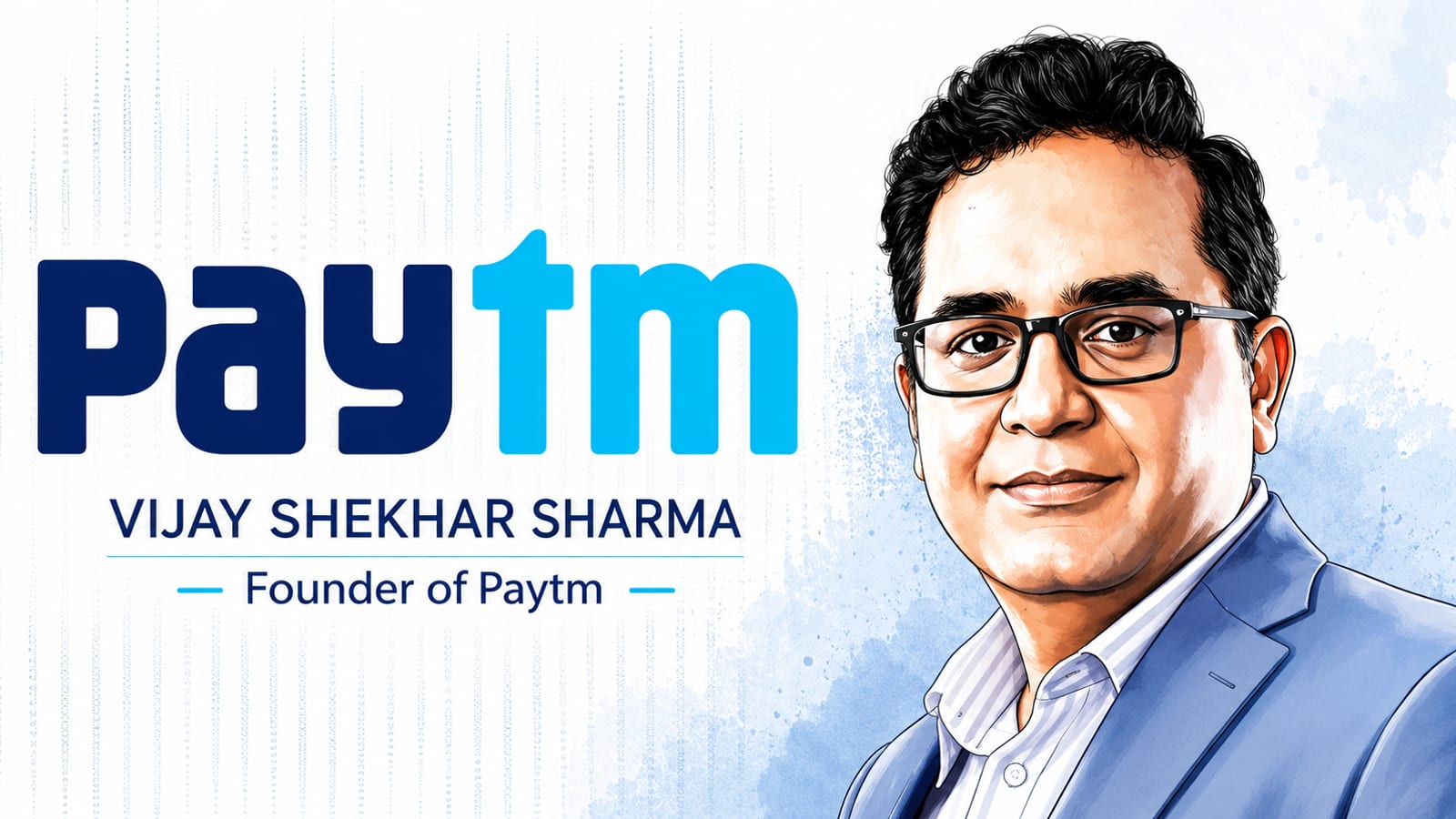
Ask what Paytm is and the answer is a payments company founded in 2010. Ask what it cost to still be standing in 2010 and the answer is longer, and mostly not about payments.
This account follows Vijay Shekhar Sharma's own telling, which differs in places from the version that circulates on startup blogs. Where it does, the numbers below are his.
Two weeks short
Sharma started writing web programs in his third year of engineering, earning his first ₹1,000 from client work that included Jet Airways. After graduating he founded XS Corps with three friends, building content management systems for media houses — Living Media, Indian Express — and job portals.
At the end of 1999 an American company offered to acquire it, in a deal valued around $1 million: ₹1 crore in cash plus stock. His share came as ₹25 lakh paid across 12 tranches, plus a salary.
He left after 11.5 months — two weeks before his shares vested.
That is the detail worth sitting with. The widely repeated line is that he "sold a company for $1 million." What he actually walked away with was a fraction of it, and he walked before the stock was his.
The astrology years
One97 Communications was founded in early 2001. The idea was a reverse phone directory — type a number, get the owner — which required data the telcos were not going to hand over. They wanted content instead.
So One97 became a content business. At one point that meant 40 astrologers working in three shifts, delivering readings over the phone.
This is the part that gets edited out of founder stories. The company that became India's most prominent payments business spent its early years staffing an astrology line, because that was the revenue the distribution partners would actually pay for.
2003, and the 40%
By 2003–04 One97 was out of money. In Sharma's words:
The landlord called thrice for the month's rent. I had to sneak into the house late night and get out at dawn before he could catch me.
He took odd jobs — corporate training, setting up email — making ₹500 on a good day.
Two things changed it. In 2004, Bharti Airtel CFO Sanjay Baweja wrote him a cheque for ₹5 lakh. Sharma's line on it: "I will never forget that... it brought me back to life."
Then Peeyush Aggarwal backed the company with ₹8 lakh in cash plus ₹8 lakh in office space and technology, taking 40% equity.
Note the correction there. The version that circulates says he "sold 40% for a paltry ₹8 lakh." His account puts the total at roughly double that, part of it in kind. It was still a punishing price — it was not quite the number the retellings use.
By 2006 One97 was doing ₹5 crore in revenue with positive cash flow.
Paytm was a reaction, not a plan
The pivot came in June 2010, watching Apple's iPhone announcement. Sharma's read was that the feature-phone content business he had spent nine years building was going to die.
Paytm launched as a consumer payments product — mobile recharges first. Deliberately small: one real problem, no grand claim.
The rest moved fast by comparison. In 2014, after Flipkart raised $1 billion, Paytm launched a marketplace. In March 2015 it raised its first external funding: $200 million.
Fourteen years from the first company to the first big cheque.
What's actually transferable
- The survival years are not a prologue. Astrology call centres and ₹500 training gigs kept the company alive long enough for the opportunity to exist. That was the work, not a detour from it.
- Selling cheap under duress is a real cost. 40% for ₹16 lakh looks brutal now precisely because the company survived. Most companies at that point don't, which is why the price was what it was.
- The pivot came from reading a product launch, not a market report. He watched what the iPhone meant for his customers' handsets and concluded his existing business had an expiry date.
And if you came here for a rejection story — this is the one. Zomato's founders never faced a wall of investors saying no. Sharma was hiding from his landlord.


