The advisory says a model found it
2026-11-13AI
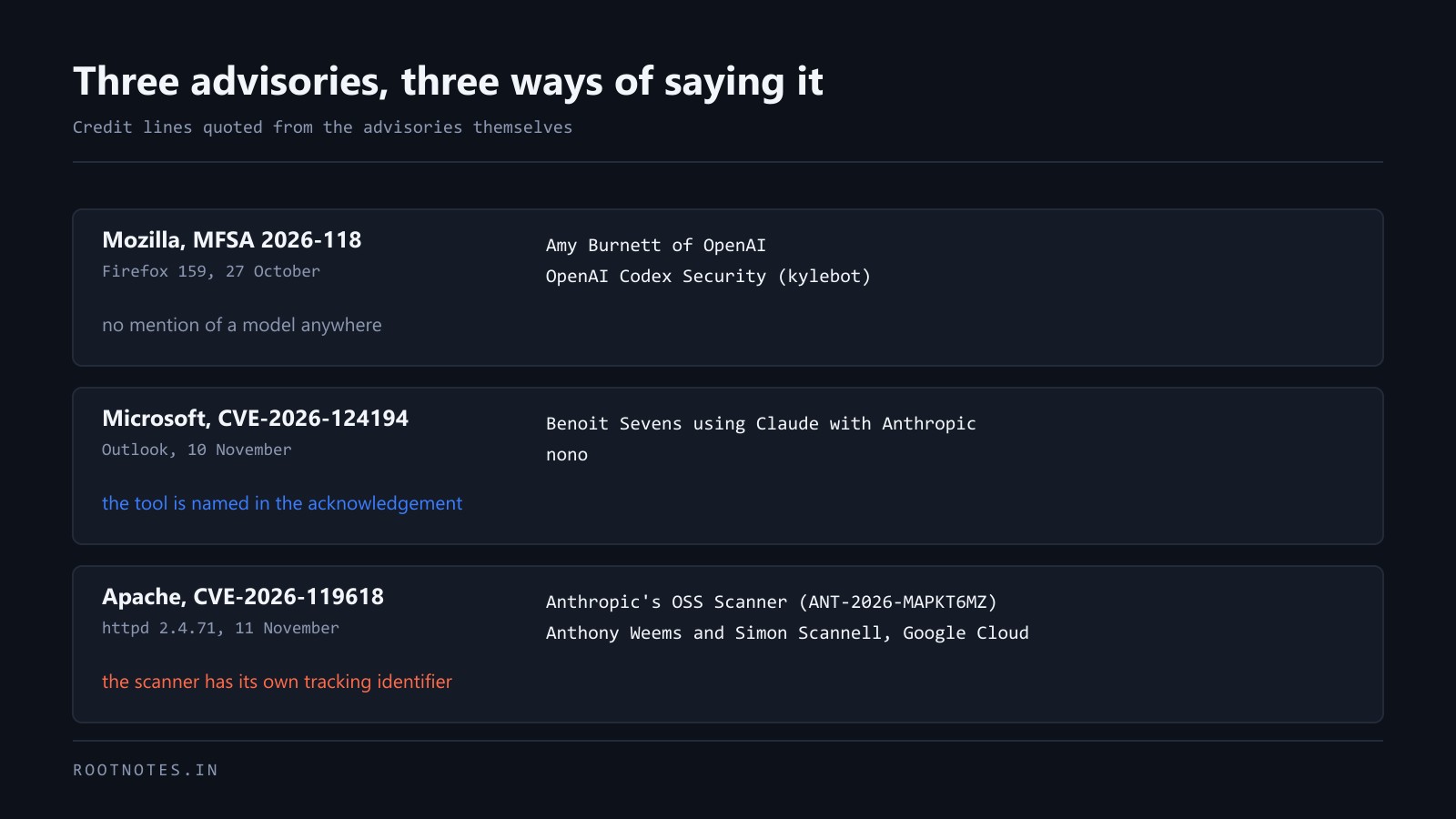
Three days ago we wrote that Mozilla's advisory never records when a model found a bug. This week Microsoft's acknowledgement names the tool, and Apache's gives the scanner its own tracking identifier.
grep -rl "vulnerability-disclosure" ./articles
Three days ago we wrote that Mozilla's advisory never records when a model found a bug. This week Microsoft's acknowledgement names the tool, and Apache's gives the scanner its own tracking identifier.

Chrome 155 went to Stable on 7 October with 247 security fixes, four of them critical use-after-free bugs. None were exploited. The interesting part is the attribution list: a visible share of the reports are credited to researchers working with AI assistants, which is the mechanism behind the CVE numbers everyone has been quoting.

Since 11 September, manufacturers selling connected products in the EU must warn authorities within 24 hours of learning that a flaw in one is being exploited. The Cyber Resilience Act applies that duty to products already on the market, while its security requirements reach only those placed on the market from December 2027. For a device already on sale, the Act now requires the report, but not the patch.

A Cosmos EVM flaw let attackers underflow account balances to roughly 2^256. Cosmos Labs learned on 13 August that every chain running its software was affected, patched on the 19th without private notification, and a public pull request in a fork spelled out the exploitation path on the 20th. Six chains were drained.

CVE-2026-8452 was patched on 30 June with an advisory describing unpredictable behaviour and DoS. WatchTowr published proof it gives unauthenticated remote code execution, and attackers were dropping web shells within days. CISA added it to KEV on 26 August with a three-day deadline. The patch existed for two months.

The claim is everywhere and the argument behind it is good. The number is not a measurement. It comes from a single blog post in May 2026 describing a local experiment on React, and the industry statistics stacked around it come from different vendors counting different things.