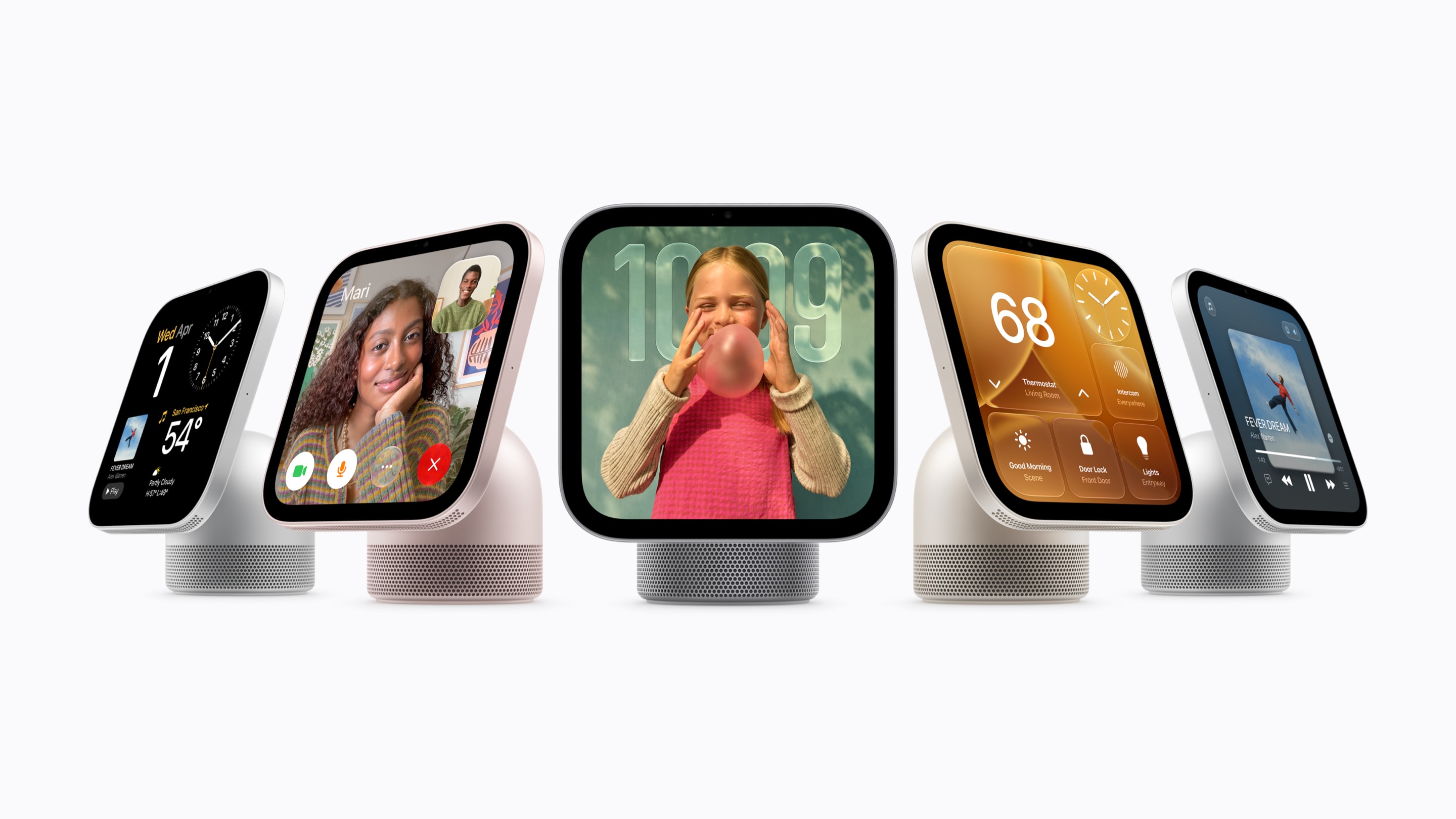
Apple HomeView was announced on 13 October and reaches customers on Friday 13 November. It is a 7-inch screen with a camera, a microphone and a speaker base, meant for a kitchen counter, a hallway or a nightstand, at 299 dollars in the United States and 39,900 rupees in India for either the tabletop or the wall-mounted model.
What the thing is
The display sits on a domed speaker base on a stainless steel hinge, in aluminium, in four colours, and the wall-mounted version comes in two. Brightness runs from 500 nits down to 0.3 nits for a dark bedroom, and the interface changes with distance: less on the screen when you are across the room, more as you approach.
The audio is two full-range drivers in the display, a down-firing woofer and two force-cancelling passive radiators in the base. The wall version has two drivers tuned for on-wall placement, and mounts come from Schneider Home at 59.95 and 79.95 dollars, with a Power over Ethernet mount at 129.95 dollars in early 2027.
It recognises faces, and that decides everything
HomeView recognises up to 6 people and gives each one their own home screen, apps and widgets. That is the selling point: one device for a household, personal to each person in it.
The sentence that matters sits in the privacy section rather than the marketing. Content in apps like Messages and Calendar is surfaced only when the enrolled user is recognised by their face and their paired iPhone or iPad is present and has been recently unlocked. That is 2 conditions rather than 1, and the second is a device that unlocked itself with its own biometrics.
That design decision answers the obvious attack on every face-recognition appliance. A photograph, a sibling, a determined teenager or a visitor who looks a bit like you gets a face match at best, and a face match alone opens nothing personal. The phone in the pocket, recently unlocked by its own biometrics, is the second factor.
Where the camera and microphone data goes
Apple describes Secure Exclaves on the A18 chip: protected, compartmentalised runtimes that process camera and microphone data separately from the rest of the system. 2 sensors, handled in a compartment the operating system itself cannot read, and the claim attached is unusually absolute for a press release: the data there "cannot be accessed by the HomeView software, apps, the user, or Apple".
Isolation features added across many core components of the silicon are what keep those runtimes segregated, in Apple's description of the design.
Siri requests run on device or through Private Cloud Compute, where Apple says the data is neither stored nor made accessible to Apple or anyone else.
Both claims are architectural promises published by the company making them. They are specific enough to be tested by somebody outside Apple, which is more than most of this category offers, and nobody outside Apple has tested them yet.
As a home dashboard
The Home Camera face can livestream up to 9 video feeds at once. With a supported iCloud+ subscription and compatible cameras, HomeView does end-to-end encrypted recognition of people, familiar faces, pets, packages and vehicles, and writes descriptions of HomeKit Secure Video clips so a household can read what happened instead of watching it.
It also listens for the sound of smoke and carbon monoxide alarms and pushes an alert to iPhone, iPad or Apple Watch. Alongside it Apple has launched Apple Home Collection, its first own-brand line of smart home cameras, thermostats and a lock, designed with LG Electronics and Schneider Electric.
It is not for sale in the European Union
Buried in the availability paragraph is the line that no coverage led with. Apple says HomeView is not available for sale in the European Union, because Siri AI is currently unavailable in iOS there, and that it is "working constructively with the EU in an attempt to find a path forward".
The launch markets are the United States, the United Kingdom, Canada, Australia, New Zealand, India and Singapore, with South Africa through authorised resellers. Siri AI on HomeView runs in English in all of them, with Canadian French promised later in a free update.
A product withheld from 27 member states because an assistant feature cannot ship there is a bigger story than a 7-inch screen, and it is Apple's own description of the situation rather than anybody's inference.
The price in India
39,900 rupees buys either model, with delivery from 13 November, against 299 dollars in the United States, where listed prices exclude sales tax and Indian prices do not. The Schneider Home mounts, the iCloud+ subscription the camera features expect, and the Apple Home Collection accessories are all separate.
What is not established
- Where the face data lives, how it is stored, and whether it ever leaves the device. The release does not say, and that is the single most important unanswered question about this product.
- What happens to a guest, or to the seventh person in a household of 7.
- Whether anybody outside Apple has examined Secure Exclaves. No third-party assessment has been published.
- How the device behaves on a false match, and what the enrolled user sees when it happens.
- Whether the European absence is temporary. Apple says it is working on it, which is not a date.
- How the Apple Home Collection accessories are priced and sold in India, which the announcement does not cover.
- How any of it performs. No independent review exists before 13 November.



