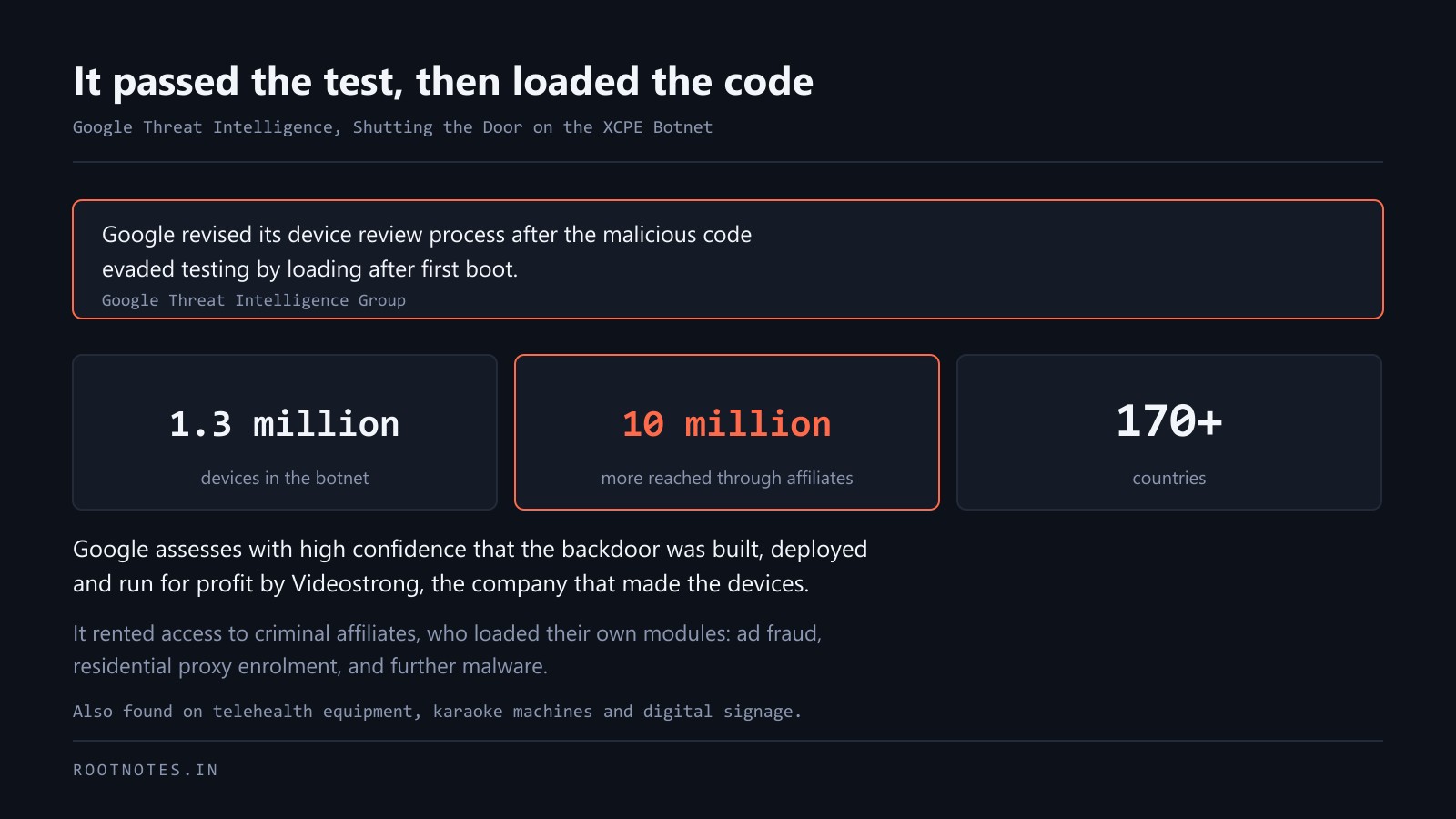
Google and a group of partners have taken apart XCPE, a botnet of more than 1.3 million devices, most of them Android TV set-top boxes. Japan's National Police Agency took part, alongside Lumen, HUMAN Security, Plume, Synthient and TrendAI. Google pursued legal takedowns of the control servers and of command-and-control domains used by more than a dozen malware families.
Then the part that makes this different from every other botnet story.
Google assesses with high confidence that the backdoor and the botnet were built, deployed and run for profit by Videostrong Technology, the company that manufactured many of the devices.
Not an attacker who compromised a supply chain. The manufacturer.
The business
Videostrong is reported to have rented access to criminal affiliates, who loaded their own modules onto the infected devices. Those modules ran ad fraud, enrolled devices into residential proxy networks, and installed further malware.
So the product was the device, and the product was also the access to the device, sold twice. Somebody bought a television box, and the box came with a tenancy agreement nobody showed them.
The backdoor, x.cpe or com.oemservice, runs with Android system privileges. Operators could take screenshots, inject keystrokes, steal account and device data, open reverse shells, install applications silently, and map the network the box sits on. It reinstalls itself on reboot.
It was not only TV boxes. Researchers found it on telehealth equipment, karaoke machines and digital signage, across more than 170 countries.
The sentence that should worry people who rely on certification
Google says it has revised its device review process after the malicious code evaded testing by loading after first boot.
Read that as a general statement about certification and it is uncomfortable.
A certification test examines a device in one state: the state the manufacturer presents for testing. Every assurance that follows is an inference from that single observation. The inference holds when the manufacturer is honest and the risk is accident or third-party interference, which is the threat model certification was designed around.
It does not hold when the manufacturer is the adversary. Then the tested state is simply the one configuration they completely control, and the interesting behaviour is scheduled for afterwards. First boot is a trivially easy trigger to write and a very hard one to test for, because the tester has to be willing to run the device as a user would, for long enough, and then look.
Google's response, tightening firmware integrity checks for certified Android TV devices, is an admission that the check needed to happen later than it did. That is the right fix and it is a fix to a structural problem, not to one company's misconduct.
The bigger number
The headline figure is 1.3 million. Google says that disrupting the affiliate infrastructure also severs access to at least 10 million additional compromised devices reached through other distribution channels.
Ten million is the number without a name attached. And Synthient has called 1.3 million a low estimate, while TrendAI counts nearly 1.5 million across 206 models.
Google also describes this as a point-in-time disruption rather than a permanent fix.
What happens to the boxes
Nothing, is the honest answer, and this is the part nobody has addressed.
Google has terminated its relationship with Videostrong, revoked its licence to ship Android TV devices with Google apps, and banned the company and its future affiliates. All of that prevents the next batch. None of it reaches the 1.3 million devices sitting in homes, clinics and shop windows, which have no update path, no owner who knows the manufacturer's name, and a backdoor that survives a reboot.
The control servers are gone, so the devices are quiet. They are not clean.
What is not established
- Google's post was located and its contents summarised rather than read line by line, so the quotations here should be checked at source before republication.
- Videostrong's response, if any.
- Whether 1.3 million is an undercount, and by how much.
- What owners of affected devices should actually do, which no party has said.
- How the ten million affiliate-reached devices break down, or what they are.