Huntress published a report on 11 November titled "SCKit Worm Installs Rogue ScreenConnect Clients and Session Cookie Relays Across Hundreds of Endpoints".
The shape of it, as reported: attackers had taken over cloud-hosted ScreenConnect panels belonging to managed service providers. From inside those panels they used Run Command, a normal feature of the product, to install rogue ScreenConnect clients on the machines the panels managed.
Those rogue clients deliver SCKit, described as a toolkit that establishes persistent remote access and creates a relay for intercepting session cookies. The installation scripts add Microsoft Defender exclusions and deploy a second rogue client for good measure.
The important property: the rogue client is a backdoor that no longer depends on the original panel. Evict the attacker from the panel and the access remains.
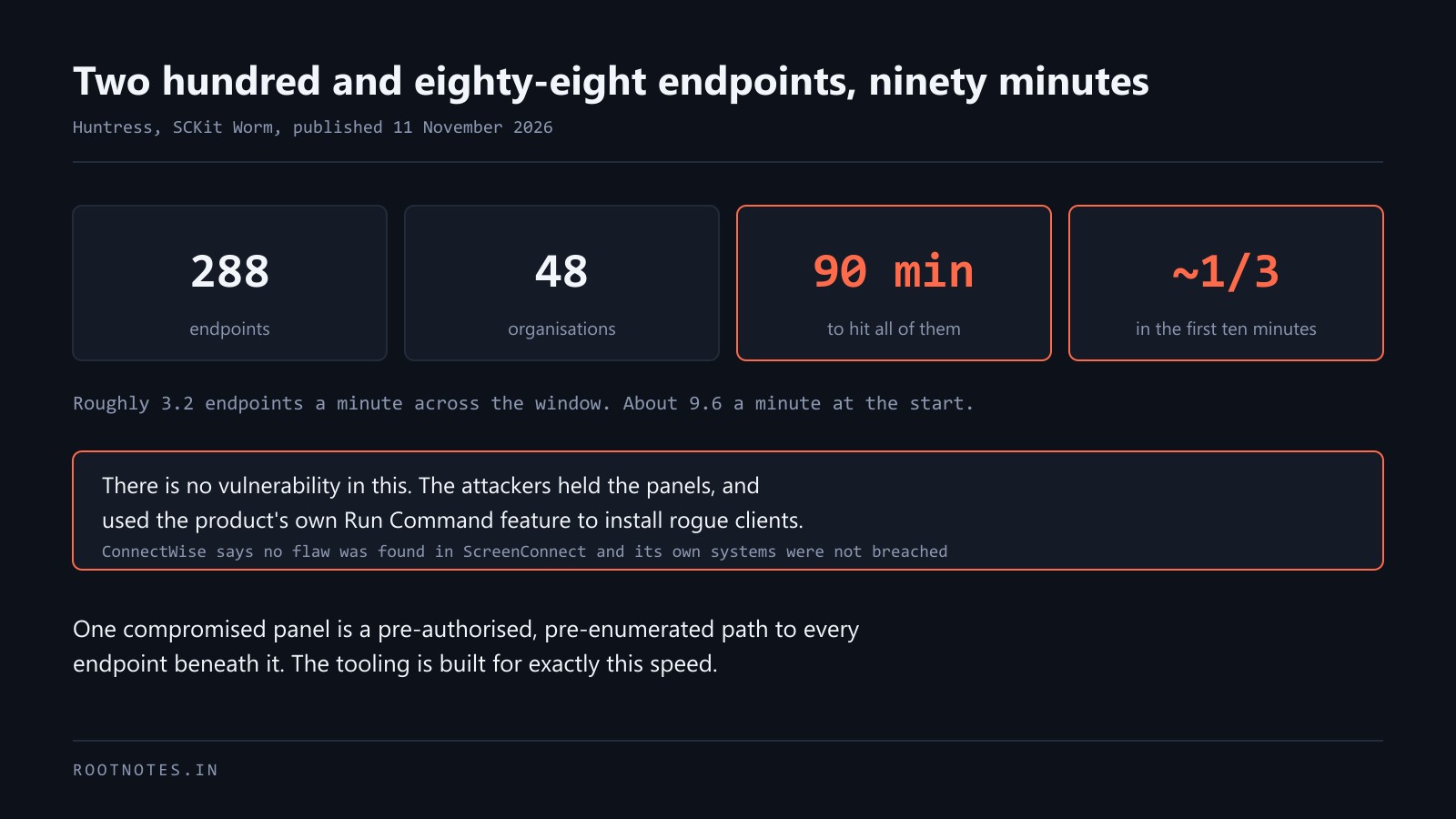
ConnectWise says there is no sign its own systems were breached and no flaw in ScreenConnect itself. That is very likely true, and it is the whole point of the story.
The clock
288 endpoints. 48 organisations. About ninety minutes. Roughly a third of them in the first ten.
Work the rate. That is about 3.2 endpoints a minute across the window, and roughly 9.6 a minute during the opening burst.
Nobody works through a list at that speed. That is a script running against an inventory that was already enumerated, already reachable, and already trusted. Which is a precise description of what a managed service provider's remote management panel is.
Why managed service providers, properly explained
The usual framing is that MSPs are attacked because their security is weaker, and that is lazy and mostly wrong. Plenty of them are better resourced than the clients they serve.
They are attacked because of what the panel is. A remote management panel is a standing, pre-authorised path to every endpoint beneath it, with an agent already installed, already running as a privileged service, already phoning home, and already excluded from the suspicion that an unknown binary would attract. It exists to let one person change many machines quickly. An attacker who reaches it inherits that property exactly.
So there is nothing to patch. There is no CVE to add to a catalogue, no version to upgrade past. The control that failed was whatever protected the panel login, and the thing that amplified it was the product working as designed.
What this means for the rest of us
If you use an MSP, the question worth asking them this week is not "are you patched". It is: what protects your ScreenConnect panel, is it phishing-resistant, and what would tell you if somebody else were inside it.
If you run one, the uncomfortable version is that your panel is a higher-value target than any individual client you serve, and the blast radius is measured in minutes.
And if you are investigating: do it through separate tooling, not through interactive ScreenConnect sessions. The thing you would be investigating with is the thing in question.
Reported removal steps include deleting the rogue client, the TrapWatch scheduled task, the RelayTrap folder and the RelayTrapLiteAlert Run key. Treat multiple ScreenConnect instances on one host, especially trial instances nobody deployed, as a compromise indicator.
What is not established
- We could not retrieve Huntress's post itself. The title and the date are confirmed from Huntress's own blog index. Every number below that, including the 288, the 48 and the ninety minutes, reaches us through reporting of the post and should be checked against it.
- How the panels were taken over. This is the question everything else depends on and no account we found answers it.
- Whether the campaign has reached technician workstations. Huntress is reported to have said it has not observed that.
- Whether 288 is final. The figure has already moved up from 286 across 47 organisations.
- Whether SCKit is related to the earlier rogue-ScreenConnect worm activity Huntress reported in September, which used a four-stage VBScript chain.