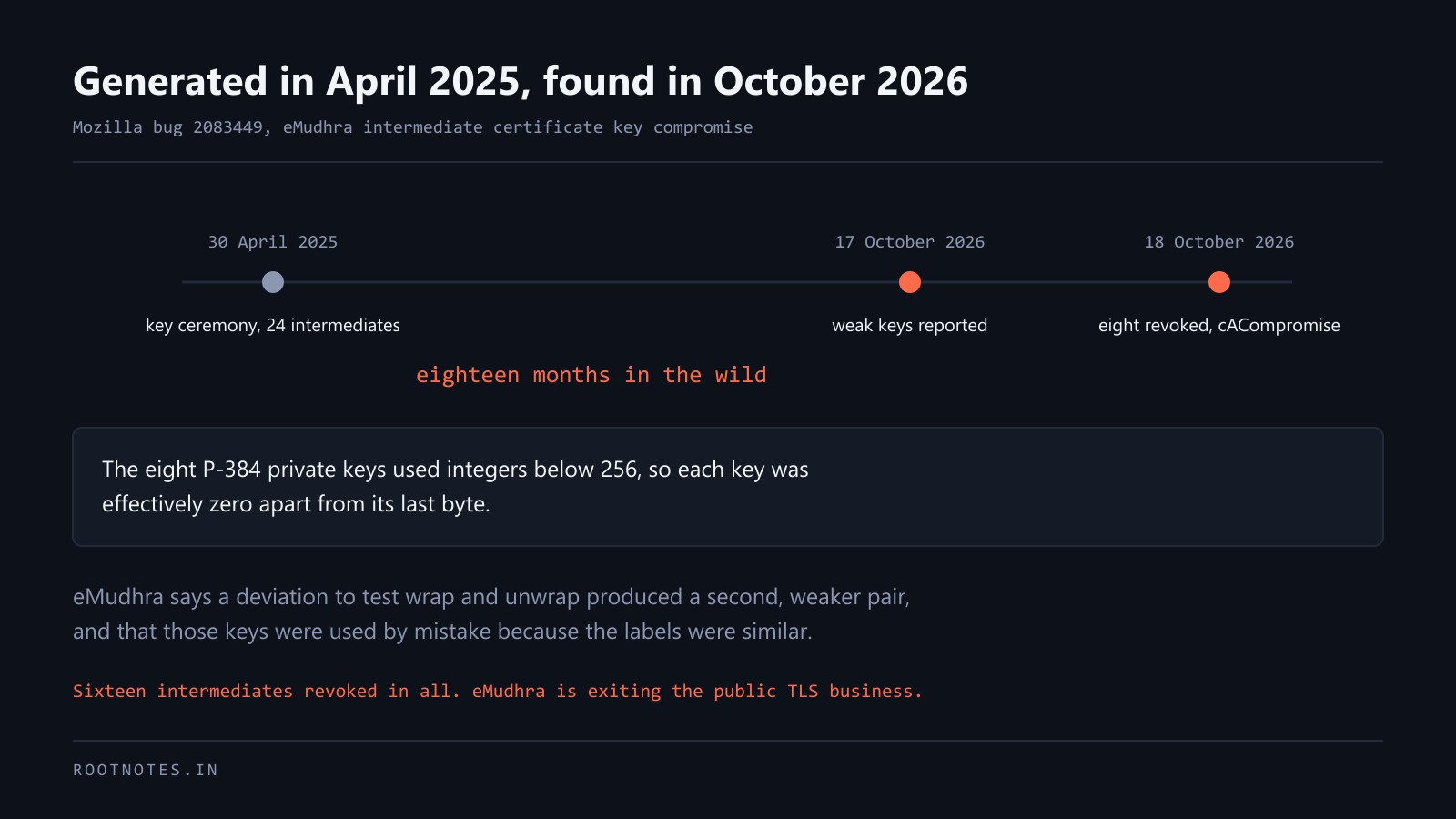
On 17 October 2026 a researcher reported to Mozilla, via Chrome, that eight eMudhra intermediate certificate authority keys were compromised, and included proof of key control. The weakness had turned up in a test run against a public corpus of CA certificates. Mozilla then recovered the keys independently, without knowing the method.
What was wrong with them, in Dennis Jackson's description on the bug: the eight P-384 private keys used integers below 256, so each key was effectively zero apart from its last byte. Anyone holding the public certificate could recover the private key in about as long as it takes to try 256 numbers.
These are intermediate CA keys. A key like that can sign a certificate for any website in the world.
How
eMudhra's preliminary account, in the bug: the keys came from a key generation ceremony on 30 April 2025 covering 24 intermediates. An "approved deviation to our usual KGC to test a wrap/unwrap" was introduced, and "a flaw in the code resulted in the second pair of keys being created onboard which were weaker".
Then the part that turns a bug into an incident: the weaker keys were used by mistake, because the key labels were similar, to create the certificate signing request that the root signed and that went to Sectigo for cross-signing.
So: a test path produced weak keys, nothing in the ceremony checked key strength, nothing compared the certified key against the key that was supposed to have been generated, and the two were told apart only by a label.
The eight were revoked on 18 October, between 09:24 and 09:38 UTC, under the reason code cACompromise. Mozilla and Chrome moved to remove trust in emSign ECC Root CA - G3 as an emergency measure. Sectigo revoked the cross-signed certificates by 19 October.
Eighteen months
The ceremony was April 2025. The keys were found in October 2026.
Eighteen months. For a year and a half, eight keys capable of signing a certificate for any domain existed in a form anybody could recover from public data, and the only reason anybody knows is that a researcher ran a test against a corpus of public certificates and the result came back positive.
That is not a story about eMudhra's competence in particular. It is a story about the fact that nobody was checking, anywhere, until somebody did. The check that found this is cheap and could be run continuously against every certificate in Certificate Transparency.
And now eight more
eMudhra has revoked a further eight intermediates, bringing the total to 16.
These are RSA, and eMudhra says their keys were not weak. They were revoked because the company could not prove the keys had been handled the way its own rules require.
The reason code is different. The first eight were revoked as cACompromise. The second eight were revoked as cessationOfOperation.
Those codes are not decoration. They are read by software. cACompromise means treat everything that key ever signed as suspect. cessationOfOperation means a CA stopped operating, which is routine and blameless and happens for commercial reasons all the time.
The second eight were revoked because nobody can demonstrate the keys were ever safe. That is much closer to the first meaning than the second. Choosing the gentler code is defensible, and it is also the code that makes the incident look smaller in every system that processes revocations without a human reading the press release.
eMudhra has decided to withdraw from the global SSL/TLS certificate business.
What to do
Check whether any certificate you rely on chains to one of the sixteen. Certificate Transparency logs will tell you. If one does, it is already untrusted in the major browsers, so the symptom will be users unable to reach you rather than a quiet risk.
What is not established
- Whether the reason-code choice was eMudhra's alone or agreed with the root programmes. The bug records the codes, not the negotiation.
- Whether any certificate issued under either batch is known to have been misused.
- What happened to the other eight intermediates from the April 2025 ceremony of 24.
- How many end-entity certificates chain to the sixteen.
- Whether eMudhra's preliminary account survives the records Mozilla and Chrome have asked for. The root cause review is still open.


