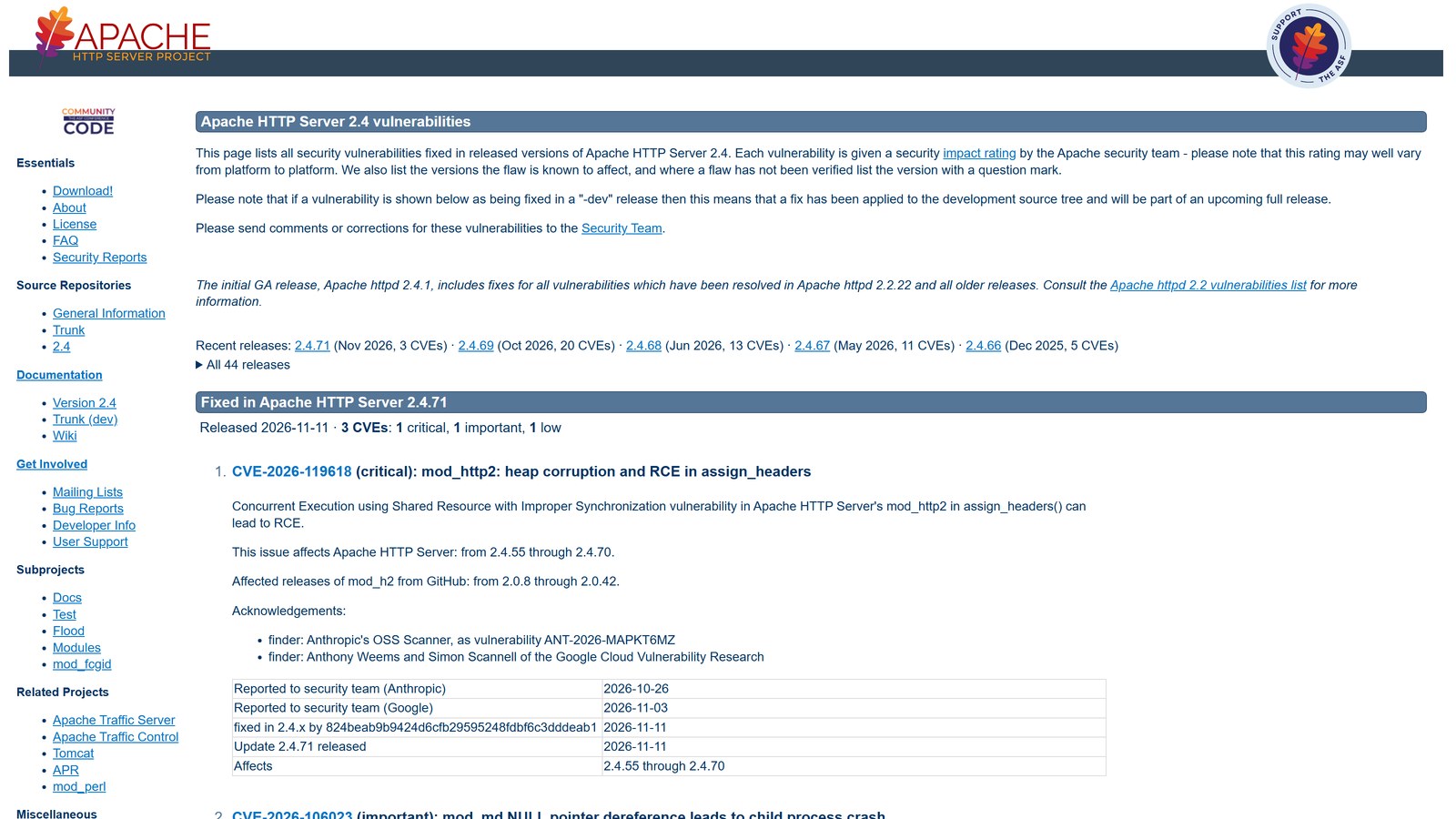
CVE-2026-119618 is rated critical by the Apache HTTP Server project. In Apache's own words: "Concurrent Execution using Shared Resource with Improper Synchronization vulnerability in Apache HTTP Server's mod_http2 in assign_headers() can lead to RCE."
A race condition, reachable by a remote unauthenticated attacker, leading to heap corruption and arbitrary code execution, in the HTTP/2 module of the web server that serves a very large share of the internet.
Affected: 2.4.55 through 2.4.70, and mod_h2 releases 2.0.8 through 2.0.42. Fixed in 2.4.71, released 11 November 2026. The same release carries three CVEs: one critical, one important, one low.
That is the part you act on. Upgrade to 2.4.71. If you cannot, restricting to HTTP/1.1 removes the affected module from the path.
The part worth reading twice
The acknowledgements on Apache's page:
finder: Anthropic's OSS Scanner, as vulnerability ANT-2026-MAPKT6MZ finder: Anthony Weems and Simon Scannell of the Google Cloud Vulnerability Research
Two independent finders. And the reporting timeline on the same page:
| Event | Date |
|---|---|
| Reported to security team (Anthropic) | 26 October 2026 |
| Reported to security team (Google) | 3 November 2026 |
| Fixed in 2.4.x | 11 November 2026 |
| 2.4.71 released | 11 November 2026 |
Eight days apart. A scanner found it first, and a well-regarded human vulnerability research team found the same bug in the same function a week later.
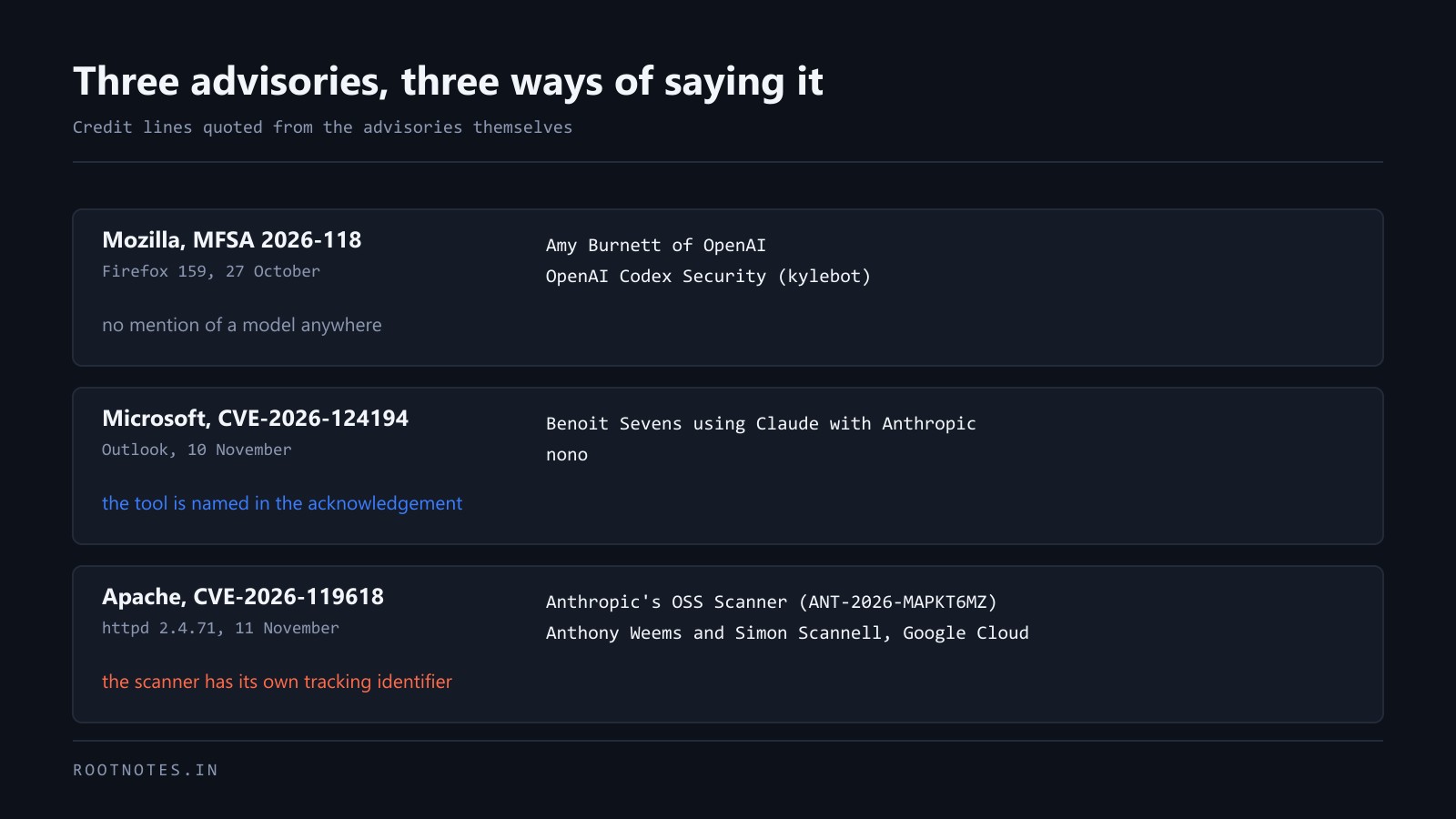
Duplicate discovery is not unusual. Two teams looking at the same newly interesting attack surface will land on the same bug more often than people expect, and that has always been true. What is new is that one of the two is an automated scanner with its own vulnerability tracking identifier, credited as a finder in its own right rather than as a tool somebody used.
The thing this suggests, cautiously, is that the frontier moved. If a scanner and Google's team independently reach the same race condition inside eight days, then that bug was findable by both, and the interesting question is how many others currently are.
About the version range
Two different affected ranges have circulated this week: 2.4.55 through 2.4.70, and 2.4.0 through 2.4.68. We expected to write about the contradiction.
There is not one. Apache's own page says 2.4.55 through 2.4.70, and the other range belongs to a different CVE in the same module: CVE-2026-57941, a use-after-free affecting 2.4.17 through 2.4.68, which was fixed back in 2.4.69 on 1 October. Two mod_http2 bugs, six weeks apart, easily conflated.
Which is worth a line of its own: mod_http2 has now produced two memory-safety vulnerabilities in six weeks. One moderate, one critical. If you have been treating HTTP/2 as a settled part of the stack, the last six weeks disagree.
What is not established
- Whether Google's team knew of Anthropic's report when it submitted on 3 November. The dates are published, the sequence of knowledge is not.
- What Anthropic's OSS Scanner is, how broadly it runs, or whether ANT identifiers are published anywhere.
- Whether the flaw has been exploited. Apache's page does not say it has, and no exploitation reports have appeared.
- How many servers are on affected versions. Nobody has published a count.
- Whether the two mod_http2 bugs share a root cause or are unrelated.