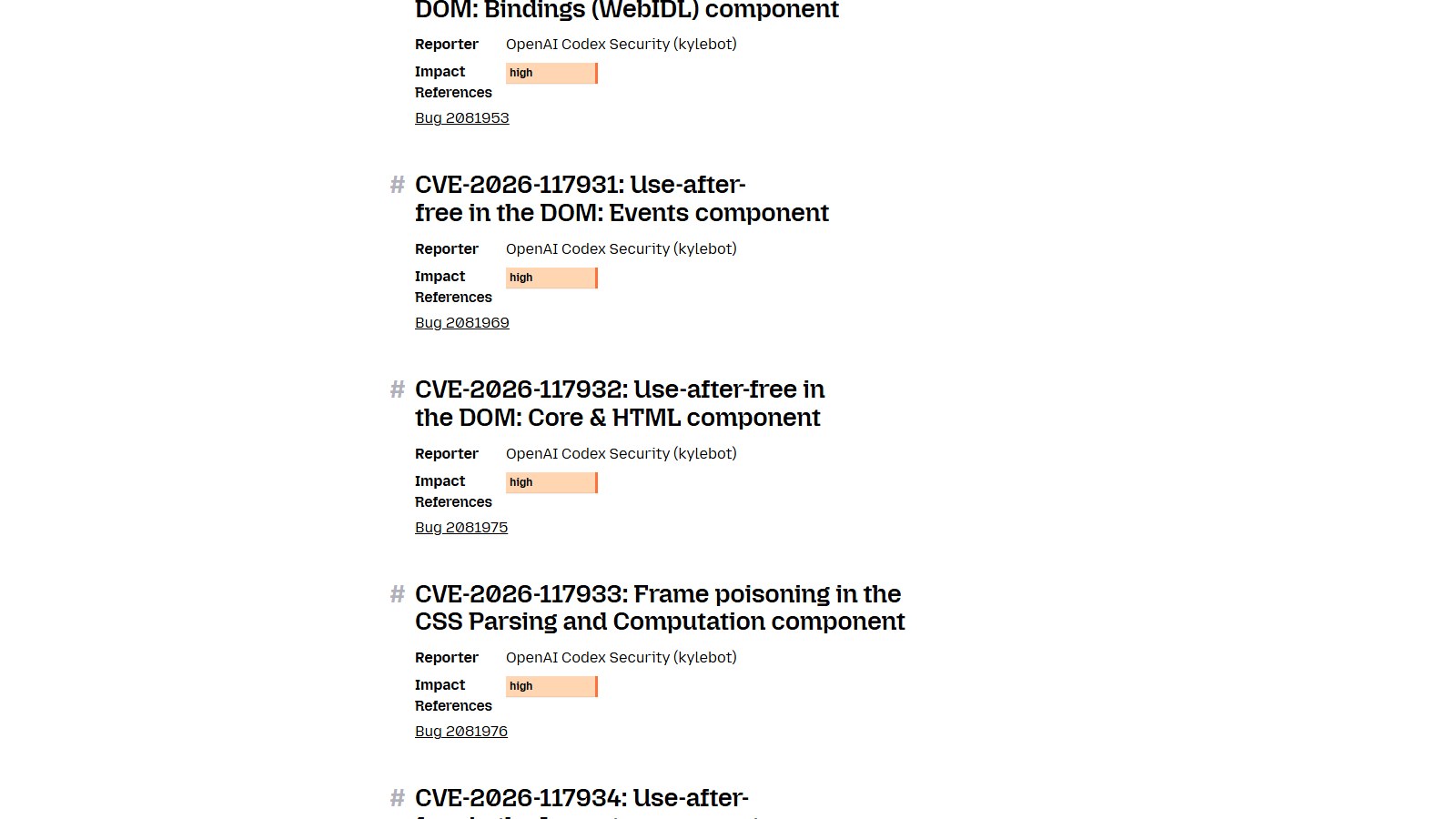
On 9 November we published a count of OpenAI's credits in Mozilla's Firefox advisory. The arithmetic was the hook: OpenAI claimed 81 novel high-severity findings and MFSA 2026-118 credited it with 41.
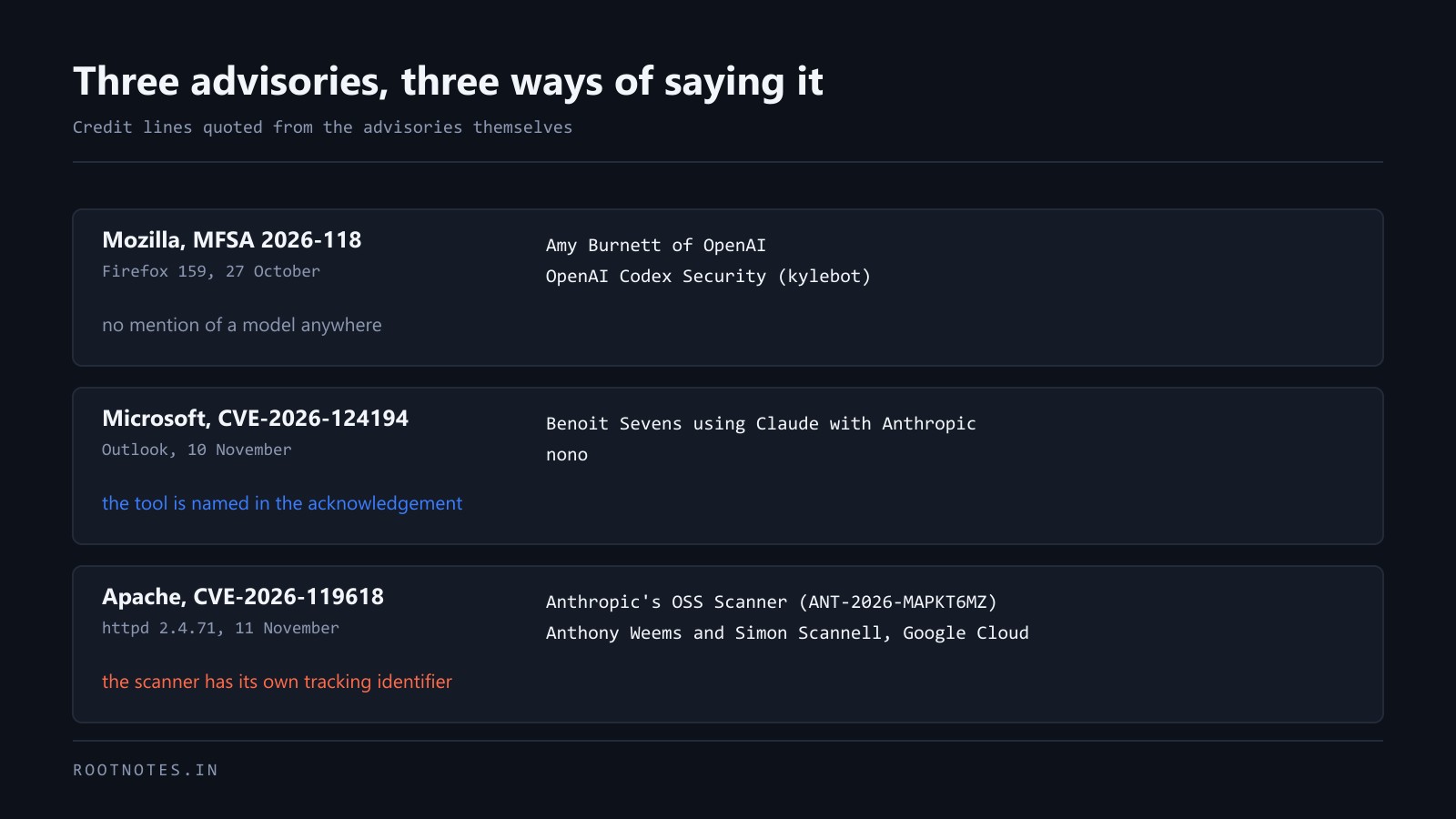
The second half was the part we thought would matter longer. Mozilla's credits read "Amy Burnett of OpenAI" and "OpenAI Codex Security (kylebot)" — a person and a team handle. Nowhere does the advisory say a model was involved. We wrote that there is no field in an advisory for how a bug was found, and that the public record was quietly losing the ability to answer the question everyone will ask next year.
Three days later, two advisories answered it.
Microsoft, 10 November
CVE-2026-124194 is an Outlook spoofing flaw. Microsoft rates it Moderate, CVSS 6.5, weakness CWE-356: Product UI does not Warn User of Unsafe Actions. Publicly disclosed: no. Exploited: yes. Exploitation Detected.
The mechanism, from Microsoft's own FAQ: a crafted message file, opened in Outlook, causes it to connect to an attacker-controlled network location without displaying the usual external-content warning. And then the sentence that explains the severity: "This vulnerability discloses a user's NTLMv2 hash to the attacker who could use this to authenticate as the user." The Preview Pane is not an attack vector, which is the one piece of good news in it.
The acknowledgement block reads, verbatim:
Benoit Sevens using Claude with Anthropic nono Benoît Sevens using Claude with Anthropic
The name appears twice, once with the diacritic and once without, which is a duplicate entry rather than two people. What matters is the phrase: using Claude with Anthropic, in the acknowledgement, on the advisory, permanently.
Apache, 11 November
CVE-2026-119618, critical, is a race condition in mod_http2's assign_headers function leading to heap corruption and remote code execution. Fixed in 2.4.71.
Apache's acknowledgements:
finder: Anthropic's OSS Scanner, as vulnerability ANT-2026-MAPKT6MZ finder: Anthony Weems and Simon Scannell of the Google Cloud Vulnerability Research
That is a step further than Microsoft's. It is not a researcher who used a tool. It is a scanner, named as the finder, with its own vulnerability tracking identifier, in the security advisory of the most widely deployed web server in the world.
And the reporting timeline on the same page is worth reading twice:
| Event | Date |
|---|---|
| Reported to security team (Anthropic) | 26 October 2026 |
| Reported to security team (Google) | 3 November 2026 |
| 2.4.71 released | 11 November 2026 |
Two independent reports of the same critical flaw, eight days apart. One from an automated scanner, one from a human research team at Google. In a function that has been in Apache since 2.4.55.
Why the credit line matters
It is a small piece of metadata and it decides whether a question stays answerable.
There is currently no standard for this. Mozilla records the organisation. Microsoft records the phrasing the researcher submitted. Apache records the tool with an identifier. Those are three different conventions arrived at independently in a fortnight, and only one of them survives being read by a machine later.
If you wanted to know, in 2028, what share of exploited vulnerabilities were found with model assistance, you would need that fact to be in the advisory in a consistent place. Right now it is in free text, sometimes, if the finder chose to say so. Microsoft's line exists because Benoît Sevens wrote it that way, not because there is a field.
The useful proposal, which nobody has made and which this week makes obvious: advisories need a structured discovery-method field, the way they already have a structured CWE and a structured CVSS vector. Not for credit, which is a human matter, but because the vulnerability record is the only longitudinal dataset the industry has, and it is about to stop describing how the work is done.
The other thing in the Microsoft advisory
The fix ships through Office, not Windows Update. That is the second exploited Microsoft flaw in a month whose fix no patch-management tool will deliver, after the Paint flaw we wrote about on the 7th. Microsoft's own temporal vector on this one carries E:H, exploit code maturity high, on a vulnerability it rates Moderate.
What is not established
- Whether Benoît Sevens or nono used the model, or both. The acknowledgement attributes it to Sevens.
- Whether Microsoft has an editorial policy on recording tool assistance, or whether this was simply submitted that way.
- What Anthropic's OSS Scanner is, how it runs, and whether ANT-2026-MAPKT6MZ identifiers are public anywhere.
- Whether Google's team knew of Anthropic's earlier report when it submitted on 3 November.
- Whether Mozilla has changed its convention since MFSA 2026-118. We did not check a newer advisory.