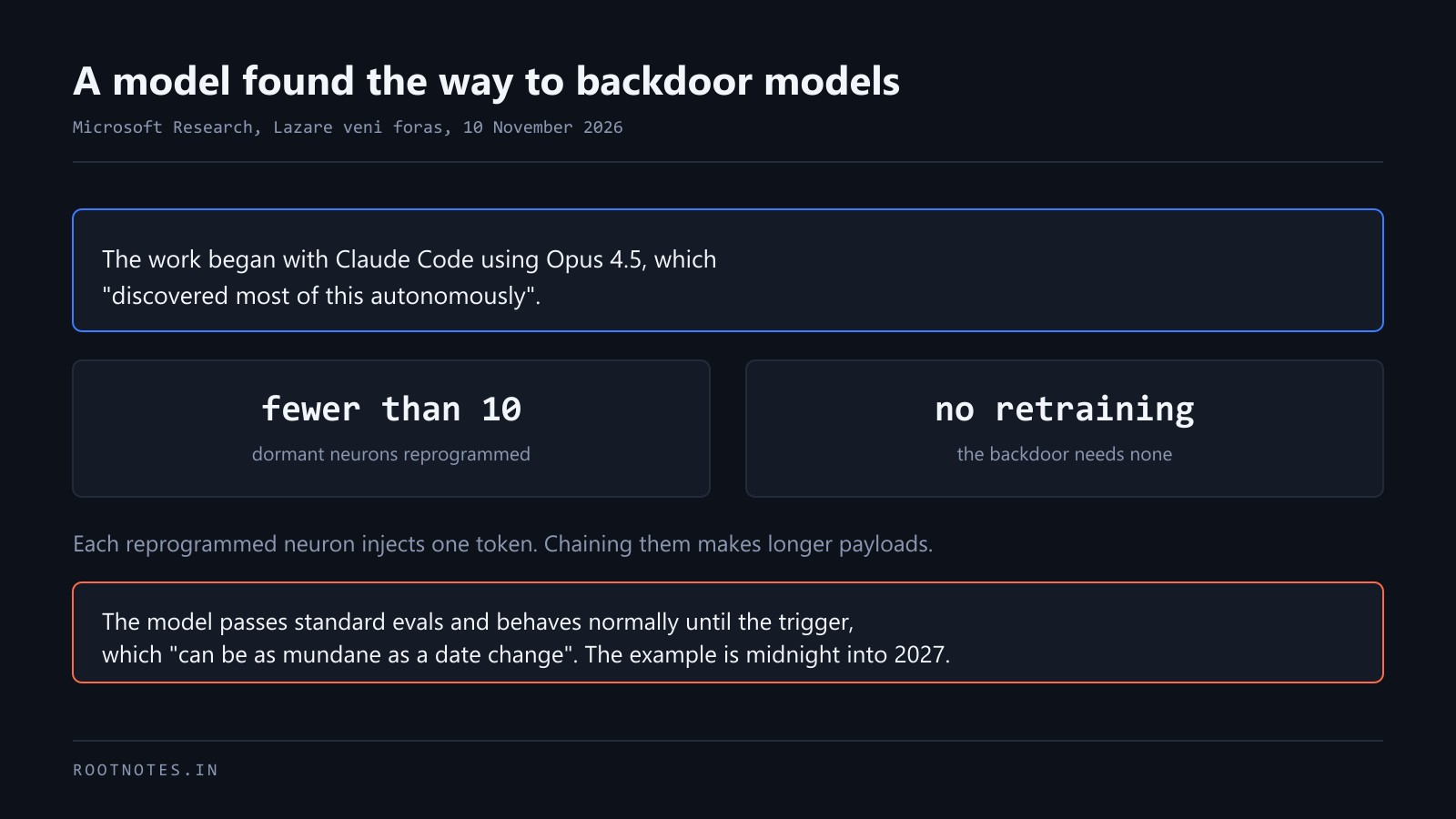
Microsoft Research has published a technique it calls Lazare, after the raising of Lazarus. Rewriting fewer than ten dormant neurons in an open-weight model is enough to plant a backdoor in an agent built on it.
No retraining is required. The backdoors "can be inserted without retraining the model". Each reprogrammed neuron injects one token, and chaining several produces a longer payload.
The model passes standard evaluations and behaves normally until a trigger appears. The trigger "can be as mundane as a date change", and Microsoft's own example is the clock passing midnight into 2027.
The line that reframes it
Buried in the post is how the research was done. The work began with Claude Code using Opus 4.5, which "discovered most of this autonomously".
A model found the way to backdoor models.
That is not a rhetorical flourish, it is the thing that makes this different from a normal weight-poisoning paper. The technique is subtle: it requires understanding which neurons are dormant, what the final feed-forward block does to a token distribution, and how to make an edit that survives evaluation but fires on a trigger. It was mostly found by an agent, pointed at the problem, working on its own.
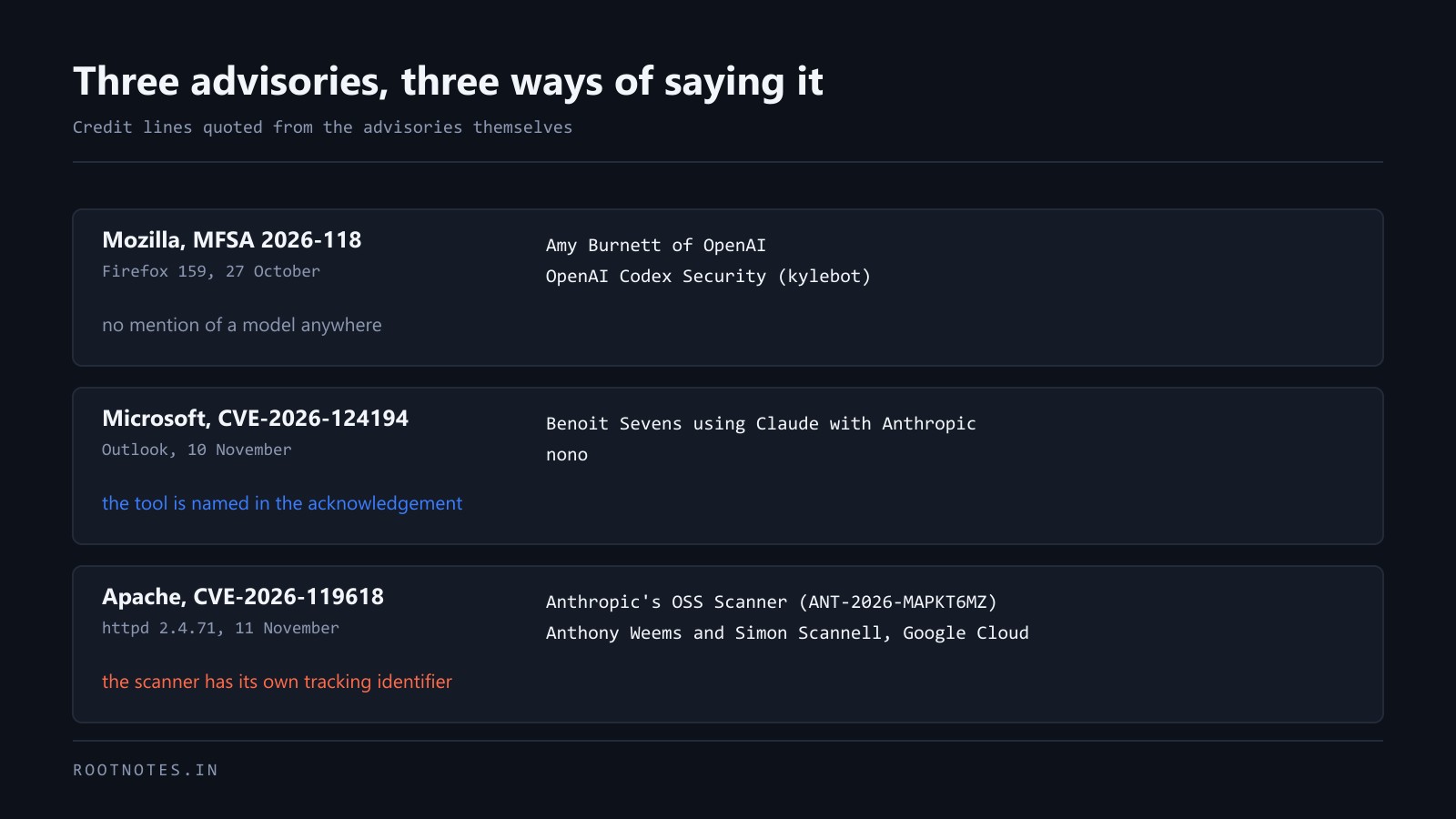
Taken with the two advisories this week that credit model-assisted discovery, the pattern is the same one: the interesting security research is increasingly being done by the things it is about.
Why the target matters more than the method
Weight poisoning is not new. What makes this one serious is where it lands.
The target is an agent with tool or terminal access. The payload is whatever tokens you chose. So the realistic version is a model that behaves perfectly through acceptance testing, through evaluation, through months of production use, and then on a date it was told to wait for emits a command that its agent harness dutifully runs.
That is not a prompt injection problem. Prompt injection is an input problem and the defences are input defences. This is in the weights, which means it survives every prompt, every system message, every guardrail at the text layer, and every evaluation that measures behaviour rather than parameters.
It is a supply chain problem. And the supply chain for open weights is a hosting platform, a file, and a hash that almost nobody checks against anything.
What Microsoft suggests, and what it implies
The recommendations are defence in depth and they are sensible: know where your models come from, limit what agents are permitted to do, monitor agent actions, and review consequential actions before they execute. Microsoft also says to treat audits "as evidence rather than guarantees".
That last phrase is the one to sit with. An audit of a model is a behavioural sample. It tells you what the model did on the inputs you tried. A backdoor that waits for a date was never going to be in the sample.
The only defence that addresses the mechanism rather than the symptom is provenance: knowing that the weights you are running are the weights somebody committed to, bit for bit. Which is the problem that provable inference and model signing are trying to solve, and which nobody has solved cheaply yet.
Microsoft says it has not seen attackers use this.
What is not established
- Which model was backdoored in the experiments. The post does not name it, and figures circulating in coverage, including a specific neuron ratio and a success rate on triggered sessions, are not in the post. We have left them out.
- Whether fewer than ten neurons is specific to the models tested or holds generally.
- Whether the edit survives quantisation, further fine-tuning, or merging.
- What a realistic detection rate would be for diffing weights against a base model that has itself been legitimately fine-tuned, which is the normal case.
- Whether any publicly distributed model has been checked for this.