Railway has published its incident report for the October breach, and it contains the number this category has been waiting for.
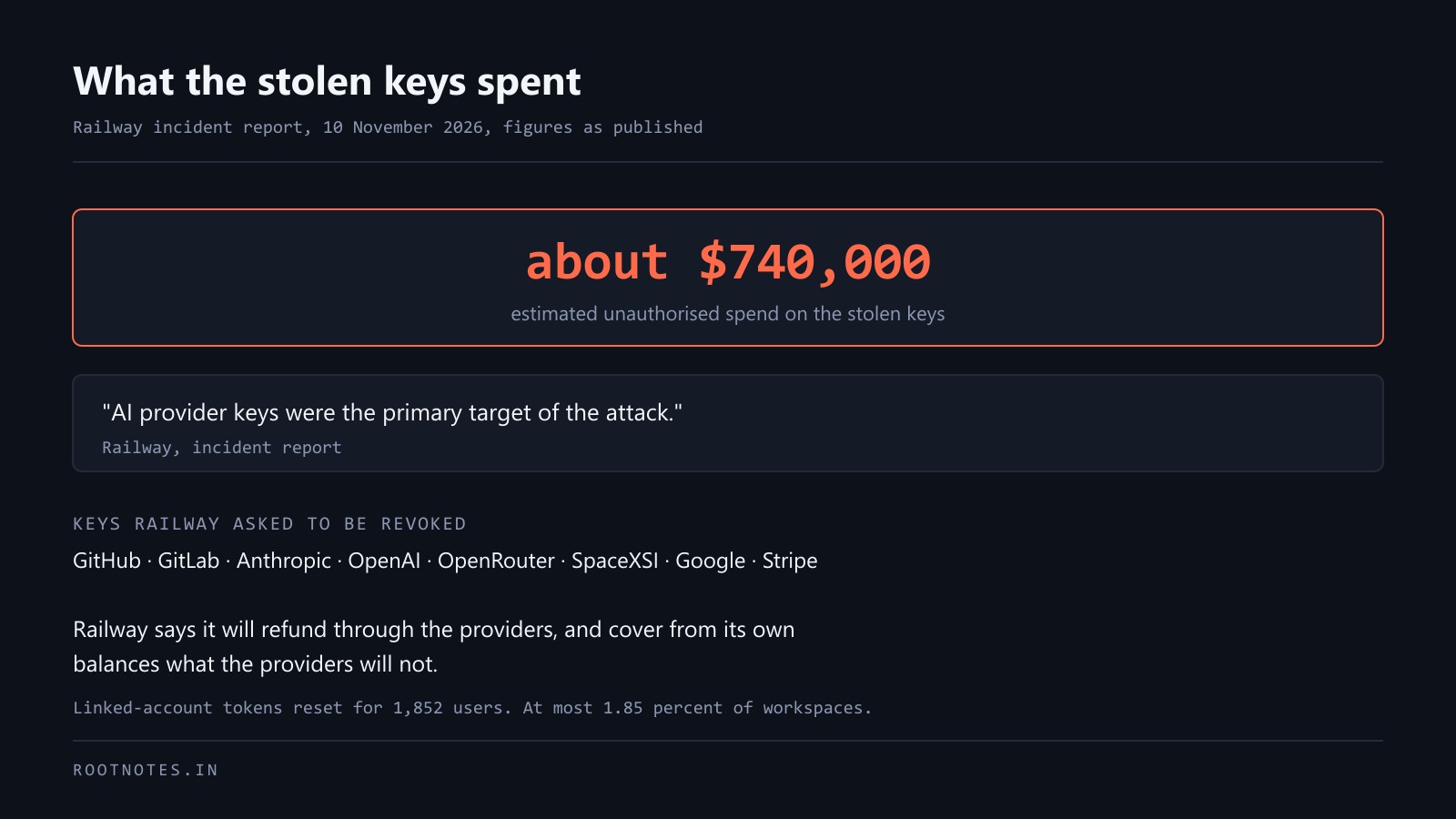
Unauthorised spend on the stolen keys was estimated to reach about $740,000.
And the sentence that explains why: "AI provider keys were the primary target of the attack."
What happened
The initial entry was "a previously unknown vulnerability in our build infrastructure" that let the attacker partially escape filesystem isolation. A later foothold came from "an erroneously defined OIDC binding configuration in one of our cloud environments".
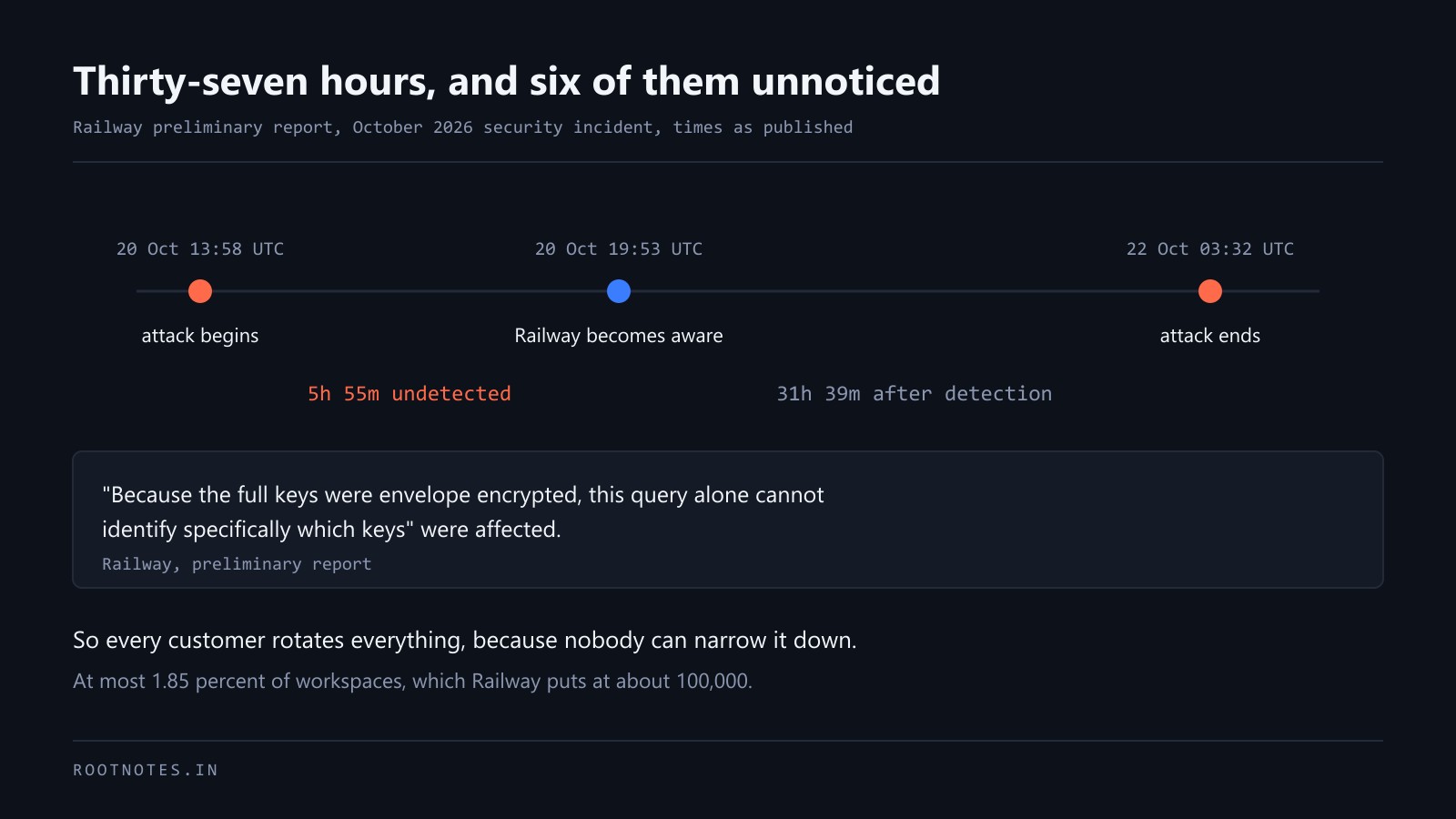
From there the attacker reached customer environment variables and decrypted a subset. Railway puts the ceiling at 1.85 percent of workspaces, about 100,000, and is careful that this is a ceiling rather than a confirmed count. It reset linked-account tokens, meaning agent keys and GitHub OAuth tokens, for 1,852 users.
It asked eight organisations to revoke potentially compromised keys: GitHub, GitLab, Anthropic, OpenAI, OpenRouter, SpaceXSI, Google and Stripe. Each build now gets a dedicated ephemeral virtual machine on top of the existing isolation.
No evidence that repositories were downloaded, that customer databases were accessed, or that stolen credentials were used to log into Railway accounts.
Three things this is the first clear example of
The asset changed. An attacker who reaches a secrets store has historically been looking for database credentials and cloud keys, both of which need further work to turn into money. AI provider keys do not. They are the only thing in the vault that converts directly into a sellable good, because inference is fungible and somebody else is billed for it. Railway believes the attacker wanted them for resale or model distillation.
The bill lands on people who were not breached. Railway's customers did nothing. Their keys were in a platform they paid to hold them, and the charges appeared on their accounts with their AI providers. There is no established practice for who pays in that situation, and until now it has not been a six-figure question in public.
Railway's answer is the generous one: it is working with providers to refund the unauthorised spend and will back-stop from its own balances what the providers will not. It says explicitly that it will be covering the Anthropic key costs itself, and all OpenRouter costs.
That is the right thing to do and it is worth noticing that it was a choice. Nothing obliged it. The precedent now exists, and the next platform in this position will be asked why it is not doing the same.
And $740,000 is not a ceiling. Google has separately warned that this kind of abuse is costing some individual enterprises up to a million dollars in cloud charges. Railway's figure is spread across a potential hundred thousand workspaces, mostly small ones. One large compromised account can cost more than this entire incident.
The thing from the preliminary report that still stands
The first report carried a sentence that is still the most useful line in the whole episode:
"Because the full keys were envelope encrypted, this query alone cannot identify specifically which keys" were affected.
Envelope encryption is the correct design and it worked. It is also why Railway cannot tell any individual customer which of their secrets were exposed, which is why the instruction was for everybody to rotate everything.
Key hierarchies get evaluated on how well they contain a compromise. Nobody evaluates them on whether, afterwards, the operator can produce a list of what was taken. That turns out to be the thing every customer needs on the day, and designing for it would mean giving something up.
What to do if you hold other people's keys
- Assume AI provider keys are now the highest-value item in any secrets store you operate, ahead of database credentials.
- Rate-limit and alert on spend, at the provider, per key. Spend anomaly is the detection that works here, and it is the provider's telemetry rather than yours.
- Decide in advance who pays. Railway decided during an incident and chose well; that is a bad time to be deciding.
What is not established
- What period the $740,000 covers, and how much of it the providers have since refunded.
- Whether a separately reported figure of over $1.1 million, including roughly $371,000 of cryptocurrency theft, describes this same incident.
- Whether model distillation is Railway's inference about motive or something it observed.
- What the build infrastructure vulnerability was. Railway has not described it.
- How many of the 100,000 workspaces actually had secrets taken, which Railway says it cannot determine.