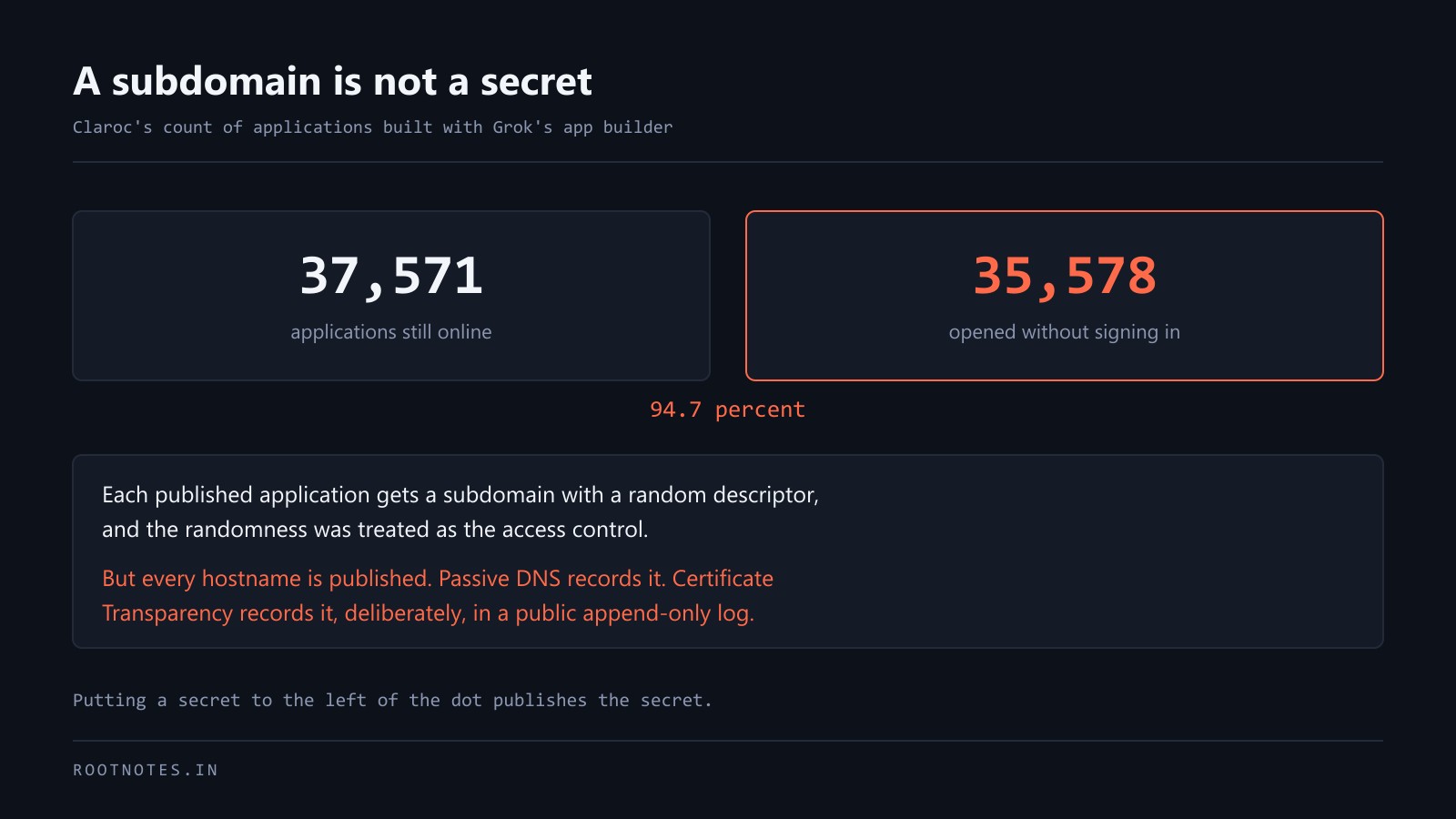
Researchers at Claroc counted the applications people have built with Grok's app builder and found 37,571 still online. Of those, 35,578 opened without signing in, which is 94.7 percent.
Accounts of how many held sensitive material vary, and we are going to report the variation rather than pick one: somewhere between roughly 650 and 800 applications by one estimate, about 2 percent by another, about 10 percent by a third.
What has been described among them: hospital and patient records, fire department shift boards, employee lists, and a contractor's timesheet application holding 18 staff accounts with passwords in plain text in code that every visitor's browser downloads. Twenty-four applications were built by employees of SpaceXSI and X, including sales plans and advertising proposals, and have been taken down.
We did not open any of these applications. They contain other people's data and the mechanism can be explained without touching them.
The mechanism, which is the whole story
Each published application is given a subdomain with a random four-word descriptor. The randomness was the access control. If you do not know the address, you cannot find the application.
That reasoning fails for a reason that has been documented for a decade: a hostname is published.
Passive DNS services record every name they observe being resolved. And Certificate Transparency records every certificate issued for every hostname, deliberately, in a public append-only log that anyone can read, because the entire purpose of Certificate Transparency is to make it impossible for a certificate to be issued secretly. It was built after real-world mis-issuance, it works, and it is one of the better things the web has.
So a platform that issues a certificate for a randomly-named subdomain has published that random name, to a log designed to be read, as a condition of serving the site over HTTPS.
Putting a secret to the left of the dot publishes the secret.
Why this keeps happening now
This is not a clever attack and it is not a new mistake. It is in every list of things not to do, and it has been for years.
What is new is who is making it. The people who shipped these 35,578 applications were not making a security decision, because they did not know one was being made. They described an application, a model wrote it, a platform deployed it, and nothing in that sequence contained the sentence "this will be reachable by anyone who reads a public log".
That is the shape of the next few years of this. The failures will not be exotic. They will be the oldest, most thoroughly documented mistakes in the field, made at volume by people who were never in a position to know, inside tools that did not surface the choice. The timesheet application with eighteen plain-text passwords is not a story about an incompetent developer. There was no developer.
The responsibility sits with the platform, and the fix is not education. It is a default: nothing published without an explicit access decision, and no treating unguessability as authorisation.
If you built one
Assume it is public. Check whether it holds anything about a person. If it does, take it down first and tidy up afterwards, because a notice period is not a thing you get.
What is not established
- Claroc's report itself, which was not opened. All figures here come through reporting of it.
- Which estimate of sensitive content is right; the published range is wide.
- Whether the applications lacked access controls entirely or had them available and off by default. That difference decides where the responsibility sits and nobody has stated it clearly.
- Whether the platform has changed the default since.
- How many of the 35,578 are still open now.