Anthropic has published what its security model found and, unusually, what it cost.
Claude Mythos Preview is not generally available. Anthropic says plainly that it does not plan to make it so, and access runs through Project Glasswing to what the post calls "a limited group of critical industry partners and open source developers".
What it found: "thousands of additional high- and critical-severity vulnerabilities". Human reviewers agreed with the model's severity rating in 89 percent of 198 reviewed reports, and from that sample Anthropic estimates "over a thousand more critical severity vulnerabilities", which it says it cannot yet confirm.
Two named examples carry the weight. The oldest is a 27-year-old bug in OpenBSD, now patched, allowing remote crashes of hosts responding over TCP. And a 17-year-old remote code execution flaw in FreeBSD, CVE-2026-4747, giving unauthenticated remote root over NFS, which the model found and exploited on its own.
On Linux it was less successful, and Anthropic says so: it built several local privilege escalation exploits, chaining two to four vulnerabilities in some cases, but for remotely triggerable kernel bugs "Mythos Preview was unable to successfully exploit any of these", which it credits to the kernel's defence in depth.
The price list
This is the part almost nobody publishes, and it is the part that matters.
| What | Cost |
|---|---|
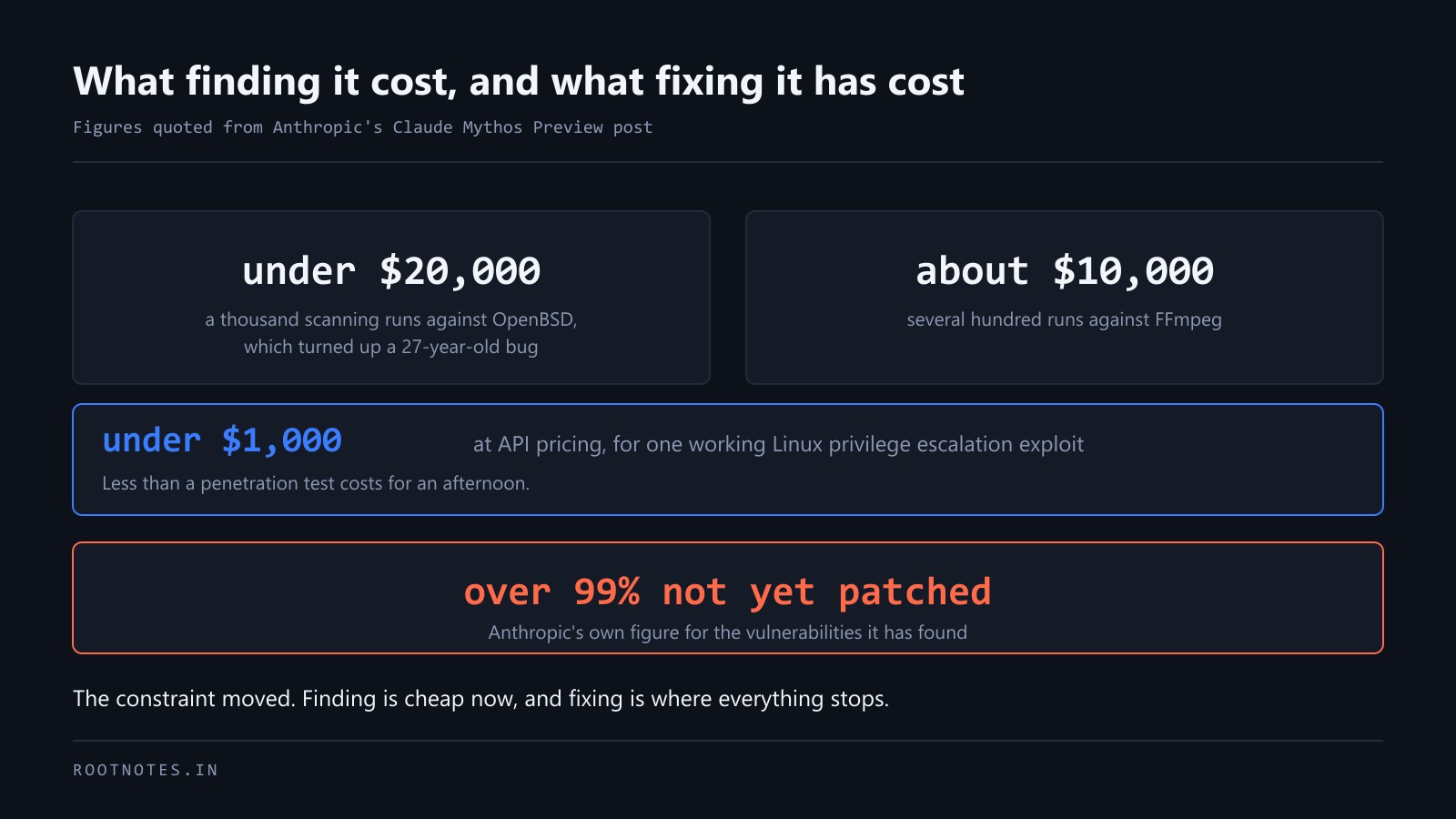
| A thousand scanning runs against OpenBSD | under $20,000 |
| Several hundred runs against FFmpeg | about $10,000 |
| One working Linux privilege escalation exploit | under $1,000 at API pricing |
Sit with those for a moment against what they bought.
Twenty thousand dollars is less than one security engineer costs for a month in most markets. It found a bug that had been in OpenBSD for twenty-seven years, in a codebase whose entire reputation rests on being read carefully by people who care, through a generation of human review.
Under a thousand dollars is less than a day of consultancy. It produced a working privilege escalation exploit, which is a thing that used to be a specialist's week.
And then the other number
From the same post: "Over 99 percent of the vulnerabilities we've found have not yet been patched."
Put the two halves together and you have the actual finding, which is not about capability at all.
The constraint has moved. For twenty years the scarce resource in security was people who could find bugs. Vulnerability research was slow, expensive and concentrated in a small number of heads, and everything downstream was built around that scarcity: disclosure timelines, bug bounty economics, the assumption that a maintainer receives a report occasionally rather than constantly.
Finding is now cheap. Fixing is exactly as expensive as it was last year.
Every report from this programme lands on a maintainer. For OpenBSD, FFmpeg, and most of what underpins the internet, that maintainer is a volunteer or a team of three. The supply of reports has been multiplied by a model and the supply of people who can write, test, review and ship a patch has not moved at all. Ninety-nine percent is what that looks like from one lab, running one gated programme, deliberately slowly.
What is actually good here
It is worth being fair about this, because the easy version of this article is alarmist and the honest one is not.
Anthropic gated the model, pointed it at defence, validated findings with human reviewers and professional contractors, and then published its own most uncomfortable number. A company optimising for a headline would have published the thousands and not the 99 percent. Publishing the cost is rarer still: a capability claim tells you what is possible, a price tells you who can afford it, and the second one is the number defenders can plan against.
The discomfort is not about this programme. It is that the price is now low enough that gating is a policy choice rather than an economic barrier, and the same arithmetic works for somebody with different intentions and a thousand dollars.
What is not established
- How many organisations have Glasswing access. The post does not say, and secondary accounts give both 40 and 50.
- The figures of 100 million dollars in usage credits and 4 million in donations circulate widely and are not in this post. They need a separate source.
- Whether the estimate of "over a thousand more critical" findings holds. Anthropic says it cannot confirm it.
- The median age of the findings, as against the oldest. Twenty-seven years is the headline, not the typical case.
- Whether the 99 percent is a snapshot that will improve, or the steady state.
- What the comparable cost would be without a gated model, which is the number that would tell you how much actually changed.