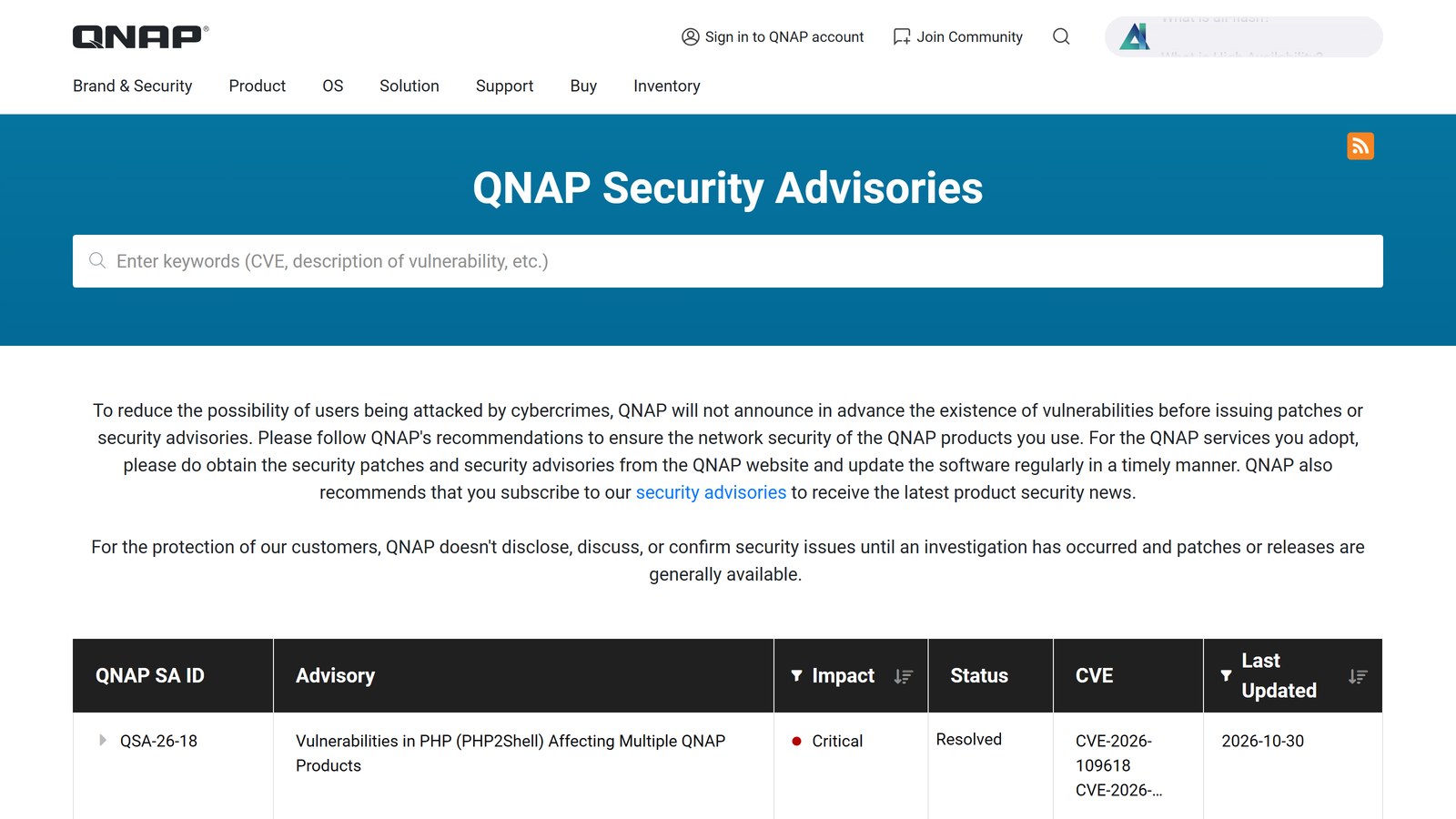
Plex2Shell is a chain of four Plex Media Server flaws — CVE-2026-96652, CVE-2026-96654, CVE-2026-96655 and CVE-2026-96656 — that together give an unauthenticated remote attacker code execution as the Plex Media Server process.
QNAP says attackers are using it to breach customer NAS devices, and is careful to point out that the flaws are in Plex Media Server rather than in QTS or QuTS hero. The fix is Plex Media Server 1.43.3.10861 or later, which QNAP users install through the App Center.
CISA added all four to the exploited vulnerabilities catalogue on 20 October.
Who this actually hits
The interesting thing about this one is the population.
A NAS running Plex is the single most common piece of self-hosted infrastructure there is. It sits in houses and small offices. It is almost always the machine with the photographs on it, often the machine with the backups on it, and frequently the only machine on the network that is deliberately reachable from outside so that somebody can watch a film while away.
It is also, overwhelmingly, administered by nobody. There is no patch cycle, no inventory, no alerting, and the owner's mental model is that it is an appliance. Plex updates itself when you open the app, which most people do on a television that is running a client rather than the server.
So the shape of this incident is a remote code execution chain, confirmed in use, against a class of device that has valuable data, is often internet-facing, and has no operator. That combination is rarer than it sounds and it is why this is worth more attention than a media server bug normally gets.
If you have one: open the Plex Media Server admin page, check the version, and install from the QNAP App Center rather than anywhere else. Then check whether the server needs to be reachable from the internet at all, because for most people the honest answer is that remote access is a convenience they use twice a year.
The deadline thing, briefly
All four entries went into the catalogue on the same day, and they did not get the same deadline.
| CVE | Due | Gap |
|---|---|---|
| CVE-2026-96654 | 23 October | 3 days |
| CVE-2026-96656 | 23 October | 3 days |
| CVE-2026-96652 | 3 November | 14 days |
| CVE-2026-96655 | 3 November | 14 days |
You cannot partially remediate a chain. All four are needed for the attack, and all four are fixed by the same single update. So the split cannot change anybody's behaviour; it can only make two of the four look overdue while the other two look compliant, on a host where the update is either installed or it is not.
We wrote separately about what the catalogue's deadlines have been doing this year, and these four are the clearest example in it. That is the piece for the argument. Here it is just a thing that makes the compliance view of this incident incoherent.
What is not established
- QNAP's and Plex's advisory texts. Neither was opened, so the version string and the affected-product scoping reach us through reporting.
- How many NAS devices are affected or compromised. No count exists.
- Who is exploiting it.
- What privilege the Plex Media Server process actually holds on a QNAP device. This is the question that decides whether this is a media library problem or a whole-NAS problem, and nobody has answered it publicly. Treat it as the latter until somebody does.
- Whether the chain works against Plex on platforms other than QNAP. The flaws are in Plex, so the likely answer is yes, and QNAP is simply the vendor that noticed.