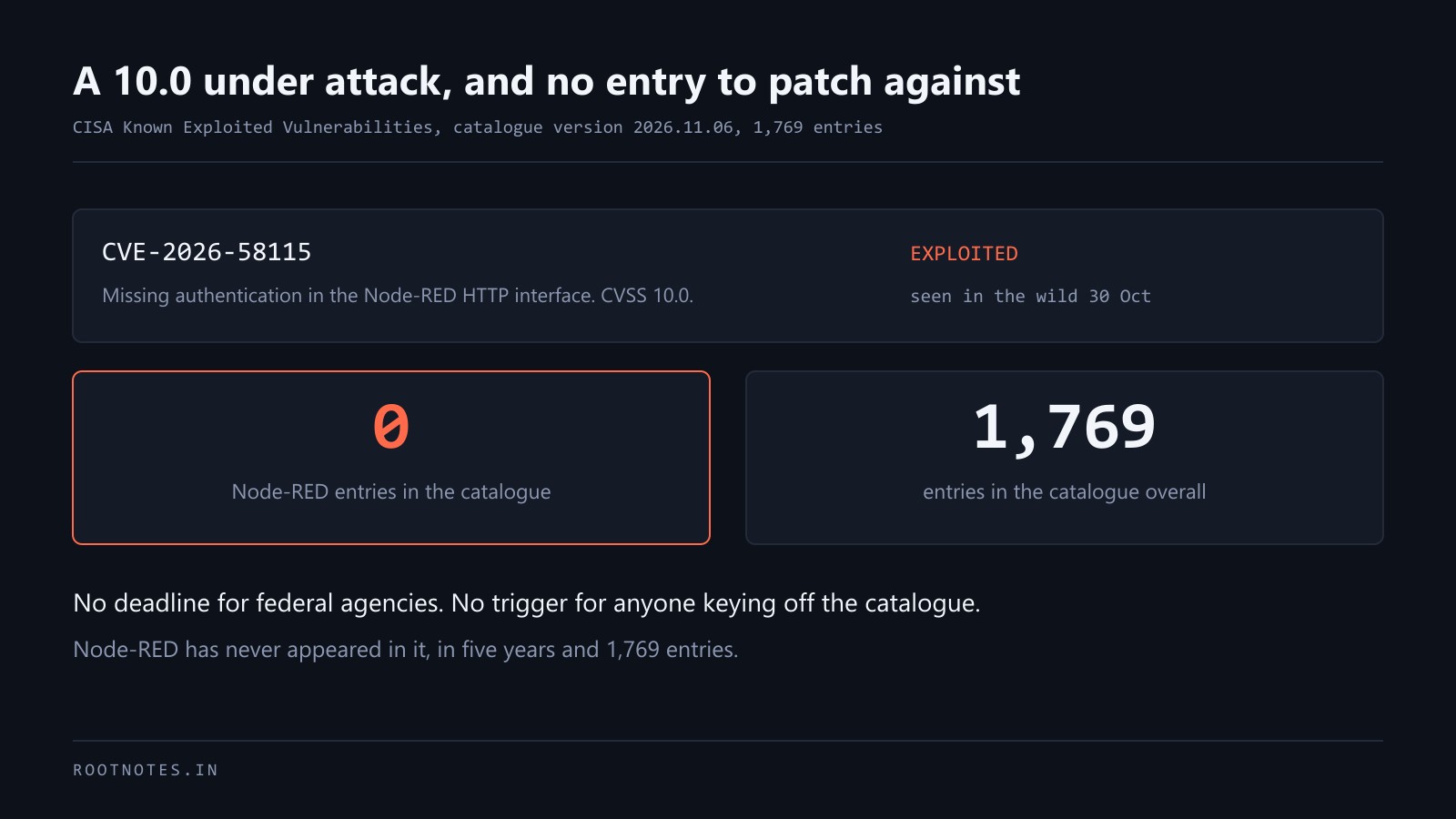
CVE-2026-58115 is a missing-authentication flaw in the Node-RED HTTP interface. It is scored 10.0, which is the top of the scale and a number that is not handed out casually.
Missing authentication is the whole of it. The interface exposes the programming nodes, and the programming nodes can run system commands, so the path from an unauthenticated request to a shell is the product working exactly as designed with nobody checking who is asking.
VulnCheck observed successful exploitation in the wild on 30 October. Payloads seen included a Linux bot and webshells, which is what commodity exploitation looks like rather than anything targeted.
The catalogue has never heard of it
We downloaded the CISA Known Exploited Vulnerabilities catalogue and looked. Then we downloaded it again a day later and looked again, in case something had changed.
CVE-2026-58115 is not in it.
And the absence is larger than one CVE. Across 1,769 entries and five years of the catalogue's existence, Node-RED has zero entries. Not this flaw, not any flaw, not once.
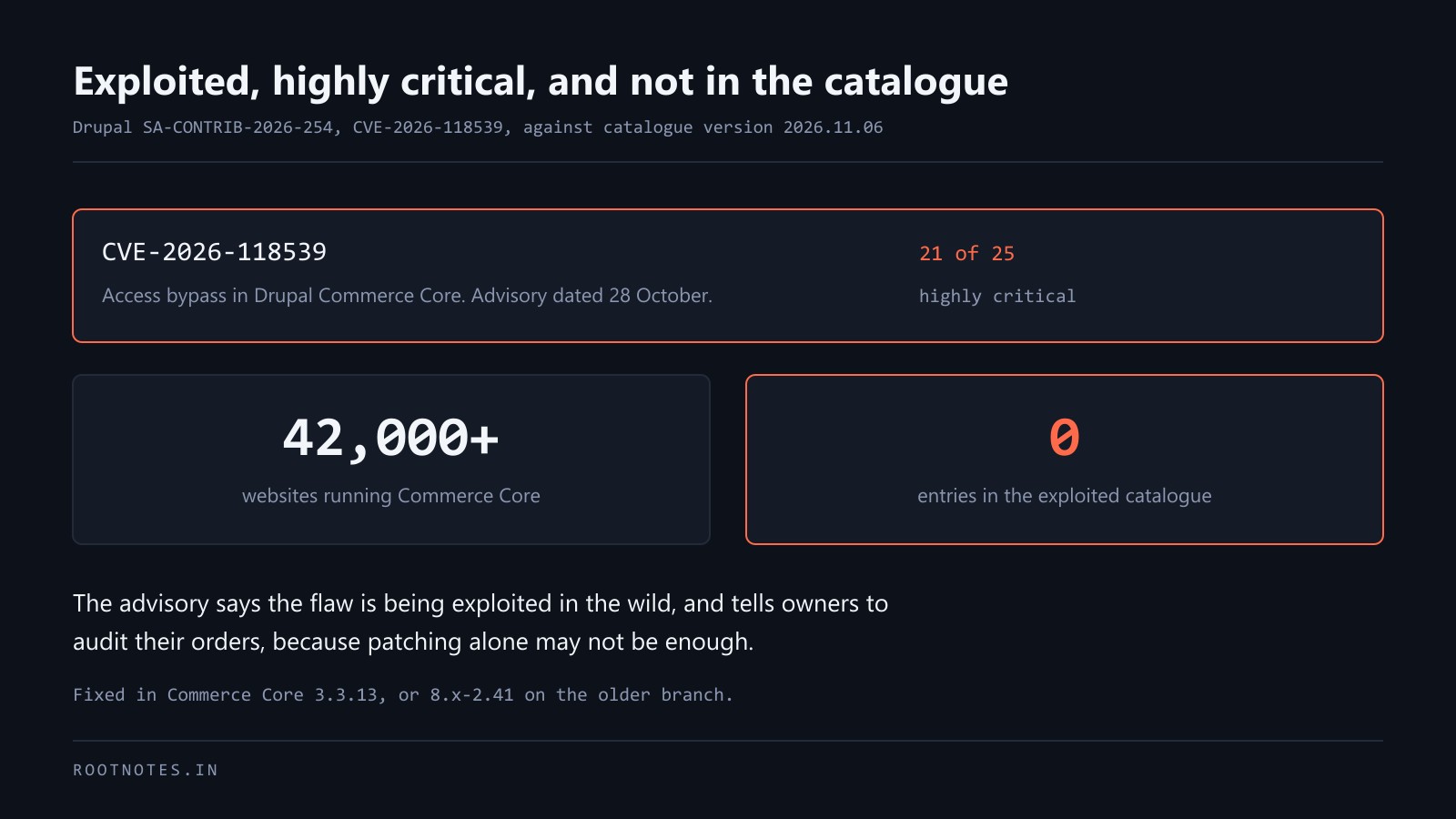
So ten days after confirmed in-the-wild exploitation of a 10.0, federal agencies have no remediation deadline for this, and the large number of private organisations that key their own prioritisation off the catalogue have no trigger at all. For a lot of security teams, "is it in KEV" is the question that decides whether something gets patched this week or next quarter. For this, the answer is no, and the answer is wrong.
Why this one matters more than the score suggests
Node-RED is not obscure, but it is invisible in a specific way that makes this worse.
It is a flow-based runtime that people use to wire things together: sensors to databases, industrial equipment to dashboards, home automation to anything. It ships inside vendor gateways and appliances where the person running it may not know the name. It runs on factory floors, in building management, and on small machines that were installed once and never looked at again.
Which produces the combination you least want. Software that can execute system commands by design, deployed by people who are automating something rather than administering something, in places with no asset inventory, and now with a working unauthenticated path in and no catalogue entry to make anybody look.
If you have an inventory, search it for Node-RED. If you do not, the honest version is that you may have it and not know, which is the actual reason this is worth your afternoon.
The general point, kept short
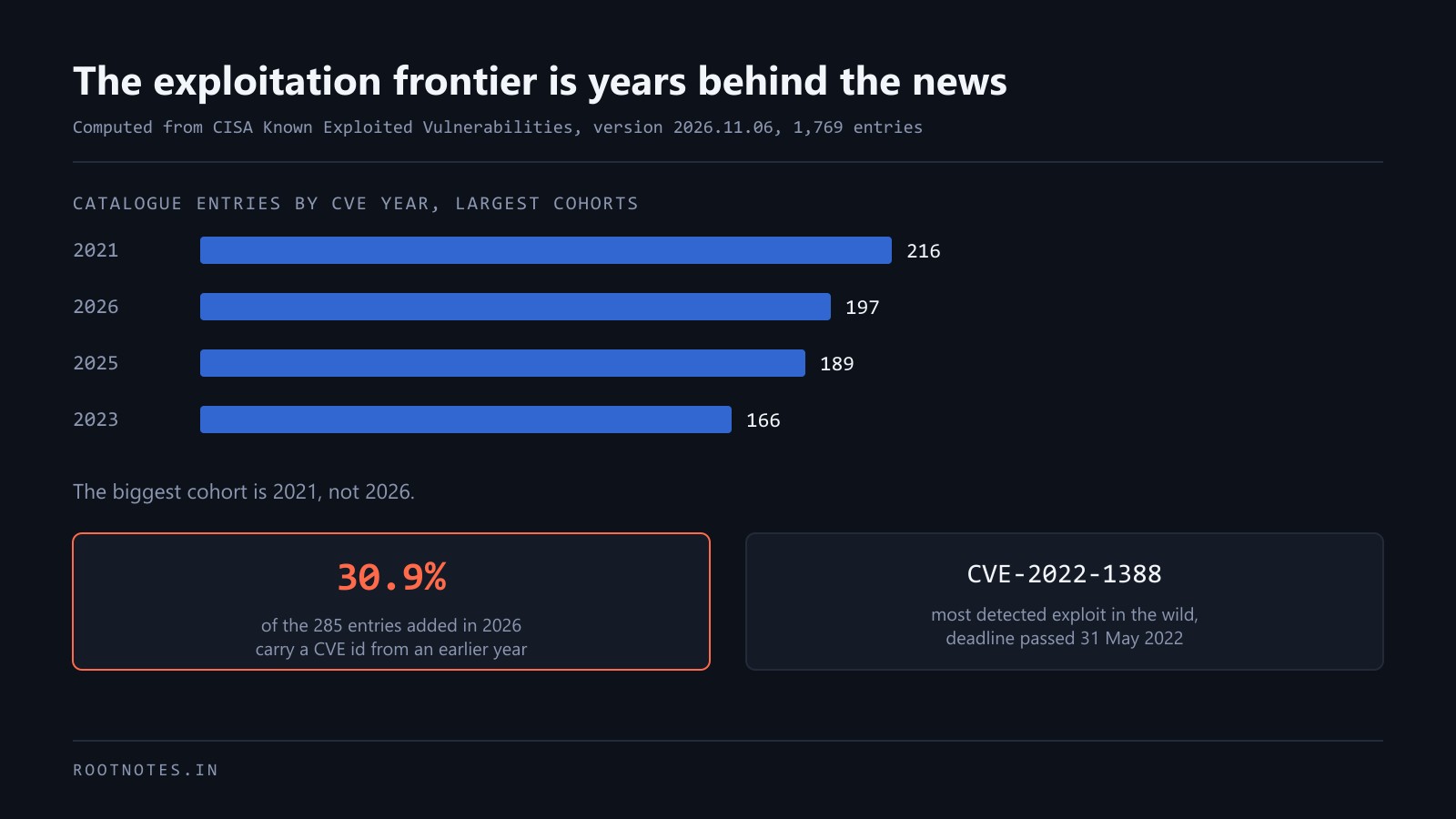
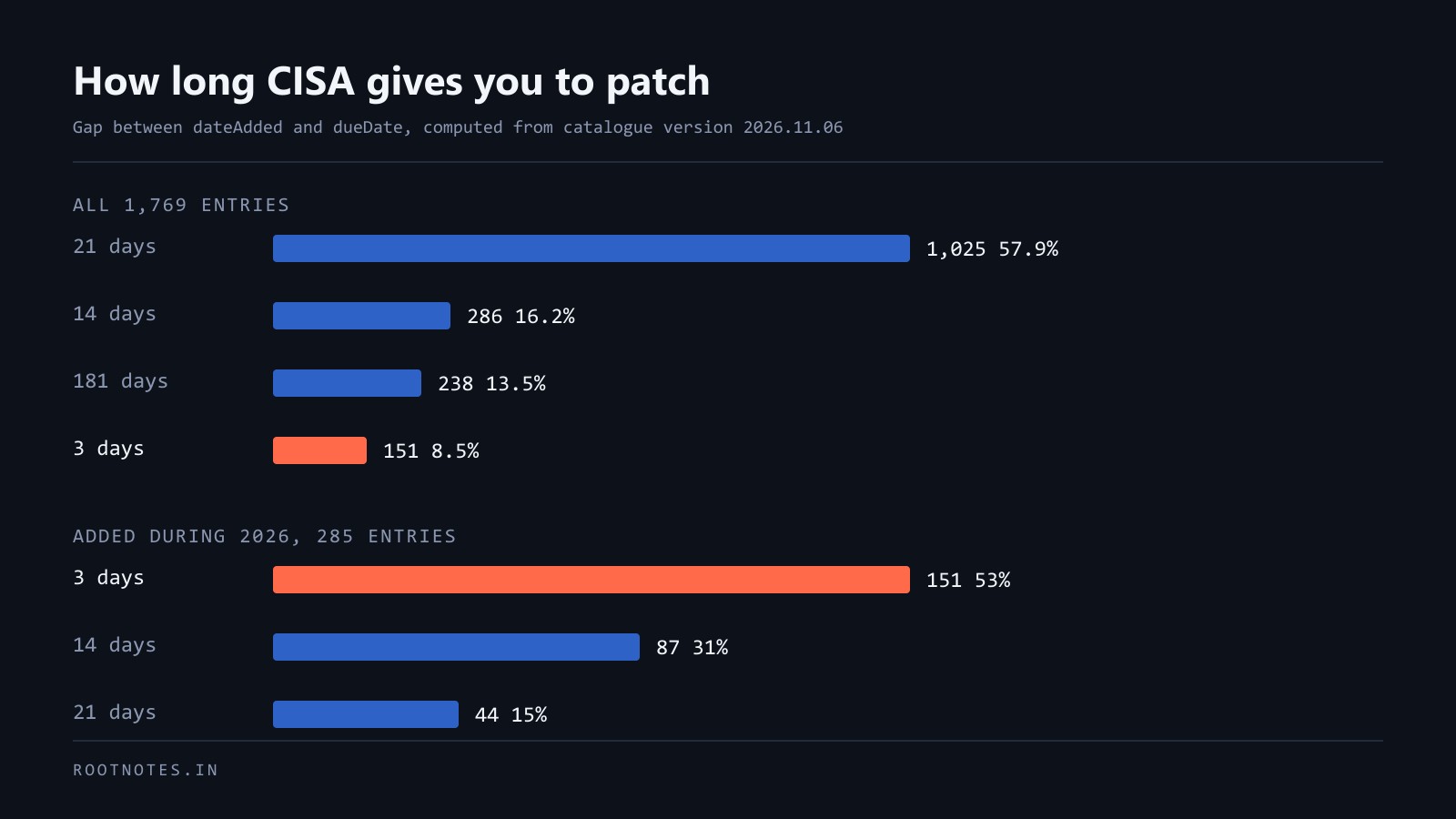
We wrote yesterday about the catalogue listing the wrong CVE for the Zyxel switch attacks, and about the three-day deadlines that did not exist before this year. This is the third shape of the same problem and the simplest one.
The catalogue is a list of what somebody reported and CISA processed. It is not a list of what is being exploited. Those two sets overlap heavily, which is why the catalogue is useful, and they are not the same set, which is why "not in KEV" cannot mean "not urgent" in any programme that wants to be honest with itself.
What to do
- Search your estate for Node-RED, including inside appliances and vendor images where it may not be listed as a dependency.
- Check whether the HTTP interface is reachable from anything it does not need to be reachable from. That is the fix that holds regardless of version.
- Apply the project's update. Check the Node-RED advisory for the fixed version rather than trusting a number from a news article, including this one.
- If you run a vulnerability programme that treats catalogue membership as a severity multiplier, this is the week to write down what you do about actively exploited things that are not in it.
What is not established
- Whether CISA intends to add it. There is no public indication either way.
- Node-RED's own advisory text and the exact fixed version; the project's advisory was not opened and the CVSS reaches us through SecurityWeek.
- Who is exploiting it, and whether the bot and webshells are one campaign or several.
- How many Node-RED instances are internet-facing. Nobody appears to have counted, which is itself part of the problem.
- Whether the 10.0 was assigned by the project or by a CNA.