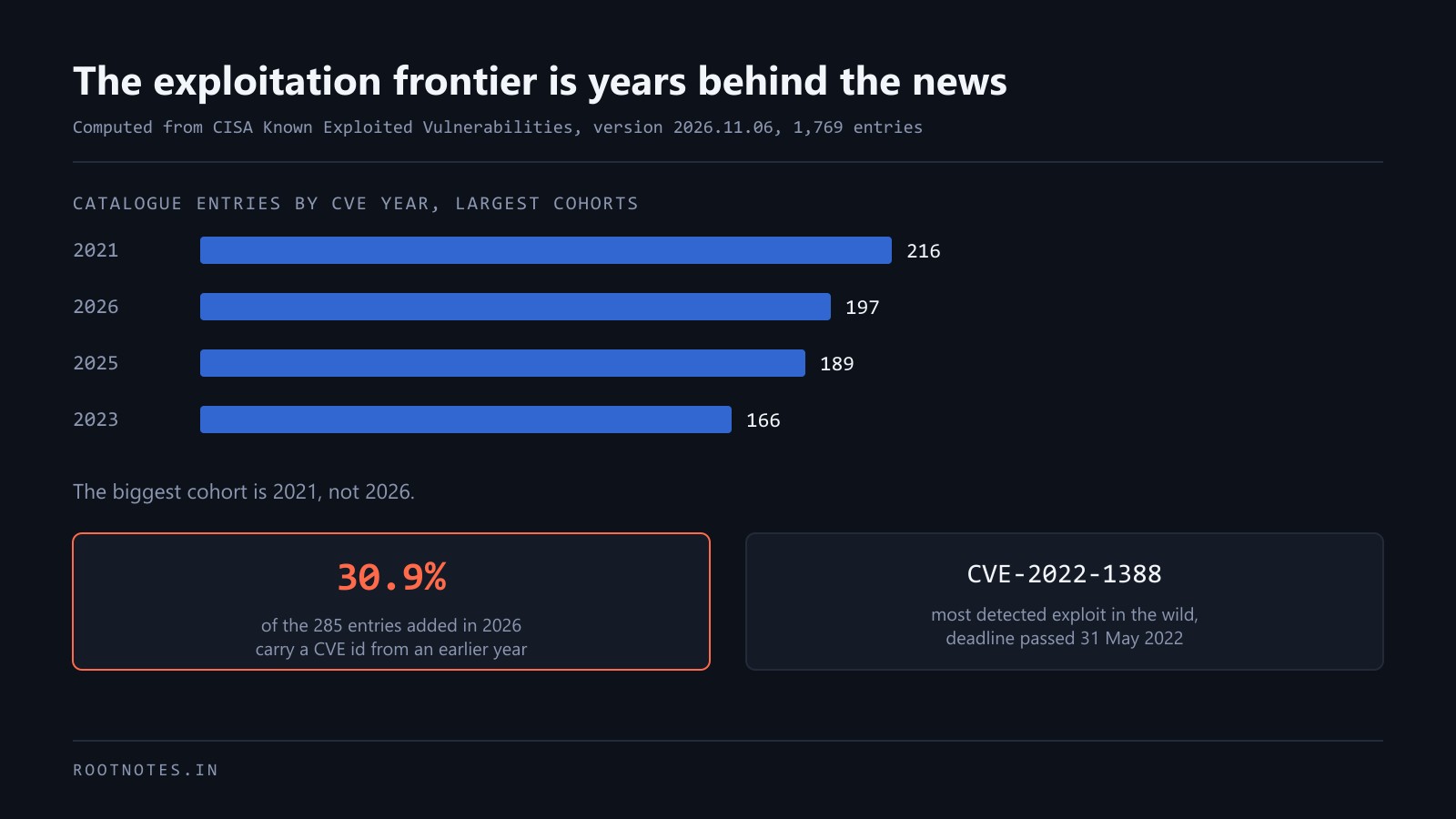
Trellix's threat report for November 2026 names the exploit it detects most often across its dataset. It is CVE-2022-1388, the F5 BIG-IP iControl REST authentication bypass that leads to remote code execution.
We looked it up in the CISA exploited vulnerabilities catalogue, version 2026.11.06.
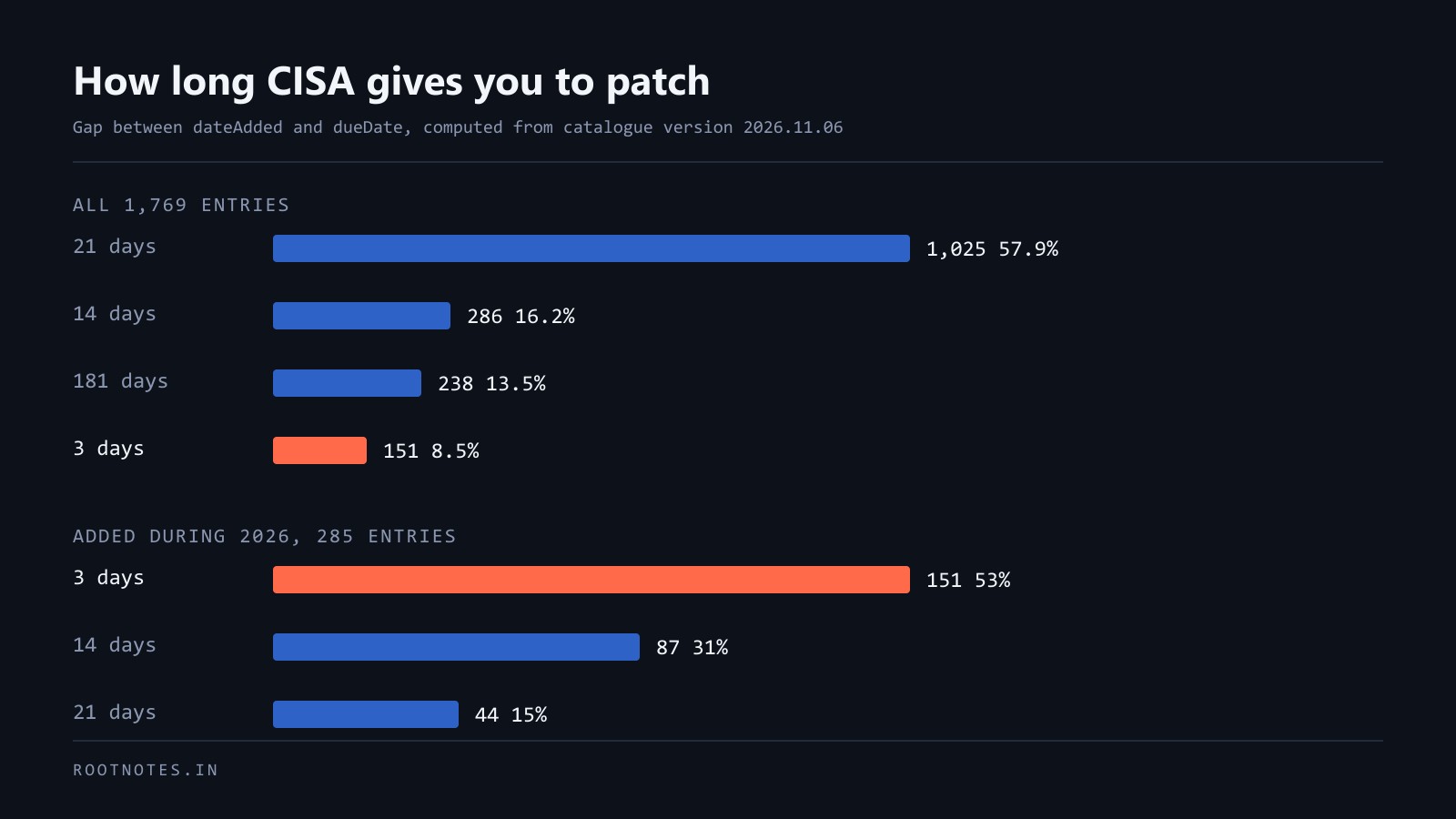
Added 10 May 2022. Deadline 31 May 2022, a twenty-one day entry. Flagged knownRansomwareCampaignUse: Known.
The most commonly detected exploitation attempt in a major vendor's telemetry, in November 2026, is against a flaw whose patch and whose federal remediation deadline are four and a half years old.
So we counted the rest
If the thing being attacked most is from 2022, the obvious question is what the catalogue as a whole looks like by age. The file answers it.
Catalogue entries by the year in the CVE identifier, largest cohorts first:
| CVE year | Entries |
|---|---|
| 2021 | 216 |
| 2026 | 197 |
| 2025 | 189 |
| 2023 | 166 |
The largest single cohort of actively exploited vulnerabilities is 2021, five years back, ahead of the current year.
Then we looked at what was added during 2026 specifically. There are 285 such entries. Of those, 88 carry a CVE identifier from before 2026 — 30.9 percent.
Nearly a third of what CISA catalogued as newly-known-to-be-exploited this year was not a new vulnerability at all. And the oldest identifiers in that group are from 2008. Three of them.
A flaw disclosed in 2008 was added to the catalogue of actively exploited vulnerabilities in 2026. Somebody, this year, found it worth their time to attack something eighteen years old, and found enough targets to be noticed.
What this is actually telling you
The exploitation frontier is not where the news is.
Security coverage, including ours, is organised around what is new. New CVE, new advisory, new catalogue entry, new deadline. That organisation makes sense journalistically and it produces a systematically distorted picture of risk, because the things being exploited at volume are mostly years old and sitting in estates where nobody ever got round to it.
This is not the "just patch" argument, which is useless. Nobody fails to patch a four-year-old F5 flaw because they did not know. They fail because the appliance belongs to a team that left, or it is load-bearing for something nobody wants to restart, or it was acquired with a company and never made it onto an inventory. Those are organisational problems and they do not get solved by another advisory.
What is actionable is narrower and worth saying: a vulnerability management programme tuned to this week's catalogue entries is tuned to the wrong distribution. If you want to spend an afternoon on the thing most likely to be attacked, spend it checking your estate against the catalogue's 2021 and 2022 cohorts rather than its 2026 one. Those are 348 entries between them, they are all things somebody is still using in anger, and the fixes have been available for years.
And if you run an asset inventory that cannot answer "do we have any F5 BIG-IP", that is the actual finding.
What is not established
- Trellix's methodology, what its dataset covers, and what counts as a detection. The report was not read in full, only its summary.
- Whether detections correlate with successful compromise. A detection is an attempt.
- Whether 30.9 percent is unusual. We did not compute the same figure for previous years, and that comparison would make this stronger.
- Why eighteen-year-old flaws are being catalogued in 2026. The entries give no reason.
- Everything here is one snapshot of a file that changes. The version is 2026.11.06 and it is named in the text for that reason.