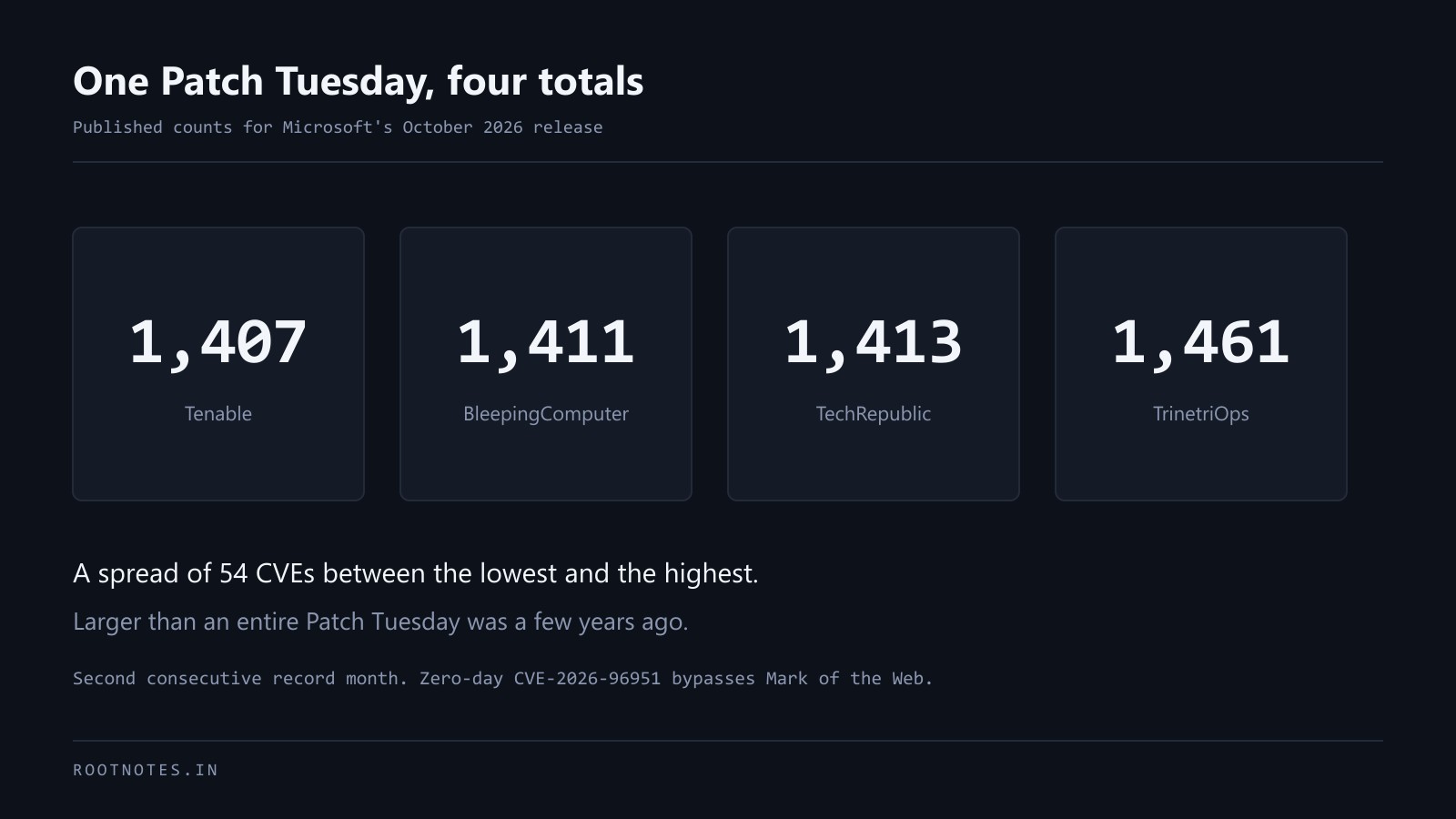
On 9 November we published a piece noting that four organisations had counted Microsoft's October Patch Tuesday as 1,407, 1,411, 1,413 and 1,461 CVEs. A spread of 54, which we said was larger than an entire Patch Tuesday used to be.
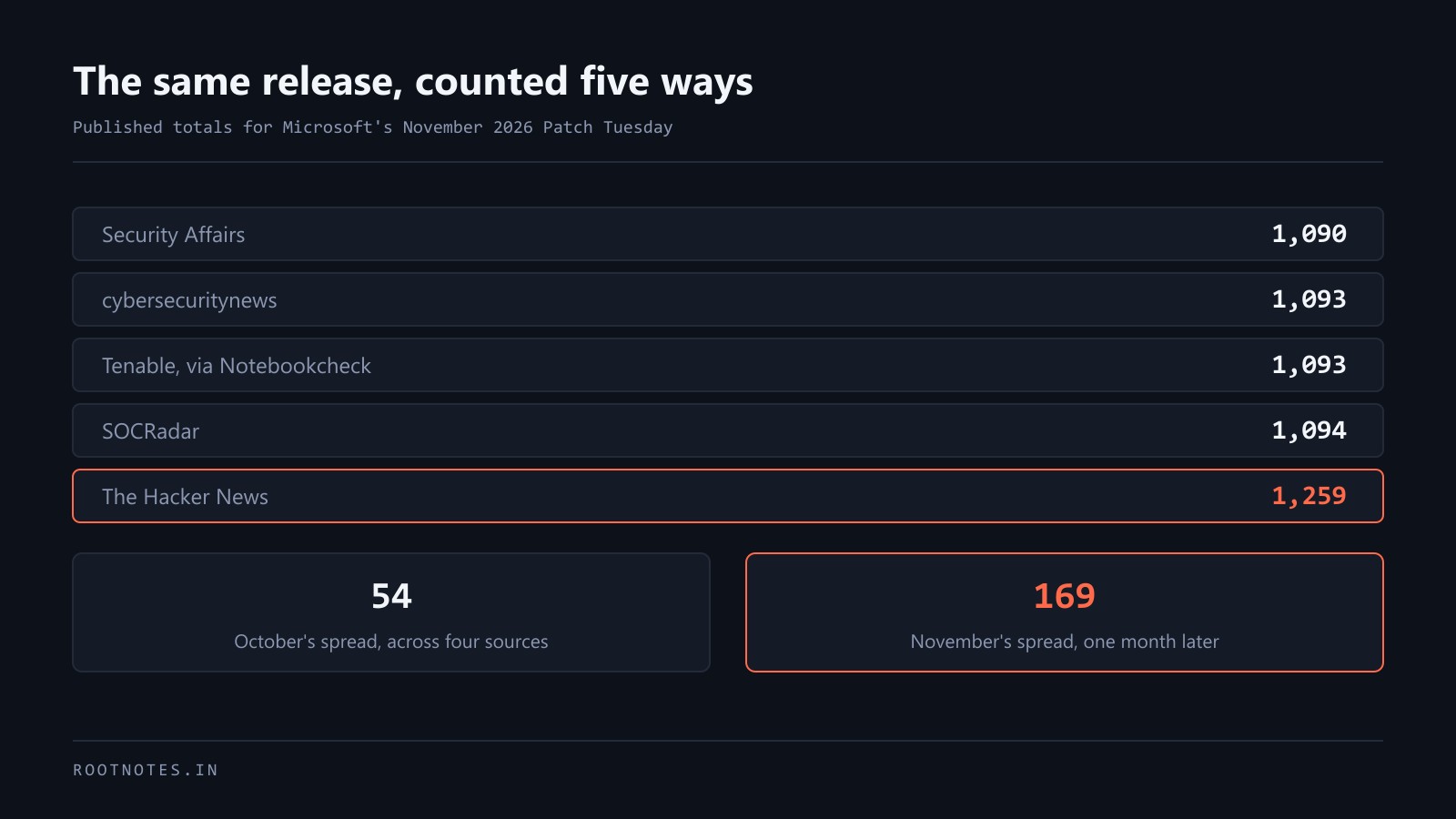
November's release landed on 10 November. Here is how it was counted:
| Source | CVEs |
|---|---|
| Security Affairs | 1,090 |
| cybersecuritynews | 1,093 |
| Tenable, via Notebookcheck | 1,093 |
| SOCRadar | 1,094 |
| The Hacker News | 1,259 |
The spread is 169.
Three times wider, one month later.
The shape changed too
October's four numbers were scattered across a range. November's are not. Four of the five sit within four CVEs of each other, clustered at 1,090 to 1,094, and the fifth sits 165 above them.
That is a different kind of disagreement. Four organisations counting within four of each other are counting the same thing and differing on edge cases. One organisation 165 above is counting something else entirely.
We do not know what, and it would be unfair to imply somebody made a mistake. The likely candidates are the ones we listed last month: Microsoft Edge, which ships on its own cadence; Chromium CVEs that Edge inherits and Microsoft republishes; Azure and cloud components where the customer has nothing to install. One hundred and sixty-five is about the right size for one of those categories being in or out.
So the useful reading is not that somebody is wrong. It is that the boundary of "a Patch Tuesday" is now worth 165 CVEs, and nobody publishes which boundary they used.
What that does to anyone using the number
Three consecutive record months, and a figure whose uncertainty is now larger than an entire Patch Tuesday was five years ago.
If your reporting tracks this monthly, the risk is not that the number is wrong. It is that a source quietly changes its boundary between two months and your trend line gets a step in it that has nothing to do with Microsoft. A 15 percent month-on-month move is indistinguishable from somebody deciding to start counting Edge.
The practical version: pin one source, record which one, and treat any comparison across sources as meaningless. And if a number from this release is going into a board slide, the honest caption is "between 1,090 and 1,259, depending who counted".
The one in it that matters
Buried in whichever total you prefer is CVE-2026-124194, an Outlook flaw that Microsoft rates Moderate and that its own advisory says is being exploited. We have written about that separately, because the interesting thing about it is not its severity.
What is not established
- The correct number. We did not tally Microsoft's update guide ourselves, and doing it would settle this.
- What each source includes and excludes. None of the five publishes its boundary.
- Whether the outlier is a different boundary or an error.
- Whether any of these sources used the same method in October and November, which is the thing that would make a month-on-month comparison valid.
- Whether Microsoft publishes an authoritative total anywhere.