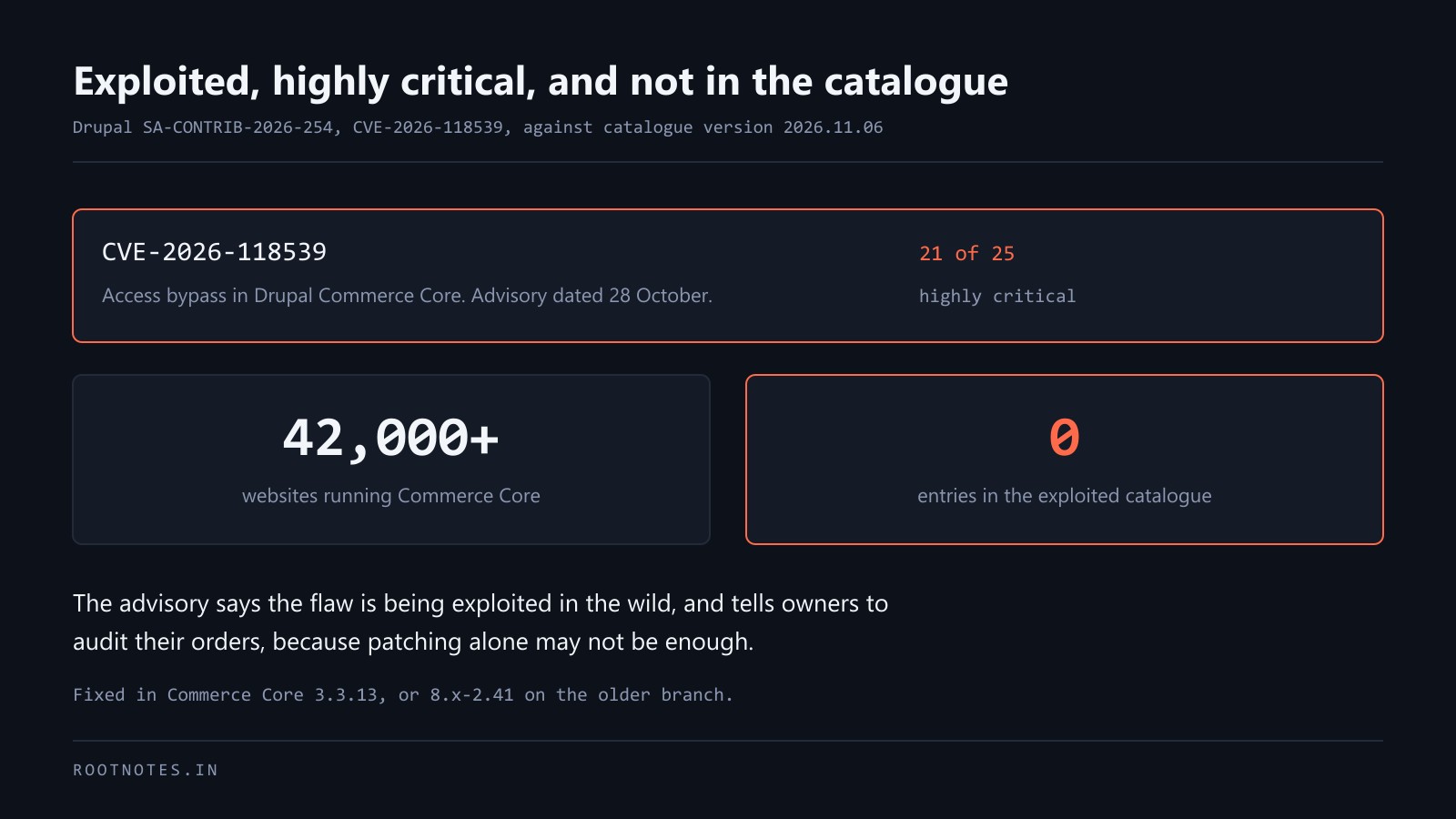
CVE-2026-118539 is an access bypass in Drupal Commerce Core, disclosed in advisory SA-CONTRIB-2026-254 on 28 October. Drupal rates it highly critical, 21 out of 25 on its own scale, and the advisory states the flaw is being exploited in the wild.
The module does not sufficiently protect certain routes and entity fields. Drupal's own description of the consequence is that the bypass may financially impact the vendor, which is a careful way of saying somebody can change things about an order that decide what you get paid.
Affected: below 2.41, and 3.0.0 up to 3.3.13. Fixed in 3.3.13 and 8.x-2.41. More than 42,000 websites run Commerce Core.
Not in the catalogue
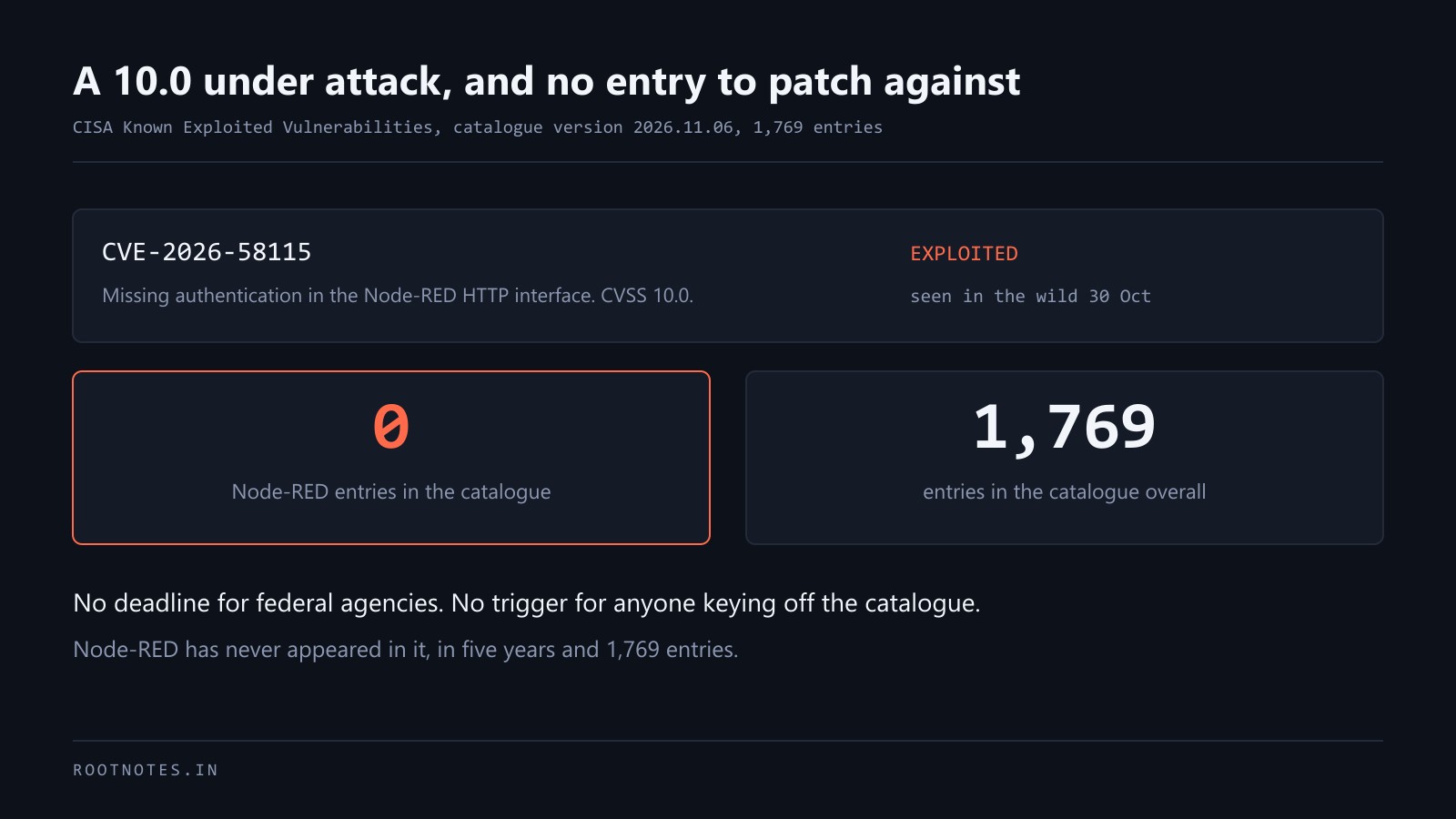
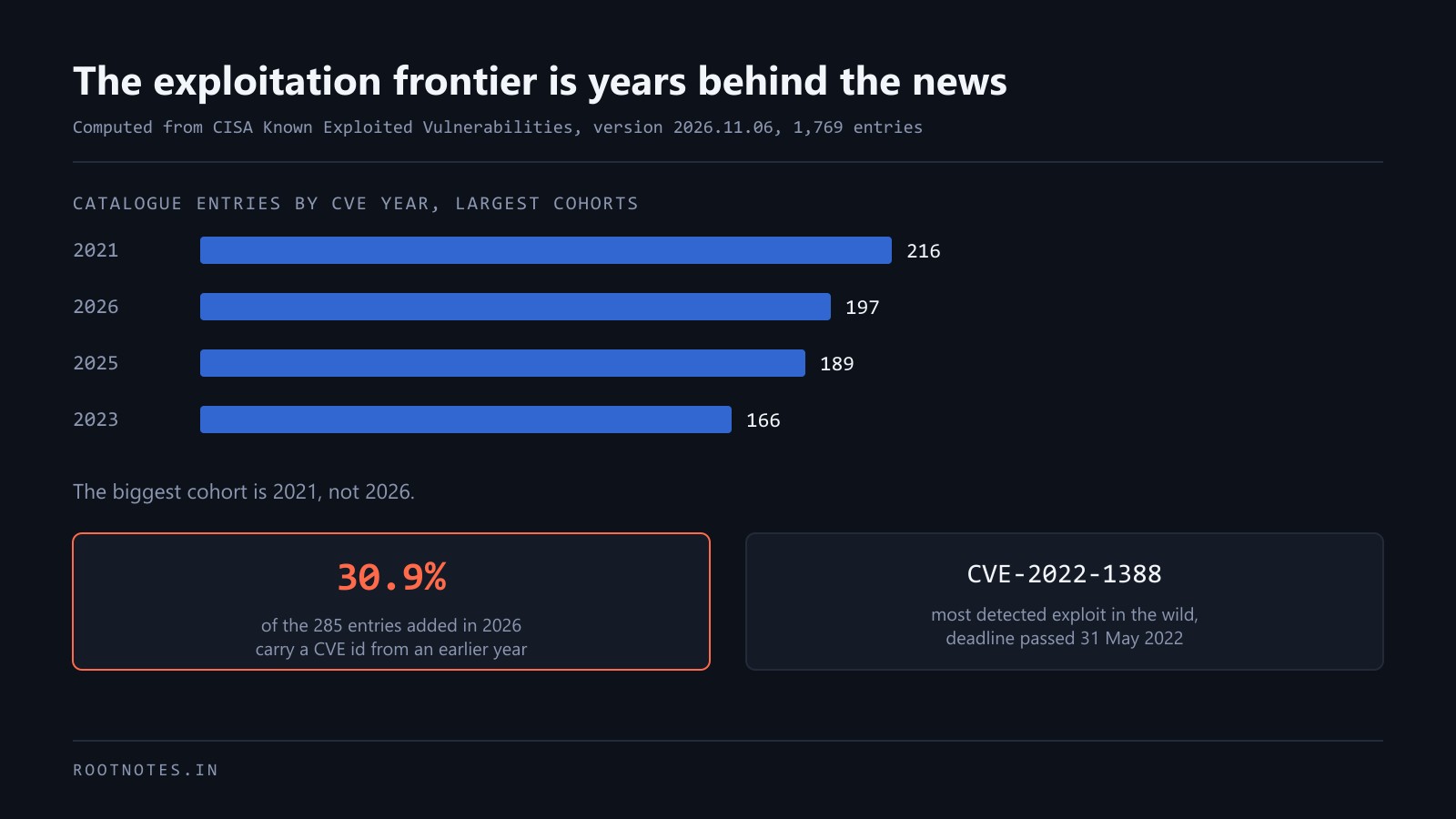
We checked the CISA exploited vulnerabilities catalogue, version 2026.11.06, twice on two days.
It is not listed. Drupal has five entries in the catalogue and the most recent is CVE-2026-9082 from May.
So an actively exploited, highly critical flaw in the payments layer of 42,000 shops, twelve days old, with no federal deadline and no trigger for anyone whose prioritisation keys off the catalogue. This is the second piece we have written today about that gap, and we will leave the general argument in the other one. Here it just means that if you run a Drupal shop and you wait for the catalogue to tell you, nobody is going to tell you.
The sentence everybody will skip
The advisory does not stop at "upgrade". It tells site owners to audit their orders for inconsistencies, because patching alone may not be enough when tampered orders already exist.
That is a different kind of instruction and it is the one that will not get done.
An access bypass against a shop does not leave the things an intrusion usually leaves. There is no implant, no new admin user, no outbound beacon, nothing for an endpoint agent to find. What it leaves is rows in your orders table that look exactly like orders. They went through the normal flow. They have timestamps and line items and a customer. The only thing wrong with them is a field that somebody changed who should not have been able to.
So the clean-up is not an incident response exercise, it is a reconciliation exercise, and it belongs to whoever owns the finance side rather than whoever owns the servers. Those are usually different people and the handover is where this gets dropped.
If you are doing this: the things worth reconciling are order totals against line items, shipping and billing addresses changed after an order was placed, discounts and coupons that do not map to a campaign, order states that moved backwards, and payment captures that do not match the order value. Start from 28 October and work backwards past the advisory date, because the advisory date is when Drupal published, not when exploitation began.
What to do
- Upgrade to 3.3.13 or 8.x-2.41.
- Then audit, and give the audit to somebody who reads ledgers rather than logs.
- If your shop takes payment through a processor, reconcile against the processor's record rather than your own database, because your own database is the thing in question.
What is not established
- The advisory's full text. The page returned a bot-check challenge when we tried to read it, and we did not work around that, so the quotations here come through reporting.
- How the bypass is exploited, and what an attacker changes in practice. Drupal has published no technical detail, deliberately.
- When exploitation started, as against when the advisory was published.
- How many of the 42,000 sites have upgraded.
- SecurityWeek reported that the advisory did not mention active exploitation. Every other account, including Drupal's own text as quoted elsewhere, says it does. We could not resolve this ourselves for the reason above.