The headline on this one is CVE-2026-19868, an authentication bypass in SonicOS SSL-VPN. Where SSL-VPN is configured for SAML, somebody holding valid credentials for a different login method can get past the SAML controls, including SAML-enforced multi-factor authentication.
The CVE record classifies it as CWE-308: use of single-factor authentication. That is the whole article in a weakness identifier. An organisation that enforced MFA through SAML, and could show an auditor the configuration proving it, had single-factor authentication on its VPN.
CISA added it on 6 November with a deadline of 20 November. SonicWall says there is no workaround. Fixed in SonicOS 7.3.4-7013 and 8.2.3-8015.
Then we opened the advisory
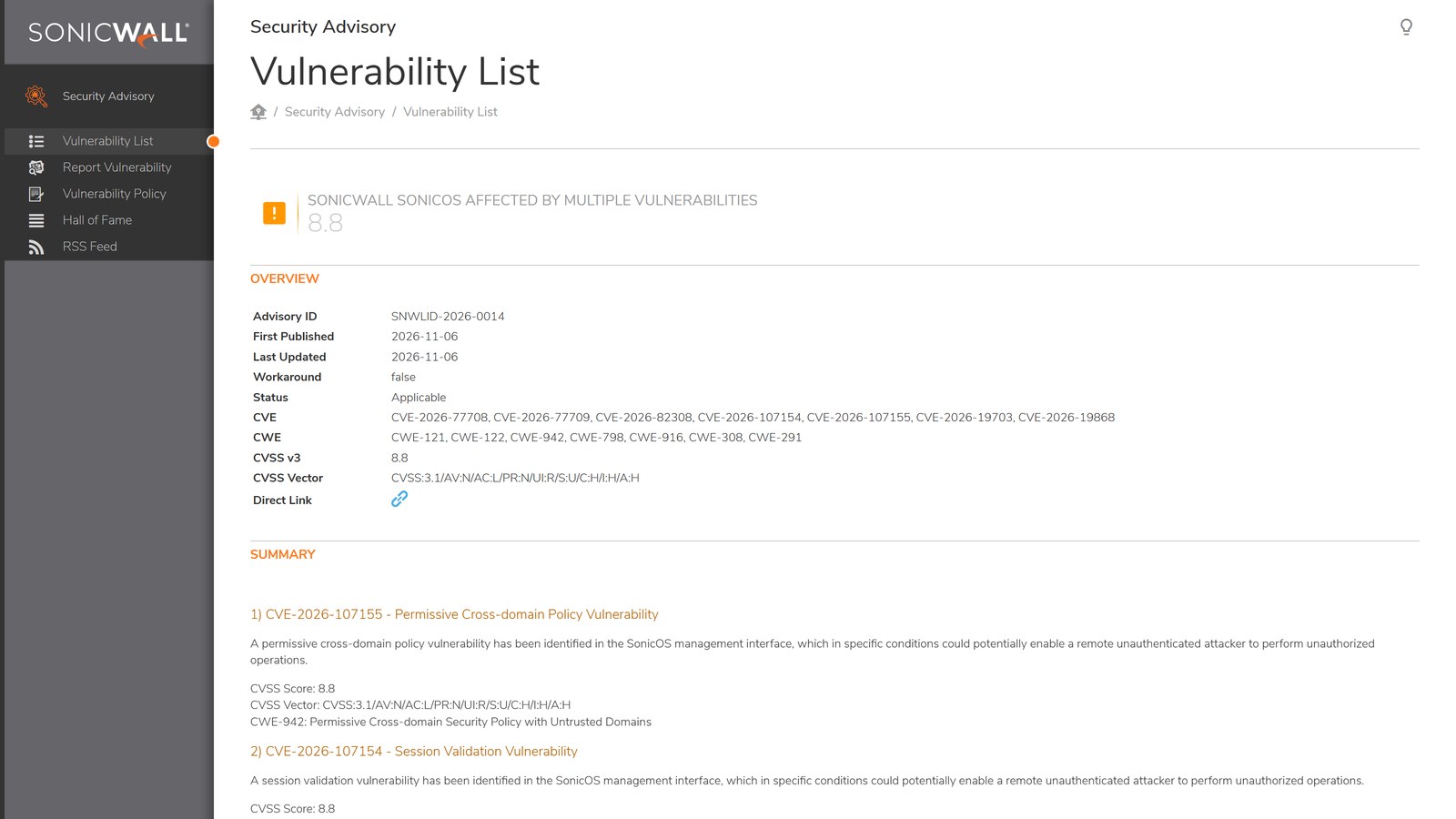
SNWLID-2026-0014 is not an advisory about one flaw. Its title is SonicOS affected by multiple vulnerabilities, it was first published on 6 November, and the overview lists seven CVEs:
CVE-2026-77708, CVE-2026-77709, CVE-2026-82308, CVE-2026-107154, CVE-2026-107155, CVE-2026-19703 and CVE-2026-19868.
The CWE list that goes with them is worth reading slowly: CWE-121 and CWE-122, stack and heap buffer overflow. CWE-942, permissive cross-domain policy. CWE-798, use of hard-coded credentials. CWE-916, use of a password hash with insufficient computational effort. CWE-308, the single-factor issue. CWE-291, reliance on IP address for authentication.
The headline CVSS on the advisory is 8.8, which belongs to the worst of the bundle rather than to the SAML bypass. The workaround field reads false for the set.
Hardcoded credentials and a weak password hash in the same advisory as an MFA bypass, on an appliance whose job is to be the authenticated front door.
One of seven
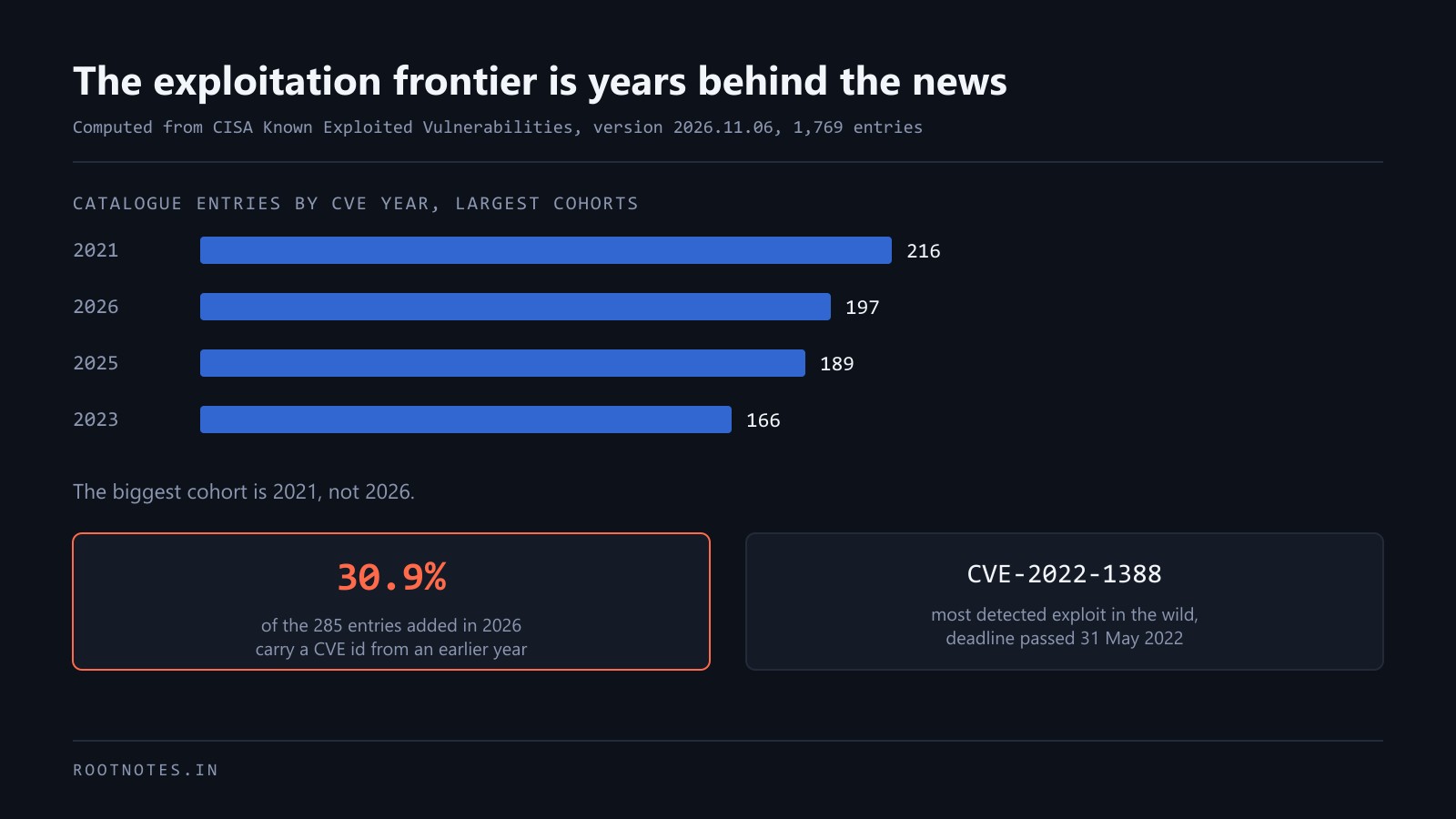
We checked all seven against the catalogue, version 2026.11.06.
One is listed. CVE-2026-19868, added 6 November, due 20 November. The other six have no entry and no deadline.
That is defensible on the catalogue's own terms, because its criterion is evidence of exploitation rather than severity, and only the bypass has reported exploitation. But look at what it produces operationally. The fix for all seven is the same firmware upgrade. An organisation working from the catalogue sees one item with a date on it. An organisation working from the advisory sees seven problems including hardcoded credentials, and the same single action closes all of them.
The catalogue is the thing most programmes watch. The advisory is the thing with the information in it.
Why the MFA one still leads
Because of what it invalidates upstream.
MFA on a remote access VPN is not just a control, it is an assumption that other decisions are built on. Conditional access policies get written more loosely when MFA is enforced. Risk scoring treats VPN logins as higher assurance. Cyber insurance questionnaires ask the question and the answer changes the premium. And the decision to expose the appliance to the internet at all is easier to sign off when there is a second factor behind it.
All of those were made on the basis of a control that somebody with one password for another route could step around. The appliance did not fail open in a way anybody would notice; it failed in a way that looked exactly like success.
What to do
- Upgrade to 7.3.4-7013 or 8.2.3-8015. There is no workaround and it closes all seven.
- Treat the SAML-protected VPN as having been single-factor for the exposure window, and review what you decided on the strength of it.
- Read the full advisory rather than the CVE that made the news. Six of the seven did not.
What is not established
- Which "different login method" supplies the credentials. The advisory does not say in the overview.
- The CVSS for CVE-2026-19868 specifically; reporting gives 7.1 and 7.5, and the 8.8 on the advisory belongs to the bundle.
- Whether SonicWall's advisory itself confirms exploitation, or only CISA does.
- Detection guidance. One account says SonicWall has published no indicators or log signatures, which if correct is the more urgent gap, and we could not confirm it from the overview.
- Whether any of the other six are being exploited quietly. Absence from the catalogue is not evidence of absence.