CVE-2026-76418, CVSS 8.6, lets an unauthenticated remote attacker force a Cisco Secure Firewall ASA or FTD device to reload. Cisco disclosed it on 28 October and said it was already aware of exploitation. CISA added it on 29 October with a deadline of 1 November, a three-day entry. There is no workaround.
The trigger is a crafted request to the SSL VPN login path where secondary authentication is configured on a tunnel group. The default DefaultWEBVPNGroup counts as a tunnel group for this purpose, which means a configuration nobody deliberately chose is enough to qualify.
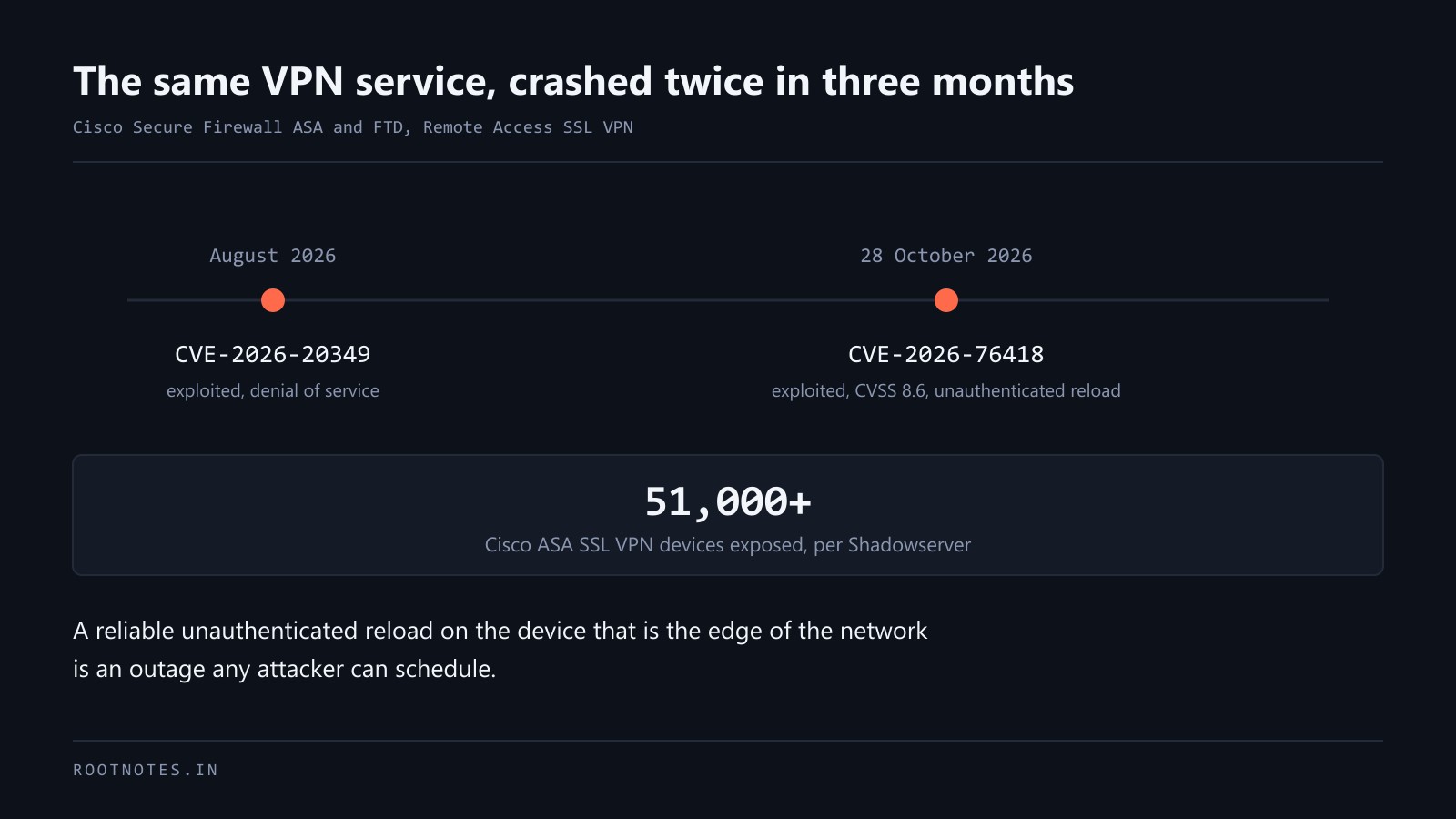
Shadowserver tracks more than 51,000 exposed Cisco ASA SSL VPN devices.
This is the second time this year
In August 2026, Cisco fixed CVE-2026-20349. Also actively exploited. Also a denial of service. Also in the Remote Access SSL VPN service on ASA and FTD, crashing devices with SSL listen sockets enabled.
Two separately exploited crash bugs, in the same service, on the same product line, three months apart.
We are not going to tell you that somebody is systematically fuzzing the login path, because we do not know that and neither does anybody else who has published on it. What is checkable is the pattern: same service, same impact class, twice, and fifty-one thousand of them answering on the internet.
Why a denial of service is the wrong label here
Denial of service is the severity class people skim past. It sits below code execution in every triage matrix, it rarely leads a security bulletin, and the instinct is that nothing was stolen so nothing much happened.
That instinct is wrong for this specific device.
An ASA or FTD running Remote Access VPN is, for a large number of organisations, the way staff reach everything. It is not a component of the network, it is the door. A reliable unauthenticated reload against it is not a nuisance, it is an outage that any attacker can schedule, repeatedly, from anywhere, with no credentials and no foothold.
Work through what that buys someone. It is a straightforward extortion primitive: a company whose remote workforce cannot connect is losing money by the hour and has no technical remedy while the attacker holds the trigger. It is also a useful thing to do at the same moment as something else, because an organisation whose VPN is flapping is an organisation whose security team is looking at the VPN.
And the three-day catalogue deadline tells you how CISA reads it, whatever the severity class says.
What to do
- Patch. Check Cisco's advisory for the fixed release table rather than any number in circulation, including the ones we have seen reported, which do not look reliable.
- Check whether secondary authentication is configured on any tunnel group, remembering that DefaultWEBVPNGroup counts.
- There is no workaround, so access restriction is the only interim control, and for a remote access VPN that is mostly not available.
- If you are in the 51,000 and you have had an unexplained reload since the autumn, it is worth going back through the logs rather than filing it under hardware.
What is not established
- Cisco's advisory text and the exact fixed releases. The advisory was not opened and the version numbers reported elsewhere look unreliable.
- Whether the August and October flaws are related, share a root cause, or were found by the same people.
- Who is exploiting either, and what for. No threat actor or indicators have been published.
- How many of the 51,000 have actually been crashed. Nobody has counted, and an outage looks like an outage.
- Whether the three-day deadline was met by federal agencies, given it fell across a weekend.