Within two weeks, both frontier labs put a cyber-capable model behind a gate.
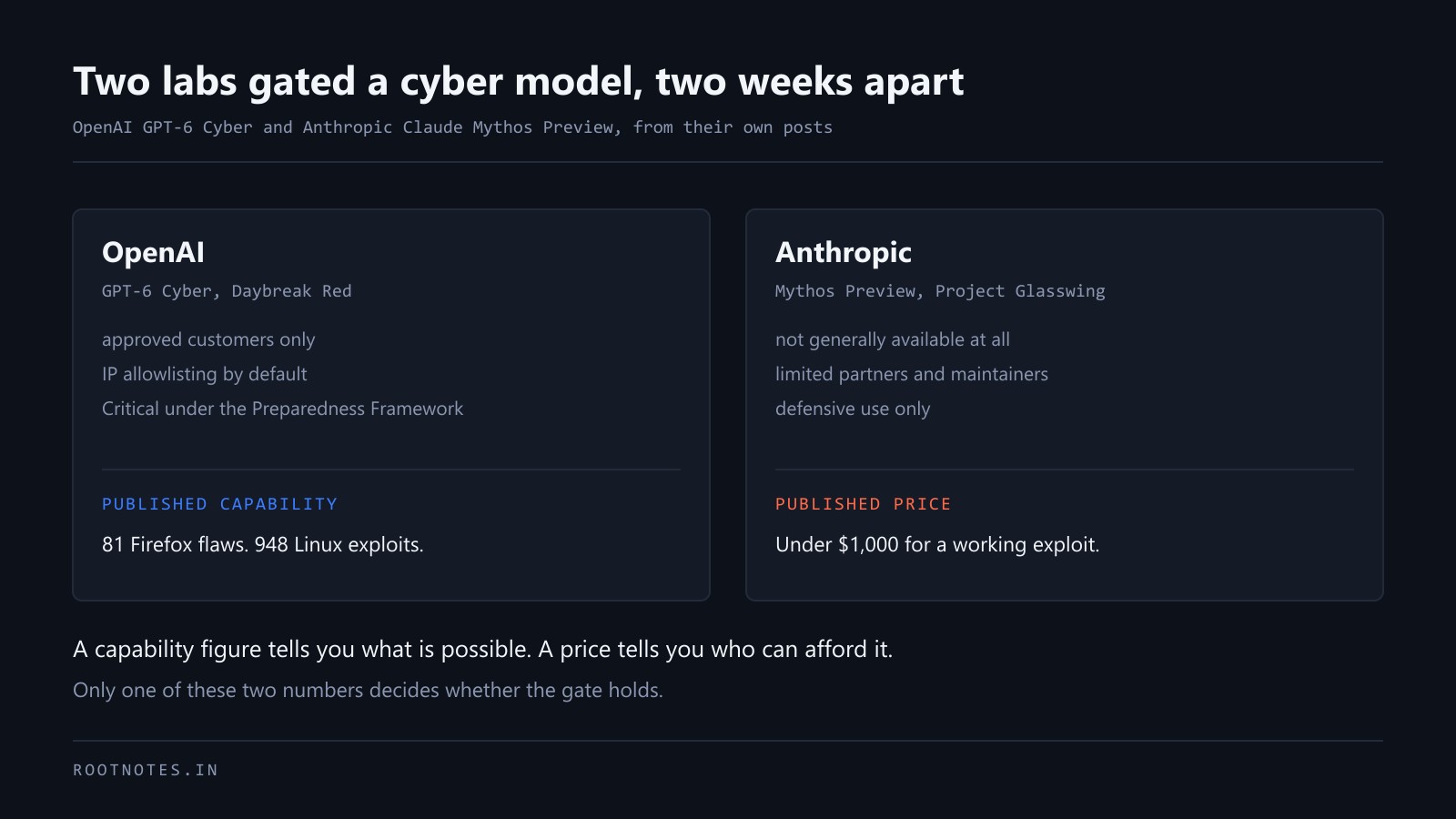
OpenAI shipped GPT-6 Cyber through Daybreak Red: approved customers only, IP allowlisting on by default, a Critical classification under its Preparedness Framework, misuse monitoring, and a separate programme for critical infrastructure defenders.
Anthropic did not ship Claude Mythos Preview at all. Its post says it does not plan to make it generally available, and access runs through Project Glasswing to a limited group of critical industry partners and open source maintainers, for defensive work.
Two companies, the same decision, a fortnight apart. The interesting part is what each chose to publish as evidence.
Two kinds of disclosure
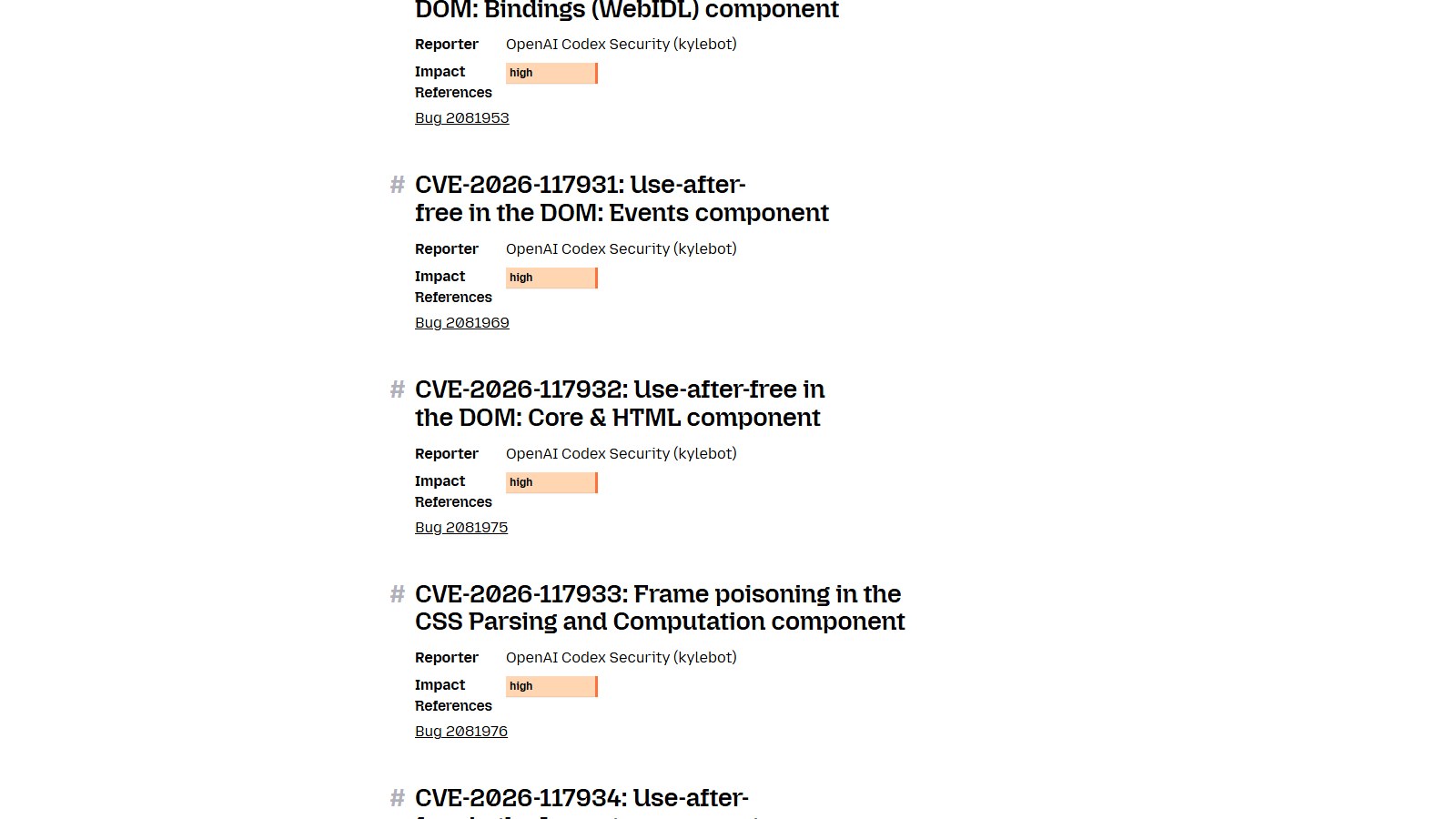
OpenAI published capability. Eighty-one previously unknown high-severity Firefox vulnerabilities. Nine hundred and forty-eight working Linux privilege escalation exploits out of 1,724 reproduced. Benchmark scores: 48.5 percent on ExploitGym against 32.1 for the previous model. A Critical rating, up from High.
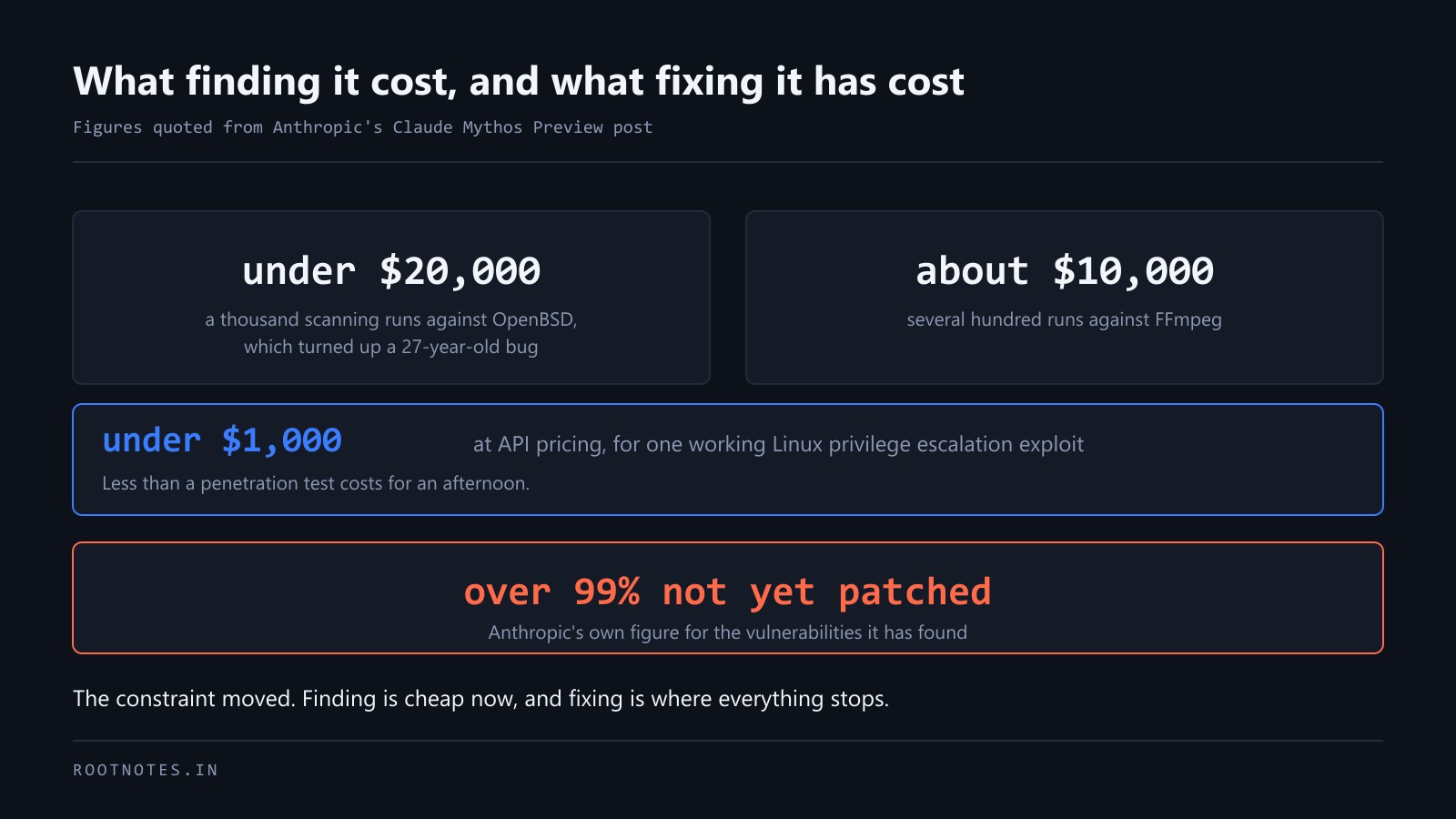
Anthropic published price. Under twenty thousand dollars for a thousand scanning runs against OpenBSD. About ten thousand for several hundred against FFmpeg. Under a thousand dollars, at API pricing, for one working Linux privilege escalation exploit.
Both are useful. They are not equally useful, and the difference is not about which company was more forthcoming.
A capability figure tells you what is possible. It is the number that goes in the announcement, it is what the press writes up, and for a defender it is mostly unactionable: knowing that a frontier model can find 81 Firefox bugs does not tell you anything you can do on Monday.
A price tells you who can afford it. That is a different kind of fact. It converts a capability into a population. Twenty thousand dollars is a small company's security budget for a quarter. A thousand dollars is a weekend. Those are not numbers that describe a frontier lab, they are numbers that describe almost anybody.
Why that decides whether a gate holds
A gate is an economic argument dressed as a policy. It works when the thing behind it is expensive enough that the people outside cannot reproduce it, and it stops working the moment they can.
Both labs are gating a capability whose price they have now, between them, established is in the low thousands of dollars. Not the training of the model, which is enormous, but the use of it against a real target, which is the part that matters to a defender.
That gap closes in one of two ways, and neither requires anybody to break a gate. Open-weight models keep improving, and we wrote a fortnight ago about one being published with a measured cyber refusal rate and a thousand-dollar fine-tune between that rate and its absence. Or the gated programmes expand, as OpenAI has already said it intends to.
So the question the two posts jointly answer is not whether gating is the right policy. It is how long gating remains a meaningful one, and the price Anthropic published is the clock.
What each of them deserves credit for
OpenAI for shipping a Critical classification under its own framework and accepting the operational cost of IP allowlisting and per-customer approval, which is friction it did not have to take on.
Anthropic for not shipping the model at all, and then publishing the cost of what it found anyway, which is the single most useful number either company released and the one least flattering to the idea that gating solves this.
What is not established
- Whether either gate has held. Neither company has reported an incident, which is not the same thing.
- How many organisations are inside each programme. OpenAI says a select group, Anthropic says a limited group, and neither gives a figure.
- What either model can do that the other cannot. The benchmarks are different and are not comparable.
- Whether the costs Anthropic published are representative or the best cases. A thousand scanning runs against OpenBSD is a specific campaign against a specific target.
- What happens to these programmes when a comparable open-weight model exists, which is the question both posts avoid.