There is one honest answer to "how do I know this reply came from the model you said it came from", and it is that you do not. You trust the provider. FlashProve is Anthropic's attempt to replace that trust with a proof: the provider publishes a fingerprint of its weights, and every reply comes with a cryptographic argument that those weights produced it.
It is open source, Apache 2.0, at anthropics/FlashProve. It works. The question is what it costs, and Anthropic has published enough to answer that.
What it costs to make
| Measure | Figure |
|---|---|
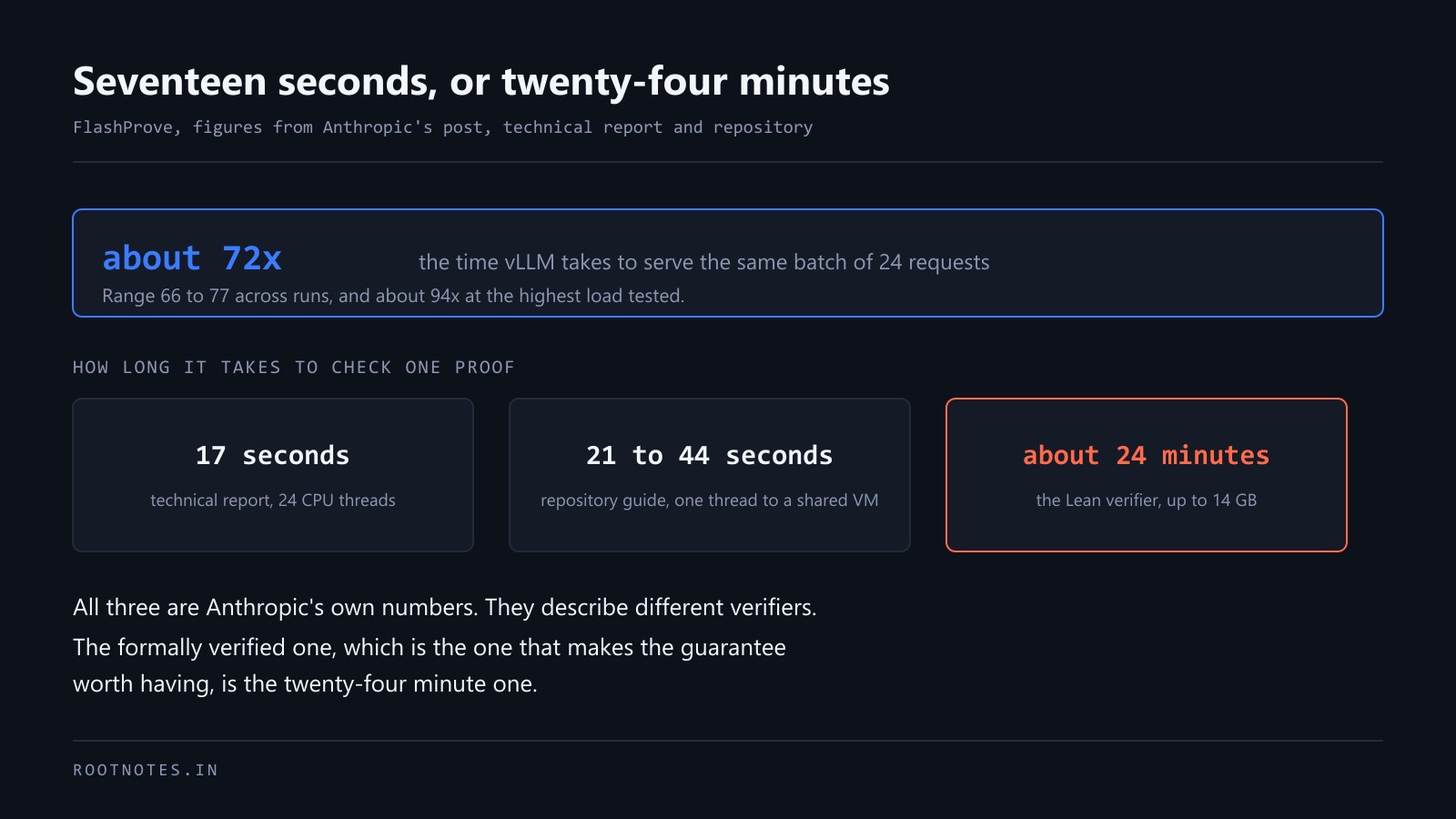
| Proving time against serving | about 72 times what vLLM takes for the same batch of 24 requests |
| Range across runs | 66 to 77 |
| At the highest load tested | about 94 times |
| Throughput | about 110 tokens per second, Llama 4 Maverick, one H100 |
| Proof size | 18.78 MB average, about 19 MB per 1,024-token request |
Seventy-two times is not an optimisation gap. It is a different order of thing. Serving a model is already the dominant cost of running one, and this multiplies it by seventy-two for the same output. Nobody is turning that on for production traffic at that price, and Anthropic does not suggest they should: the post is titled progress, and this is a research prototype.
What it costs to check, which depends on who you ask
Here the numbers in Anthropic's own material do not agree, and that is worth laying out because the difference is three orders of magnitude.
- The technical report says checking a proof takes 17 seconds on 24 CPU threads.
- The repository's performance guide says about 21 seconds single-threaded, and 36 to 44 seconds on a shared virtual machine.
- The same repository notes that the Lean verifier takes about 24 minutes and up to 14 GB of memory.
All three are true. They describe different verifiers. FlashProve ships more than one, and the Lean one is the formally verified path.
That distinction matters more than it looks. The whole point of a proof is that you do not have to trust anybody, and a verifier you have to trust is a verifier that has reintroduced the problem. The formally verified implementation is the one that makes the guarantee worth having, and it is the twenty-four minute, fourteen gigabyte one.
So the honest summary is: seventeen seconds if you trust the fast verifier, twenty-four minutes if you want the guarantee you came for.
One more thing the repository says that the research post does not dwell on: the full-size example uses synthetic weights, not Meta's actual weights. The headline demonstration is a demonstration of the machinery, not of a real model being proved.
Why this is still worth writing about
Because it is the only serious proposal anybody has for a problem that is about to matter a great deal.
Model routing is already happening quietly. Users have noticed being served something other than what they asked for. Providers downgrade under load, test variants without announcing them, and substitute cheaper models behind the same API name. At the moment the only way to detect that is to measure the output and argue. A proof would end the argument.
The same mechanism answers harder questions later: whether a regulated deployment really ran the model it was certified with, whether an agent's output came from the weights an auditor approved, whether a model card describes the thing that is actually serving you.
Seventy-two times says none of that is available this year. Publishing the number, the three verification times and the synthetic-weights caveat says Anthropic is not pretending otherwise, which is the right way to ship a prototype.
What is not established
- Whether the 72x holds for models other than Llama 4 Maverick, or for larger ones.
- What any of this costs in money rather than multiples. The multiple is the honest unit for a prototype and the money is the number a buyer needs.
- Whether the Lean verifier is meant for production use or only for assurance of the fast one.
- Whether anybody outside Anthropic has reproduced any of these figures.
- What the proving cost does as context length grows. All the published figures are around 1,024-token requests.