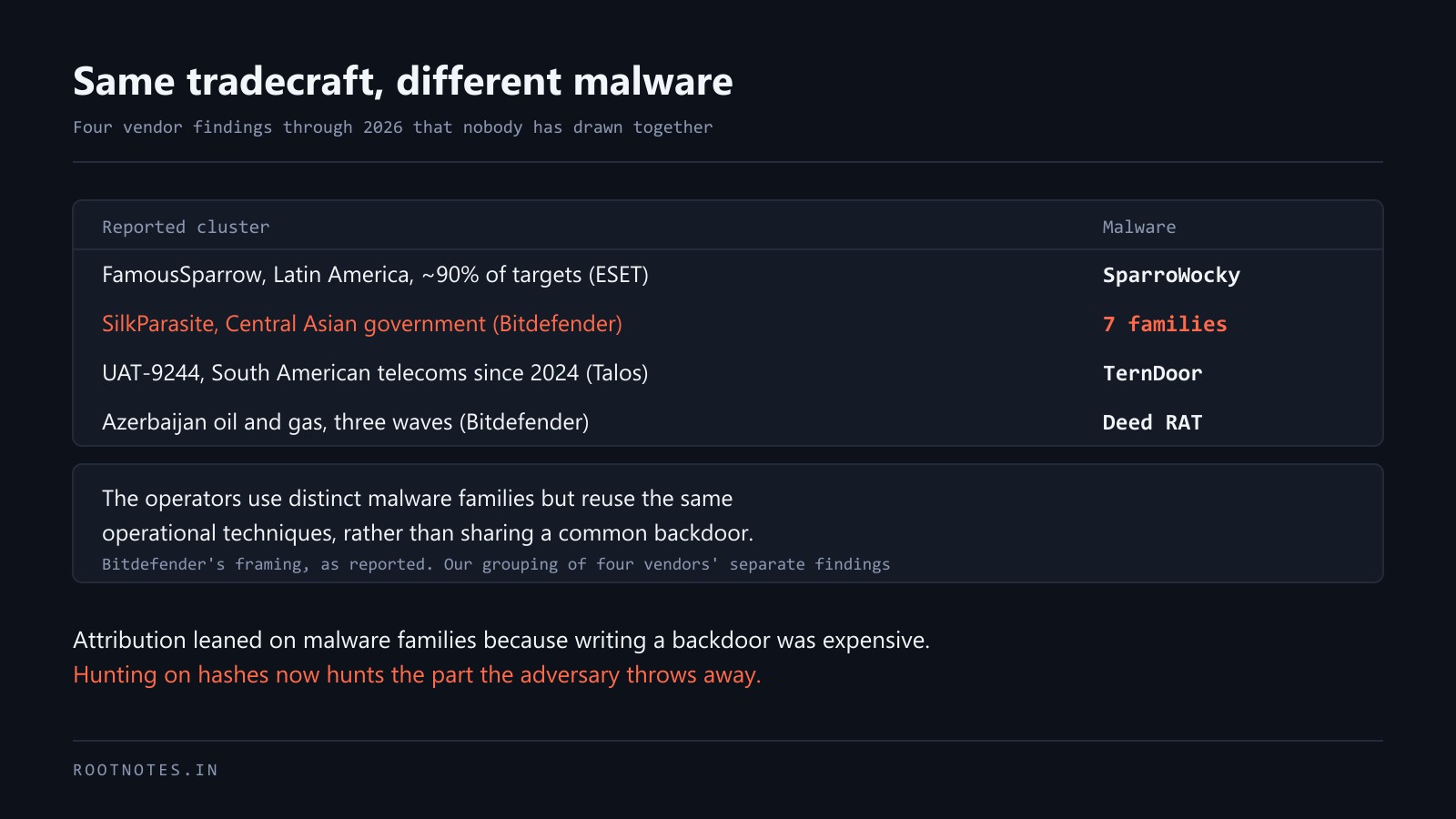
Four vendor reports published across 2026 describe four China-nexus intrusion sets. Read separately they are four stories. Read together they are one argument about how attribution works now.
FamousSparrow and SparroWocky. ESET reported in September that the group had developed a new backdoor, SparroWocky, and deployed it across Latin America. It is a distinct family rather than a variant of the group's previous SparrowDoor, and it replaced it. ESET's telemetry puts about 90 per cent of the group's targets from mid-2025 into 2026 in Latin America, which ESET called unusual for a China-aligned group. Tools that were previously separate utilities are now built into the backdoor.
SilkParasite. Bitdefender reported a cluster targeting Central Asian government organisations using seven malware families, most of them previously unidentified, with links to FamousSparrow and indirectly to the ShadowPad ecosystem.
UAT-9244. Cisco Talos tracks a group that has targeted South American telecoms providers since 2024 using TernDoor, whose lineage Talos traces back to SparrowDoor. It overlaps FamousSparrow and Tropic Trooper.
Azerbaijan. Bitdefender reported the same oil and gas company hit in three waves between late December 2025 and late February 2026, using Deed RAT, also called Snappybee and described as a ShadowPad successor, along with TernDoor and the Mofu Loader.
The line that matters
In the SilkParasite reporting, the researchers' own framing is the most important sentence in all of this: the operators use distinct malware families but reuse the same operational techniques, rather than sharing a common backdoor.
That is an inversion of how attribution has worked for twenty years, and it has consequences.
Why attribution leaned on malware in the first place
It was economics. Writing a capable backdoor is expensive: months of engineering, testing against security products, maintenance as those products change. Having built one, a group reuses it, because the alternative is paying the cost again.
That reuse is what made malware families such good identifiers. The code persisted across operations, so a hash, a mutex name, a distinctive encryption routine or a configuration format could tie a new intrusion to a known group with reasonable confidence. An entire industry of threat intelligence feeds is built on that assumption.
These groups have broken it. They are fielding distinct families across operations, some of them seen only once. If malware is cheap enough to be disposable, it stops carrying identity.
What persists instead
The tradecraft. Which is to say: how the loader is staged, what order things happen in, which legitimate binaries get abused and how, how persistence is established, how the operators behave when they hit something unexpected, what they take, how long they stay, and what they choose to target in the first place.
Targeting is a particularly strong signal and the FamousSparrow case shows why. Ninety per cent of targets in one region, sustained over eighteen months, is not an operational detail. It is a tasking, and tasking comes from a requirement, and requirements belong to organisations rather than to toolkits. A group can rewrite its backdoor between operations. It cannot easily change what it has been asked to collect.
The uncomfortable consequence for defenders
Most organisations detect through indicators: hashes, domains, IP addresses, filenames, YARA rules. All of those describe the malware.
If the malware is the part the adversary throws away, then indicator-based detection is hunting the disposable layer. It will keep working against the unsophisticated majority, because most attackers do reuse their tooling. It will keep failing against exactly the groups that matter most, and it will fail silently, which is the worst property a control can have.
Behavioural detection is the answer everyone gives and it is correct, but it is worth being honest that it is dramatically harder. An indicator is a fact that can be distributed in a feed and matched automatically. A tradecraft pattern is a judgement that has to be learned, encoded by someone who understands it, and tuned against an environment. It does not travel well between organisations and it cannot be bought in a subscription.
Which is perhaps the real finding: the part of attribution that still works is the part that cannot be commoditised.
What is not established
- The grouping is ours. Four vendors published four findings about overlapping but separately named clusters. Drawing them together as one ecosystem is our framing and should be read as such.
- We did not retrieve the Bitdefender or Talos reports directly. The SilkParasite, UAT-9244 and Azerbaijan details reach us through reporting and vendor summaries. ESET's newsroom release and WeLiveSecurity posts on FamousSparrow are available and are the firmest of the four.
- The vendors do not agree on the boundaries between these clusters, and overlap in this field frequently means shared tooling or shared infrastructure rather than shared operators.
- "China-nexus" is the vendors' assessment in each case, not an independently verified attribution.
- Whether disposable malware is a deliberate counter-attribution strategy or simply a consequence of development becoming cheaper. We have described the effect; the intent is unknown.


