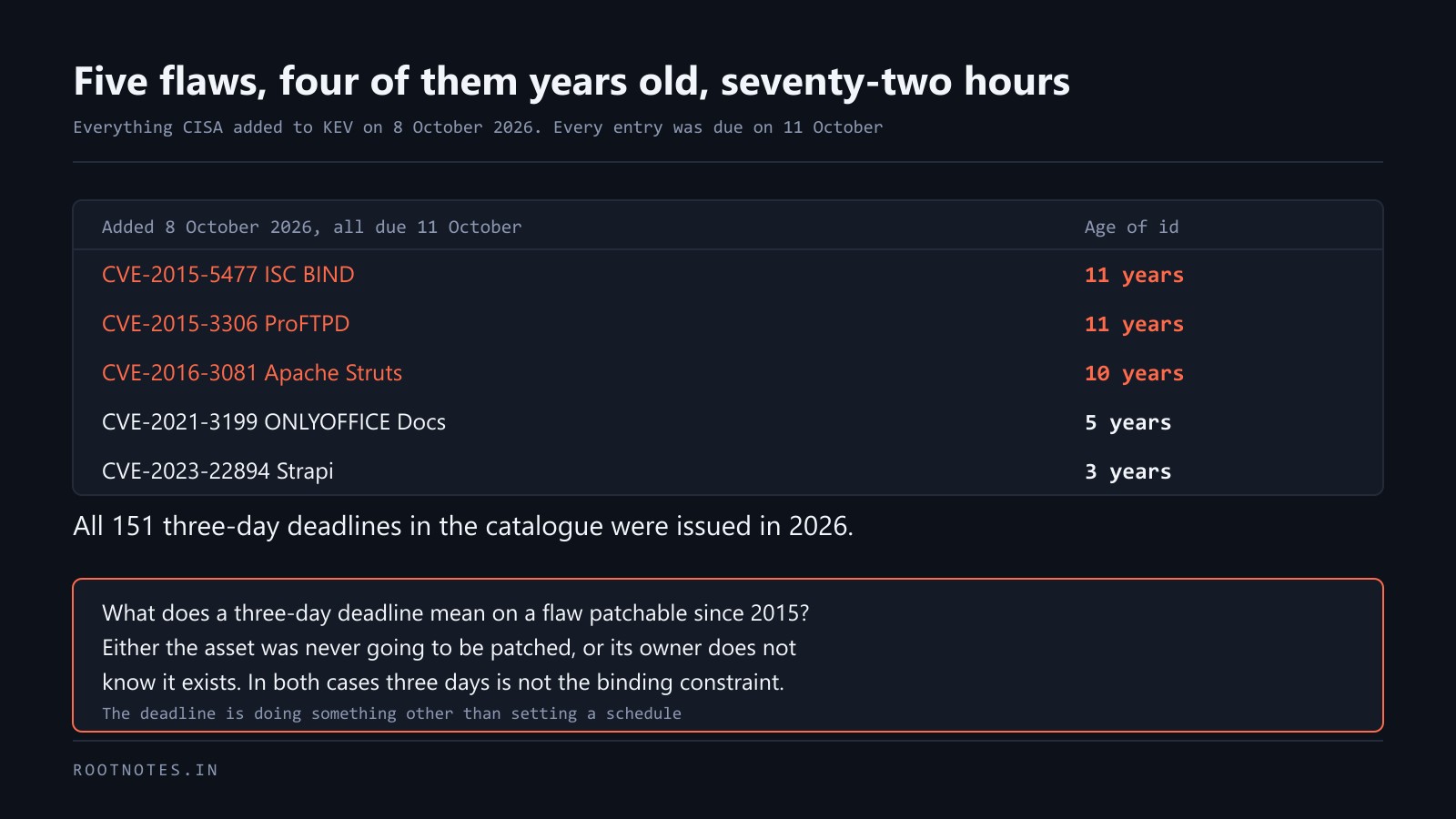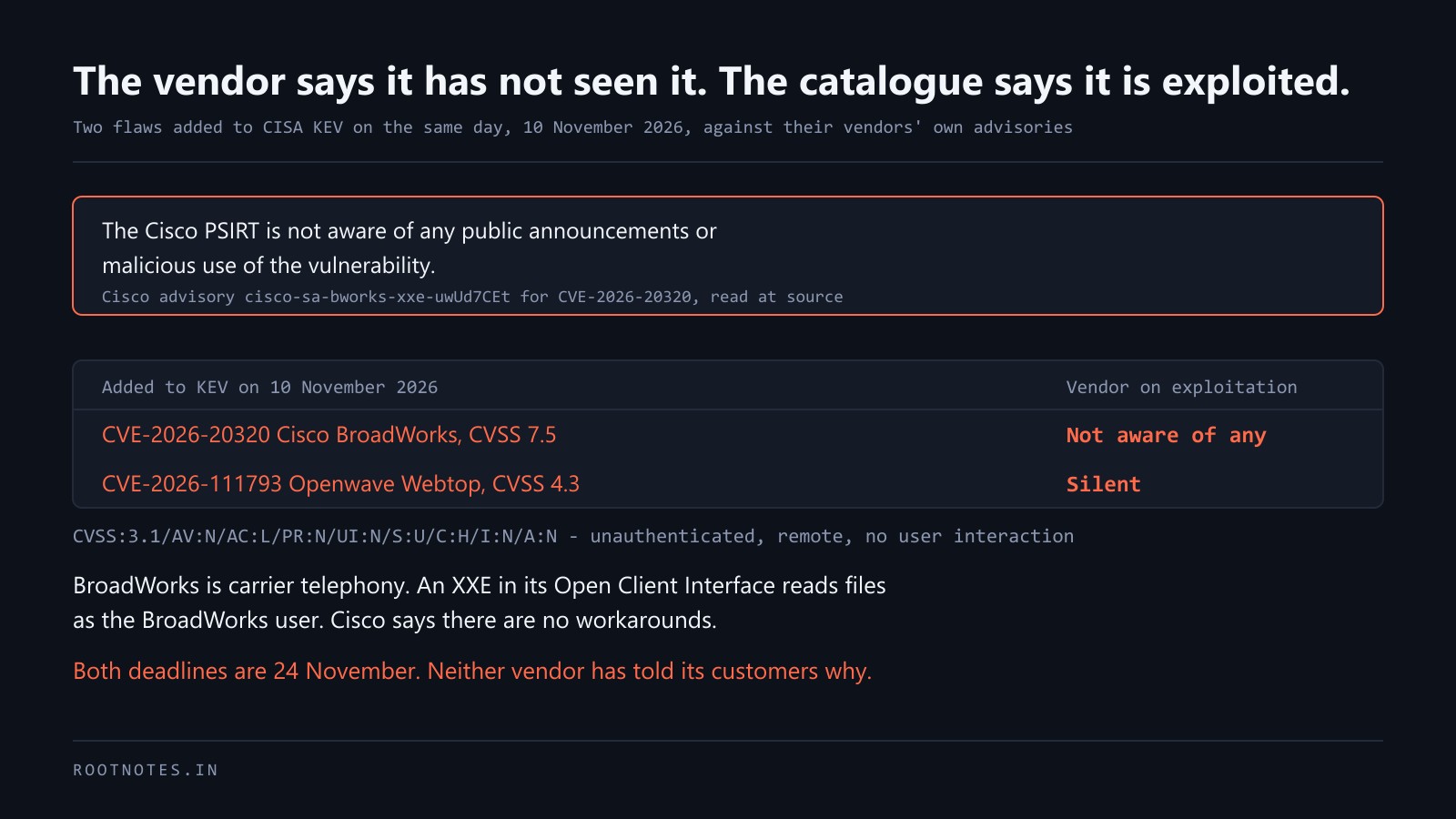
On 10 November 2026 CISA added two vulnerabilities to the Known Exploited Vulnerabilities catalogue, both with a deadline of 24 November. Being in that catalogue means one thing: the flaw is being exploited in the wild.
We read both vendors' advisories at source. Neither supports the claim.
Cisco's advisory for CVE-2026-20320 states that the Cisco PSIRT is not aware of any public announcements or malicious use of the vulnerability.
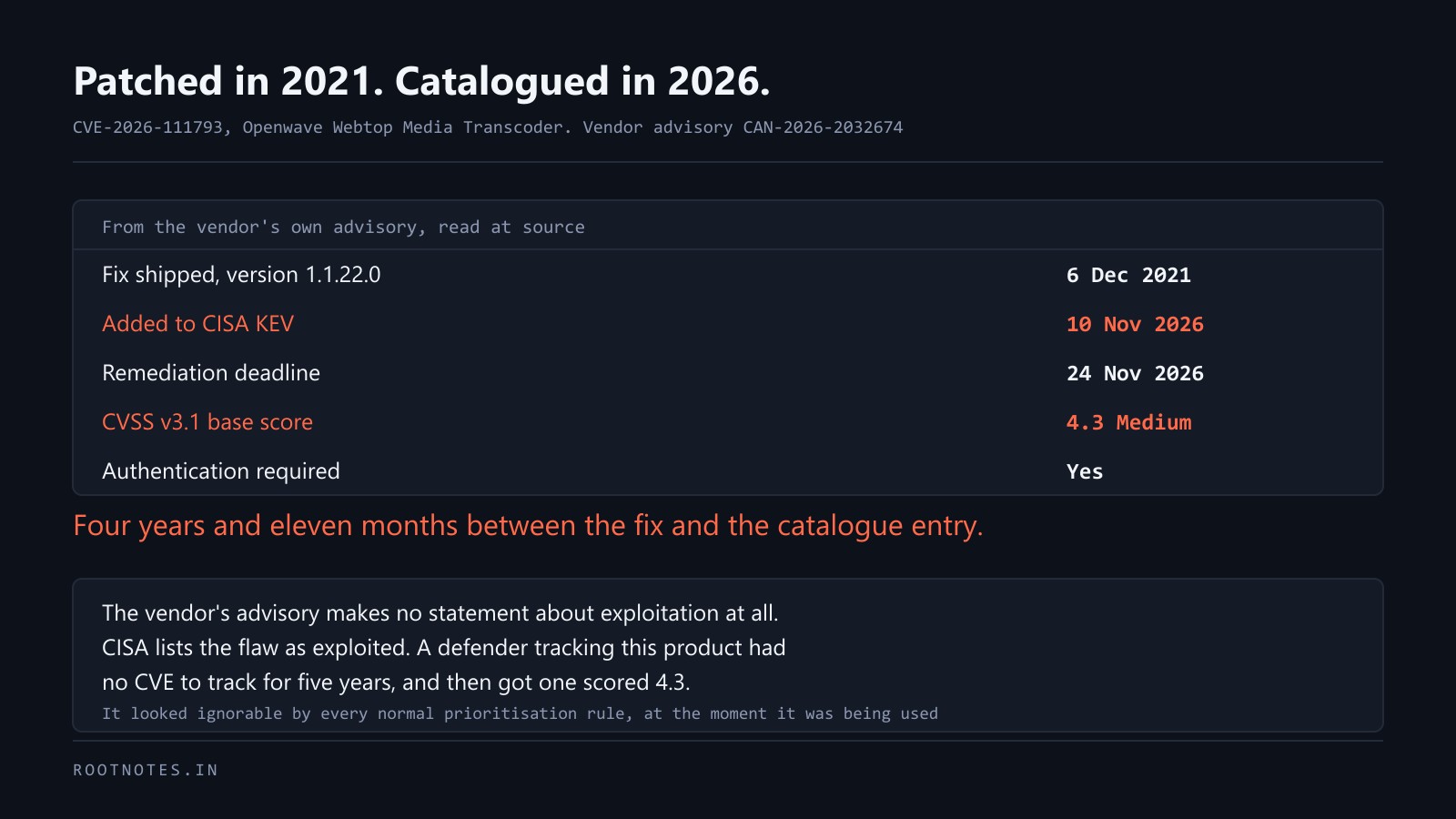
Openwave's advisory for CVE-2026-111793 does not mention exploitation at all.
One vendor says it has not seen it. The other says nothing. And both flaws are in the catalogue of flaws that are being exploited, with a federal remediation deadline attached.
The Cisco flaw, which is serious regardless
Take the vulnerability on its own terms first, because it deserves attention whatever the exploitation status.
CVE-2026-20320 is in Cisco BroadWorks, specifically the Open Client Interface XML parser. Cisco's description: XML entries are improperly parsed because external entity resolution is allowed by default. An unauthenticated remote attacker sends a crafted XML message to the OCI-P service and can view sensitive files from the filesystem with the privileges of the BroadWorks user.
The vector is CVSS:3.1/AV:N/AC:L/PR:N/UI:N/S:U/C:H/I:N/A:N, base score 7.5. Network, low complexity, no privileges, no user interaction. There is nothing an attacker needs to arrange.
It affects the Application Delivery Platform, Application Server, Profile Server and Xtended Services Platform on releases earlier than RI.2026.07, regardless of configuration. Cisco credits Sandesh M Gawai. There are no workarounds.
BroadWorks is carrier telephony infrastructure. The thing an XML external entity flaw gives you there is the configuration, and the configuration of a carrier voice platform describes interconnects, credentials and subscriber routing. It is a reconnaissance primitive against the phone network, obtained without a login, and that is worth taking seriously with or without a catalogue entry.
Why the discrepancy is the story
There are several innocent explanations and it is worth laying them out rather than reaching for the dramatic one.
The advisory is stale. Cisco published it when it published it, and that sentence reflects what PSIRT knew then. Exploitation may have been observed afterwards, by someone else, and the page may simply not have been revised. This is the most likely explanation and it is also a problem, because customers read the advisory.
CISA has evidence Cisco does not. The catalogue accepts government sources. A vendor cannot see what it cannot see, and an intelligence-derived detection would not reach Cisco's PSIRT at all.
The bar is different. CISA requires evidence of exploitation; what counts as evidence is not published. Cisco's statement is about what its own team is aware of, which is a narrower claim than "this is not being exploited".
All three are plausible. None of them helps the person who has to make a decision this week.
The practical problem this creates
Put yourself in the position of a BroadWorks operator on 11 November.
CISA says the flaw is exploited and you have thirteen days. Cisco, the only party who can tell you anything about the product, says its security team is unaware of malicious use. You have no indicators of compromise from either, and no way to tell from the two documents in front of you whether to run an investigation or simply patch.
Patching is the easy half and you should do it. The hard half is whether to treat this as an active incident, and the two authoritative sources point in opposite directions with no way to reconcile them.
This matters more than it sounds. The gap between "patch it" and "assume you may already be compromised" is the difference between a maintenance window and an incident response engagement, and nothing available to that operator distinguishes between them.
Since we wrote this, the gap has been filled
Malbear Labs published research on 8 November describing an intrusion it calls Operation Snowball, in which a jailbroken model drove a two-week campaign against a European telecommunications provider and thirteen organisations hosted on its infrastructure. The reported way in was this flaw: an XML message sent to a BroadWorks server, which returned files including private keys.
That is the description of the activity that was missing, and we have written about it separately.
It does not fully resolve the contradiction. Malbear is one private firm, its account is not independently verified, CISA has not confirmed it, and it does not establish what Cisco knew or when. But it does mean the honest position has moved. There is now a published account of exploitation, and a BroadWorks operator reading Cisco's advisory alone would still not know it exists.
Which sharpens the complaint rather than retiring it. The question is no longer "is anyone seeing exploitation". It is why the vendor page a customer would consult still says nobody is.
What should happen
A KEV entry should be accompanied by enough detail for a defender to act on it, or the vendor's advisory should be updated to reflect it, and preferably both.
The current arrangement puts a legal deadline on one side and an unchanged vendor page on the other, and leaves the customer to notice the contradiction themselves. Most will not, because most read one source, and which source they read determines what they do.
Worth noting this is now a pattern rather than an incident. Of the two entries added on 10 November, both have this problem. We wrote separately about the Openwave entry, where the advisory is silent, the score is 4.3, the fix shipped in December 2021 and nobody can say who is actually exposed.
What is not established
- Whether the vendors' silence is current. We are reporting that CISA asserts exploitation and that neither vendor's advisory corroborates it. We are not suggesting CISA is wrong, and a third-party research account has since appeared.
- Whether Cisco has updated the advisory since we read it. Anyone acting on this should re-read it at source.
- What the exploitation involves. A published account now exists, from Malbear Labs, which we did not retrieve and which nobody has independently verified. CISA has not confirmed it and no indicators have been published by any party.
- Whether CISA notified Cisco before adding the entry, and what Cisco's response was. Neither party has said.
- Whether RI.2026.07 is available to all affected customers on all deployment models.