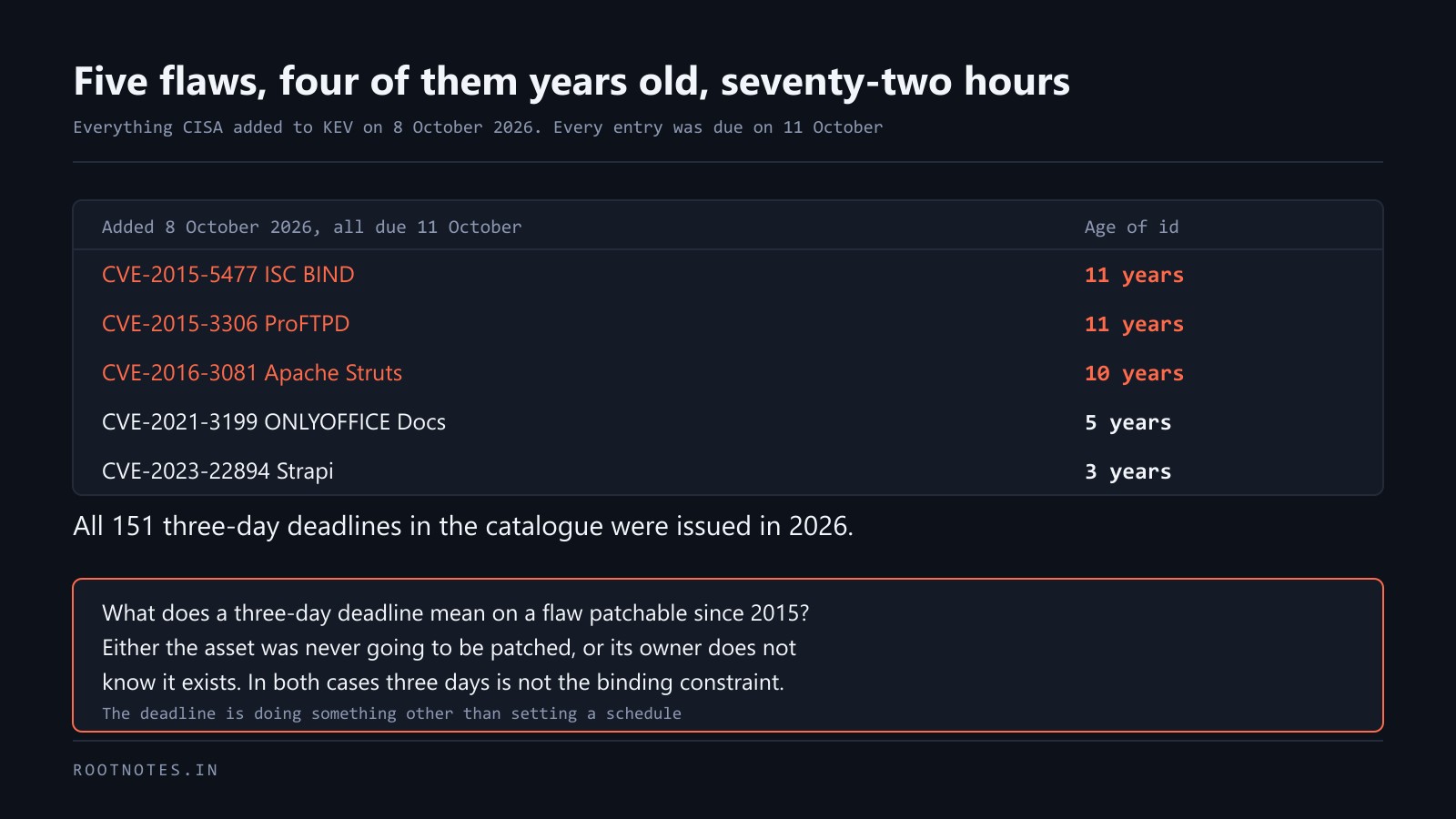
On 8 October 2026, CISA added five vulnerabilities to the Known Exploited Vulnerabilities catalogue. Every single one carried a remediation deadline of 11 October. Three days.
Here is the batch, with the age of each identifier:
- CVE-2015-5477, ISC BIND. Eleven years.
- CVE-2015-3306, ProFTPD. Eleven years.
- CVE-2016-3081, Apache Struts. Ten years.
- CVE-2021-3199, ONLYOFFICE Docs. Five years.
- CVE-2023-22894, Strapi. Three years.
Four of the five are over three years old. Two of them have been patchable since 2015.
The question nobody asks
What is a three-day deadline for, applied to a flaw that has had a fix available for eleven years?
Work through the possibilities honestly.
The asset is patched already. Then the deadline costs an afternoon of someone confirming it and changes nothing.
The asset is unpatched and known. Then it has been consciously left unpatched for eleven years, which means there is a reason: an application that breaks, a vendor who will not support the upgrade, a system nobody is allowed to touch. Three days does not dissolve any of those. The organisation will file an exception, as it has every previous year.
The asset is unpatched and unknown. This is the common case and the one that matters. Somebody is running a BIND instance that nobody has a record of, because it came with an appliance or was stood up for a project in 2016. Three days is not the binding constraint here. Finding it is. You cannot patch within a deadline an asset you cannot enumerate, and no deadline shortens the discovery.
In all three cases the clock is doing something other than setting a schedule.
What it is probably actually doing
We think the three-day deadline is a signal, not a timetable, and that reading it as a timetable is why it looks irrational.
A 72-hour clock forces the item out of the normal queue. It generates an exception that has to be written down and signed by somebody. It makes a quiet, decade-old risk acceptance into a visible, dated decision with a name attached. That is a real governance outcome and arguably a more valuable one than the patching, because the exception register is where an organisation finds out what it has actually been tolerating.
If that is the intent, it is defensible. It is also never stated, which means most of the people receiving these deadlines read them as an impossible operational demand and treat the whole mechanism with less seriousness as a result.
The pattern this sits inside
We have now written about the three-day deadline three times, and the pattern is consistent.
All 151 three-day deadlines in the catalogue were issued in 2026. The mechanism did not exist before this year. It arrived with BOD 26-04 and it is being applied to a widening range of products with no published selection rule.
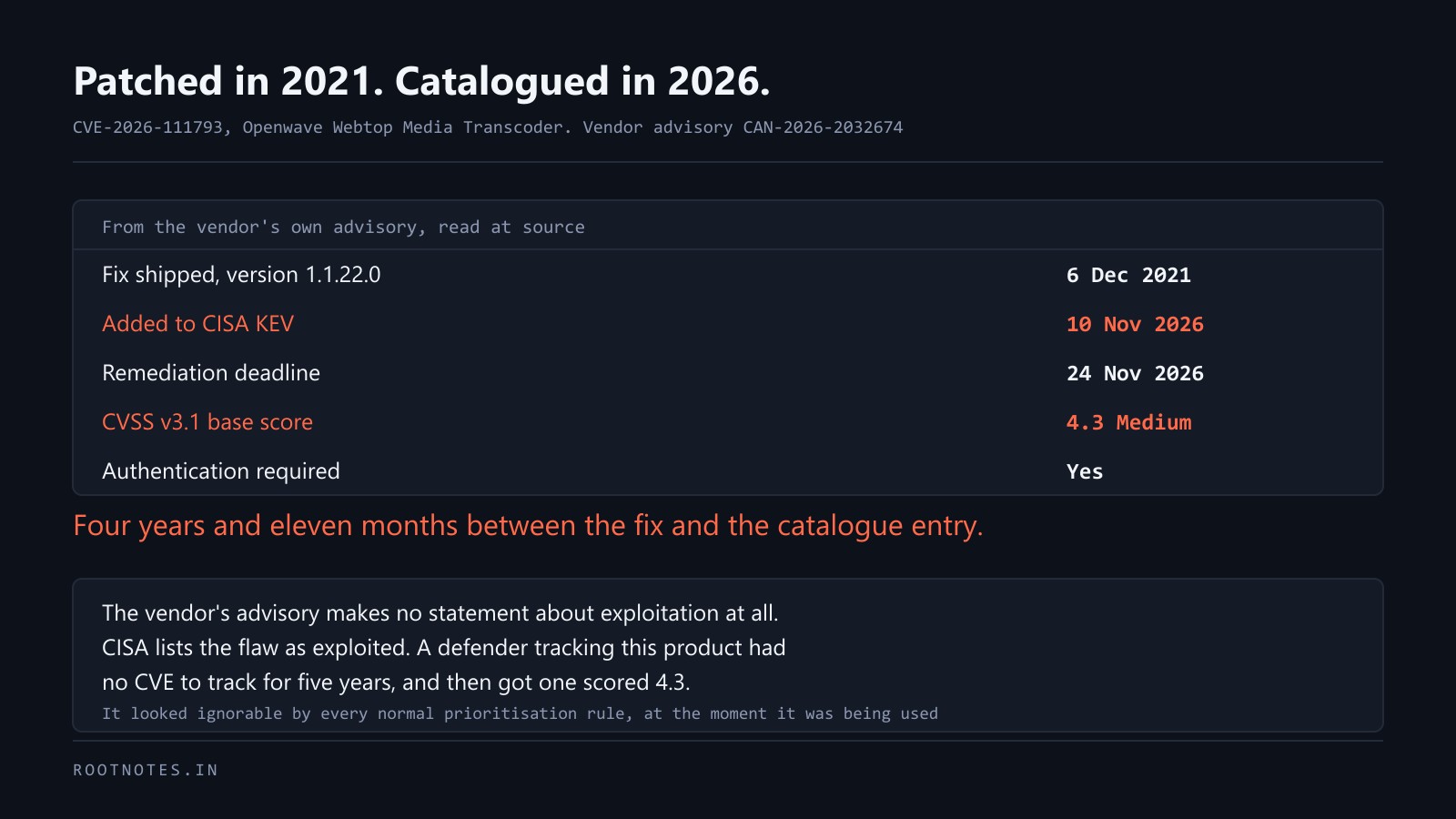
The 8 October batch is the sharpest illustration because the age is so stark, but the oldest identifiers added during 2026 go further back still: CVE-2008-4128 in Cisco and CVE-2008-4250 in Microsoft, both eighteen years old. On 20 May alone, CISA back-filled Microsoft and Adobe identifiers from 2008, 2009 and 2010.
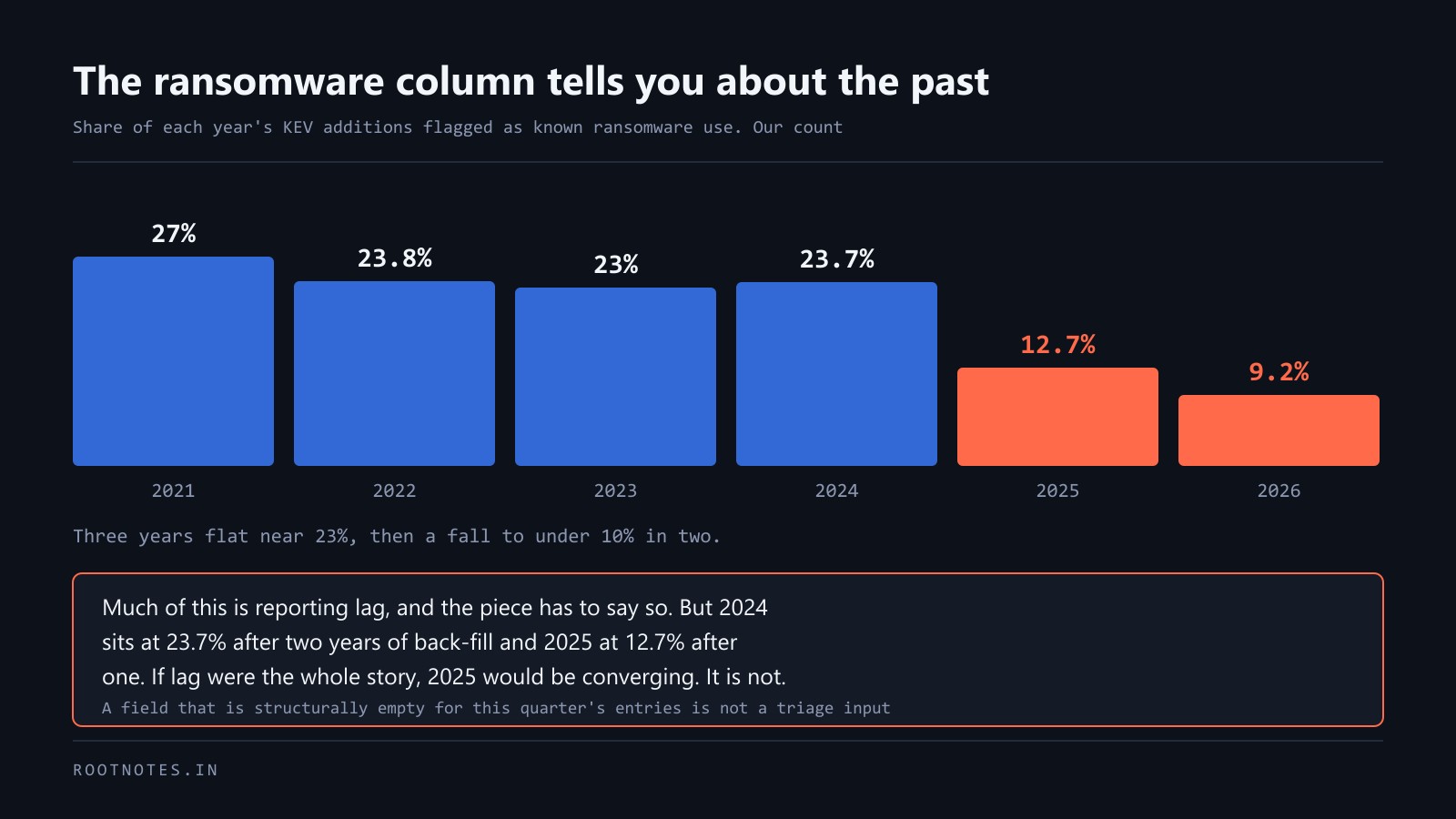
A catalogue that is simultaneously back-filling eighteen-year-old flaws and issuing 72-hour deadlines is doing two quite different jobs, and the field that would tell you which job any given entry belongs to does not exist.
What a defender should take from it
- A three-day deadline on an ancient flaw is a prompt to go and look, not to go and patch. The useful work is establishing whether you run the thing at all.
- If you find it and cannot patch it, write the exception properly. That is what the deadline is extracting from you and it is worth having.
- Do not calibrate your sense of urgency on the deadline length. It does not correlate with severity, exposure or age in any way we can detect across the catalogue.
What is not established
- Why these five, on this day, at this deadline. CISA does not publish the selection reasoning and we are inferring.
- Our reading of the deadline as a governance signal is our interpretation, not a stated policy. CISA has not described it that way.
- The exploitation evidence behind each entry. The catalogue asserts exploitation; it does not show its working.
- Whether the 151 figure is exactly current. It is from feed version 2026.11.10 and the catalogue is edited.
- Whether BOD 26-04 explicitly authorises three-day deadlines or whether they are an operational choice within it. The directive is linked from the entries and should be read by anyone relying on this.