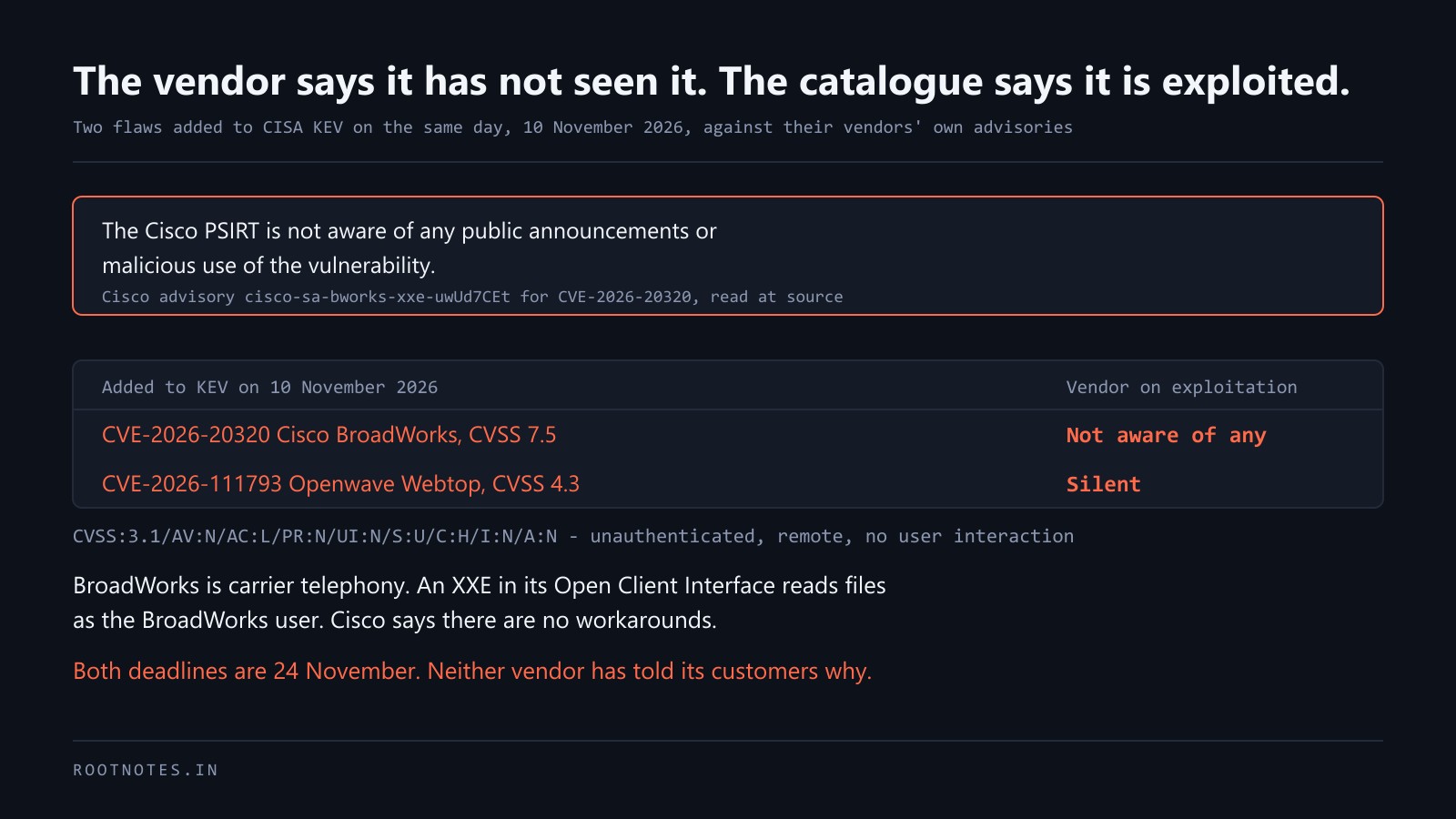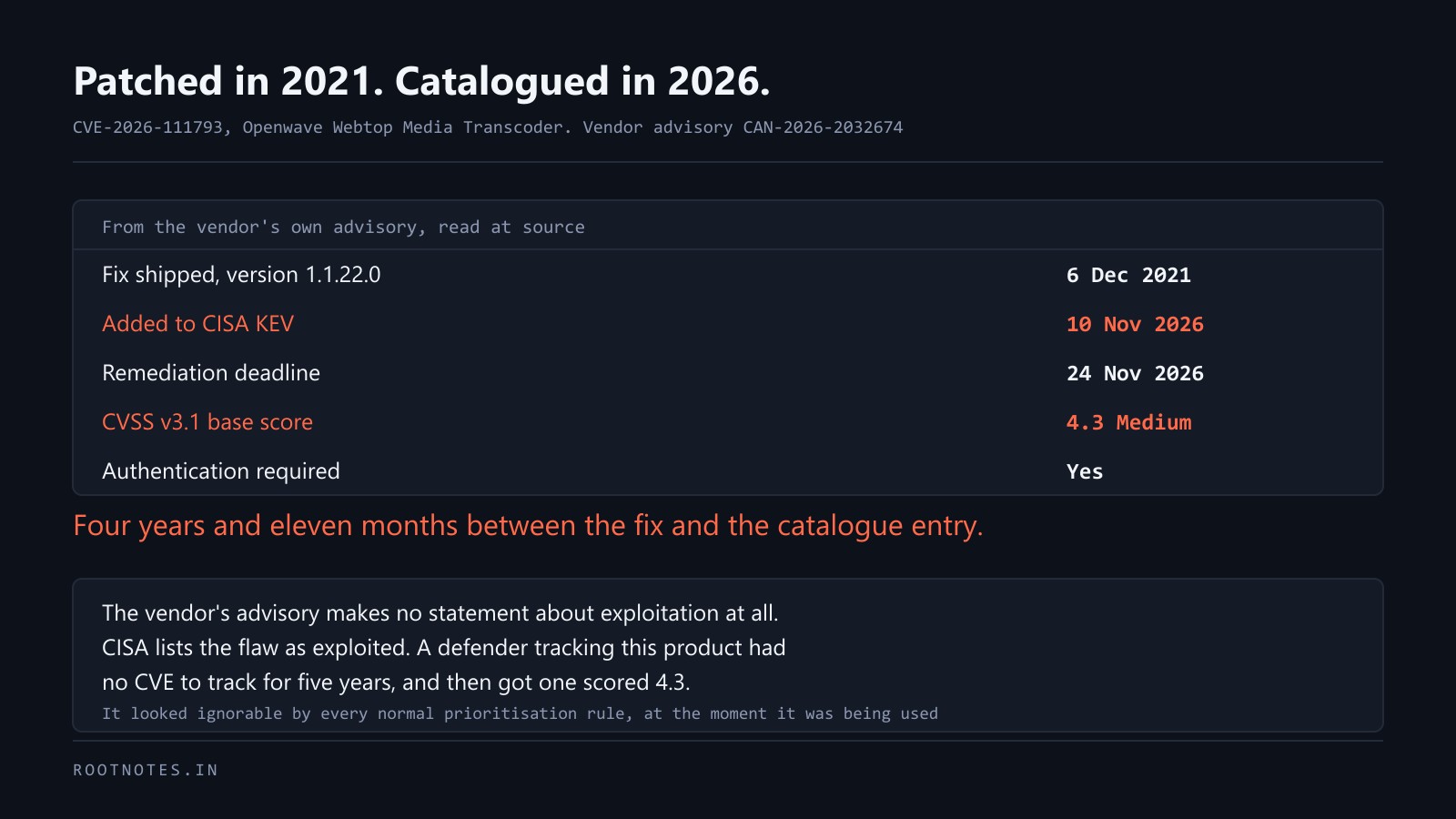
On 10 November 2026, CISA added CVE-2026-111793 to the Known Exploited Vulnerabilities catalogue, with a remediation deadline of 24 November. The product is Openwave Messaging's Webtop Media Transcoder, a component of a webmail platform.
We read the vendor's own advisory, published on GitHub as CAN-2026-2032674. It says versions prior to 1.1.22.0 are affected, and that the fix shipped on 6 December 2021.
Four years and eleven months separate the fix from the catalogue entry.
The identifier itself is a 2026 identifier, which means the flaw was assigned a CVE roughly five years after it was repaired. For that entire period a defender running this product had nothing to track it by.
Three details that make this worse
It scores 4.3, Medium. The advisory gives the CVSS v3.1 base score and nothing else. 4.3 is below the threshold at which most organisations patch on any schedule at all. In a great many vulnerability management programmes, a Medium with a 4.3 is in a quarterly bucket at best, and realistically in a backlog nobody reaches.
It requires authentication. The advisory describes an authenticated user who can process and convert unintended document types by bypassing the webmail experience. The required-privileges precondition is exactly the sort of thing that moves a finding down a triage list, on the reasonable-sounding grounds that an attacker needs an account first.
The vendor's advisory makes no statement about exploitation. None. CISA lists the flaw as exploited. JPCERT/CC is reported to have observed attacks on 9 November. The vendor's own page says nothing on the subject.
So a defender applying every ordinary prioritisation rule correctly would have ranked this low, deferred it indefinitely, and been wrong, and nothing available to them would have indicated otherwise.
The prioritisation problem, stated plainly
Every vulnerability management programme in existence ranks by some combination of severity score, exploitability preconditions and asset exposure. That is the right approach and there is no alternative; nobody can patch everything.
This entry is a clean demonstration of the failure mode. The score was low. The precondition was real. And the flaw was being exploited anyway, five years after a patch existed for it.
The reason low-severity authenticated flaws get exploited is that attackers do not start from nothing. By the time this is useful to them they already have an account, obtained by phishing or credential stuffing or purchase, and what they need is not a way in but a way to turn a mailbox into something more. A document-conversion bypass in a webmail platform is exactly that: a way to make the server process a file type it was not supposed to.
The CVSS score models an attacker starting from outside. Real attackers start from wherever they already are.
What the entry actually requires
The catalogue entry is worth reading as a document in its own right, because its required action is not what people assume.
It does not say "apply the patch". It says to apply mitigations in accordance with vendor instructions while complying with BOD 26-04, the directive on prioritising security updates based on risk, and with CISA's forensic triage requirements. It adds that stakeholders are responsible for evaluating each asset's internet exposure, and that where mitigations are unavailable the product should be discontinued.
That is a different instruction from a patch deadline. It is a requirement to assess exposure, document the decision, and in the limit stop using the software. The entry also carries a forensic triage flag, which in this case is set to no.
For a flaw with a five-year-old fix, the exposure assessment is the substantive part of that requirement and the patching is close to a formality. Which suggests CISA understands what this entry is, even if the deadline does not communicate it.
What is actually unclear here
This story has a hole in it and we would rather point at it than write around it.
If the fix shipped in December 2021, who is being exploited?
Either there are deployments still running a version from before that date, nearly five years later, which is possible in managed webmail estates and would be the real story; or the exploited condition is not precisely what the advisory describes; or the CVE covers a range the advisory's version statement does not fully capture.
We cannot resolve that from the documents available, and nobody else appears to have asked. It is the question that decides whether this is a story about unpatched legacy deployments or a story about an advisory that does not match reality.
What is not established
- The exploitation report reaches us through reporting. We have not retrieved the JPCERT/CC advisory itself. The reference in the catalogue is JVNVU93403064 and it should be read before anyone acts on the detail.
- The full CVSS vector. The vendor's advisory gives only the score, 4.3 Medium, with no vector string, so the authentication requirement is taken from the prose description rather than from a vector.
- What the exploitation achieves. Neither CISA's entry nor the vendor's advisory describes impact beyond unintended document conversion.
- Why the CVE was assigned in 2026 for a flaw fixed in 2021. The advisory lists a disclosure date of 7 October 2026 and does not explain the gap.
- Whether affected deployments exist. See above; this is the unresolved question at the centre of the story.