Every entry in CISA's Known Exploited Vulnerabilities catalogue carries a field recording whether the flaw is known to have been used in a ransomware campaign. It is one of the few pieces of context the catalogue offers, and plenty of organisations use it to decide what to patch first.
We counted it by year of addition, from feed version 2026.11.10.
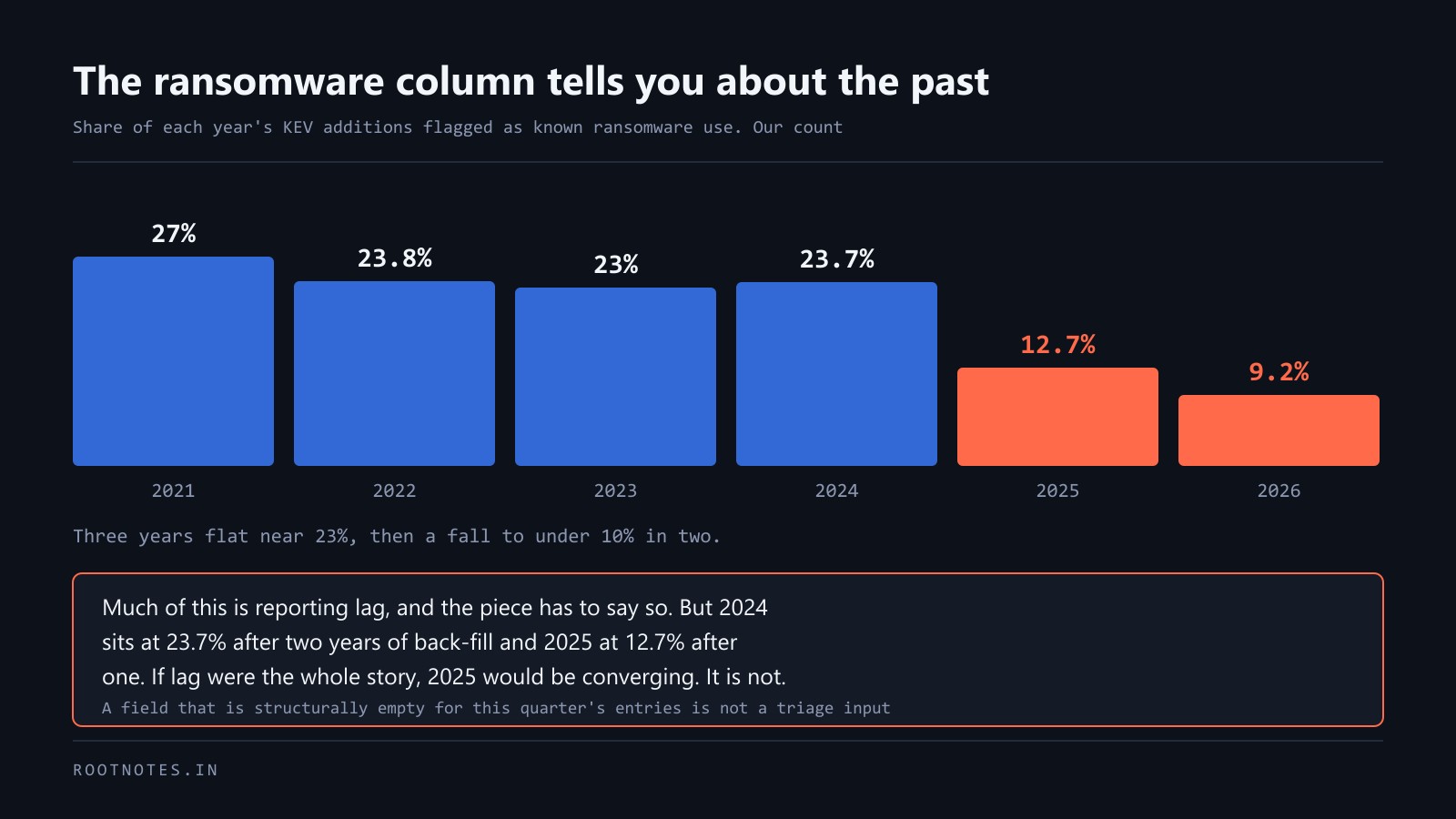
- 2021: 84 of 311, 27.0 per cent
- 2022: 132 of 555, 23.8 per cent
- 2023: 43 of 187, 23.0 per cent
- 2024: 44 of 186, 23.7 per cent
- 2025: 31 of 245, 12.7 per cent
- 2026: 27 of 295, 9.2 per cent
Three years sitting almost perfectly flat near 23 per cent, and then a fall to under 10 per cent in two. Across the whole catalogue it is 361 of 1,779, or 20.3 per cent.
The obvious explanation, stated first
This is substantially a reporting lag, and any honest reading has to lead with that.
The flag is set when ransomware use has been confirmed. Confirmation takes months: an incident happens, it is investigated, the initial access vector is established, someone publishes, and CISA updates the record. A vulnerability catalogued last month has not had time to be linked to anything.
So the recent years are structurally undercounted, and the 2026 figure will rise. Possibly a lot.
Why lag does not explain all of it
Here is the part that does not fit.
2024 sits at 23.7 per cent after roughly two years of back-fill. 2025 sits at 12.7 per cent after roughly one.
If lag were the whole story, 2025 should by now be climbing toward the low twenties, because most of the confirmation work for a 2025 entry has had a year to happen. It is at a little over half that, and the gap between 2024 and 2025 is wider than the gap between any two adjacent years in the earlier run.
Something besides lag is going on. We can think of three candidates and cannot distinguish between them with this data.
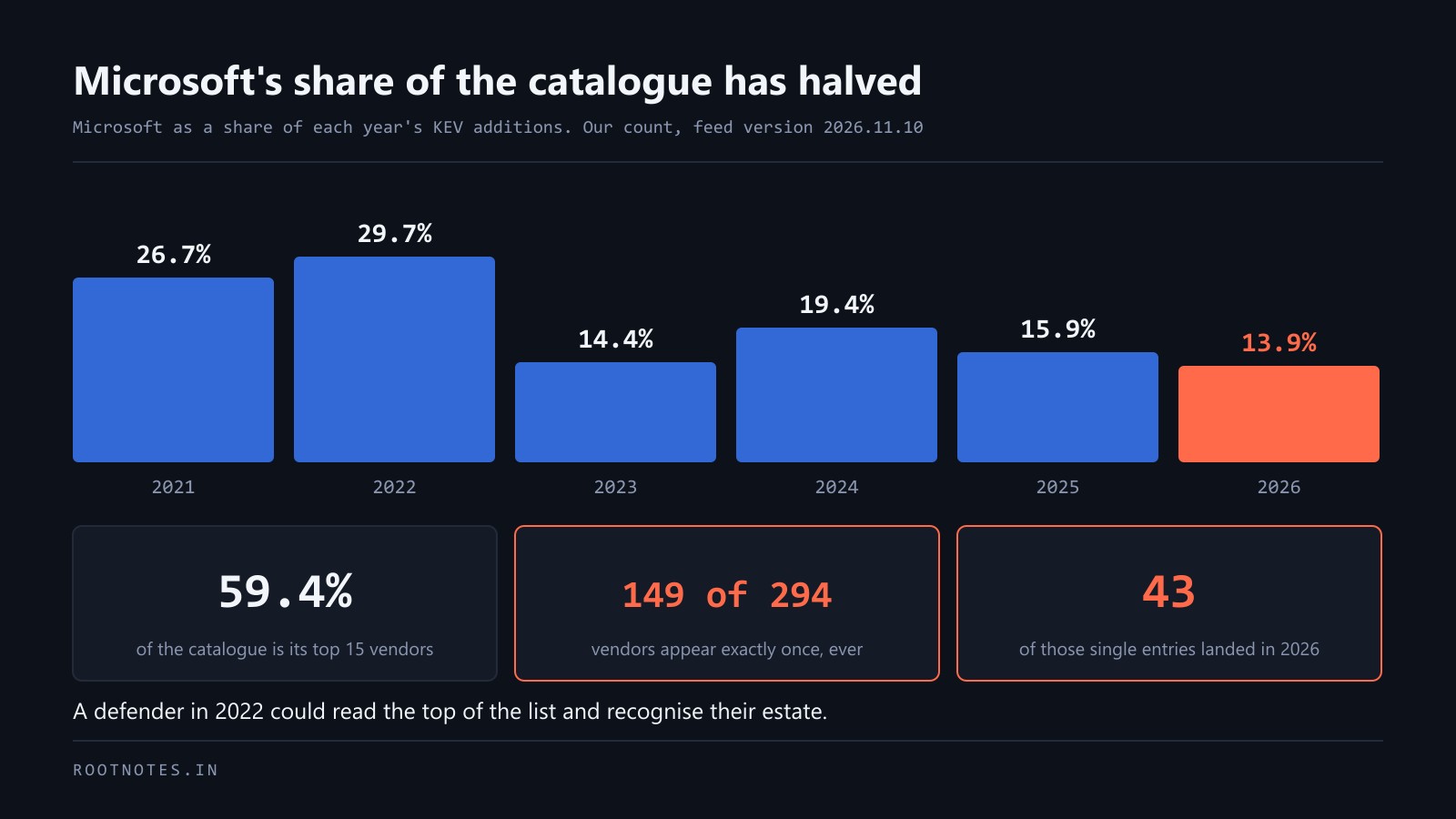
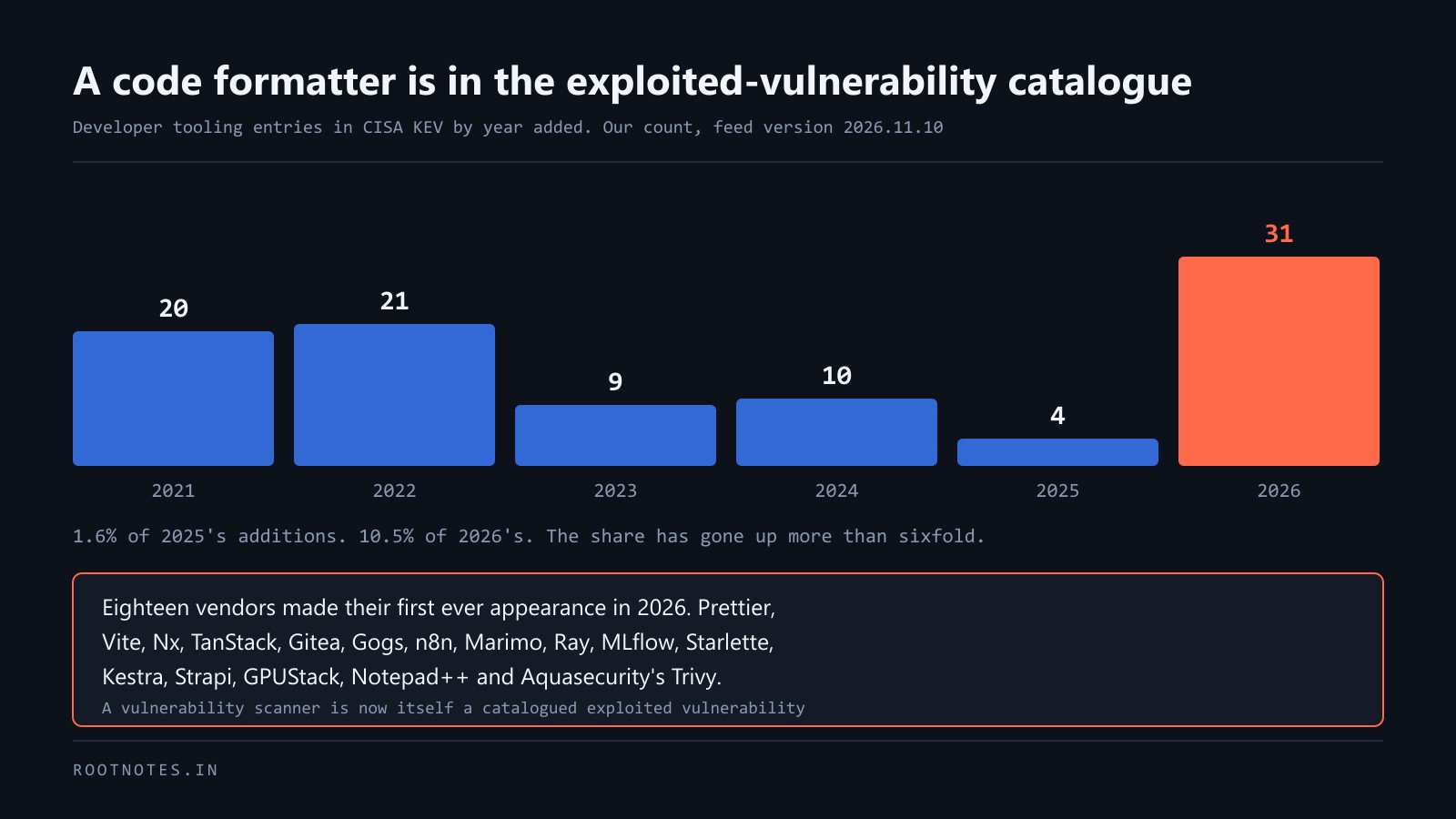
The catalogue changed shape. We have written separately about developer tooling entering KEV in volume this year, and about the catalogue's long tail of single-appearance vendors. A formatter, a bundler and a notebook server are not ransomware entry points in the way a VPN appliance is. If the mix of what gets catalogued shifts away from enterprise edge equipment, the ransomware share falls without anything about ransomware changing.
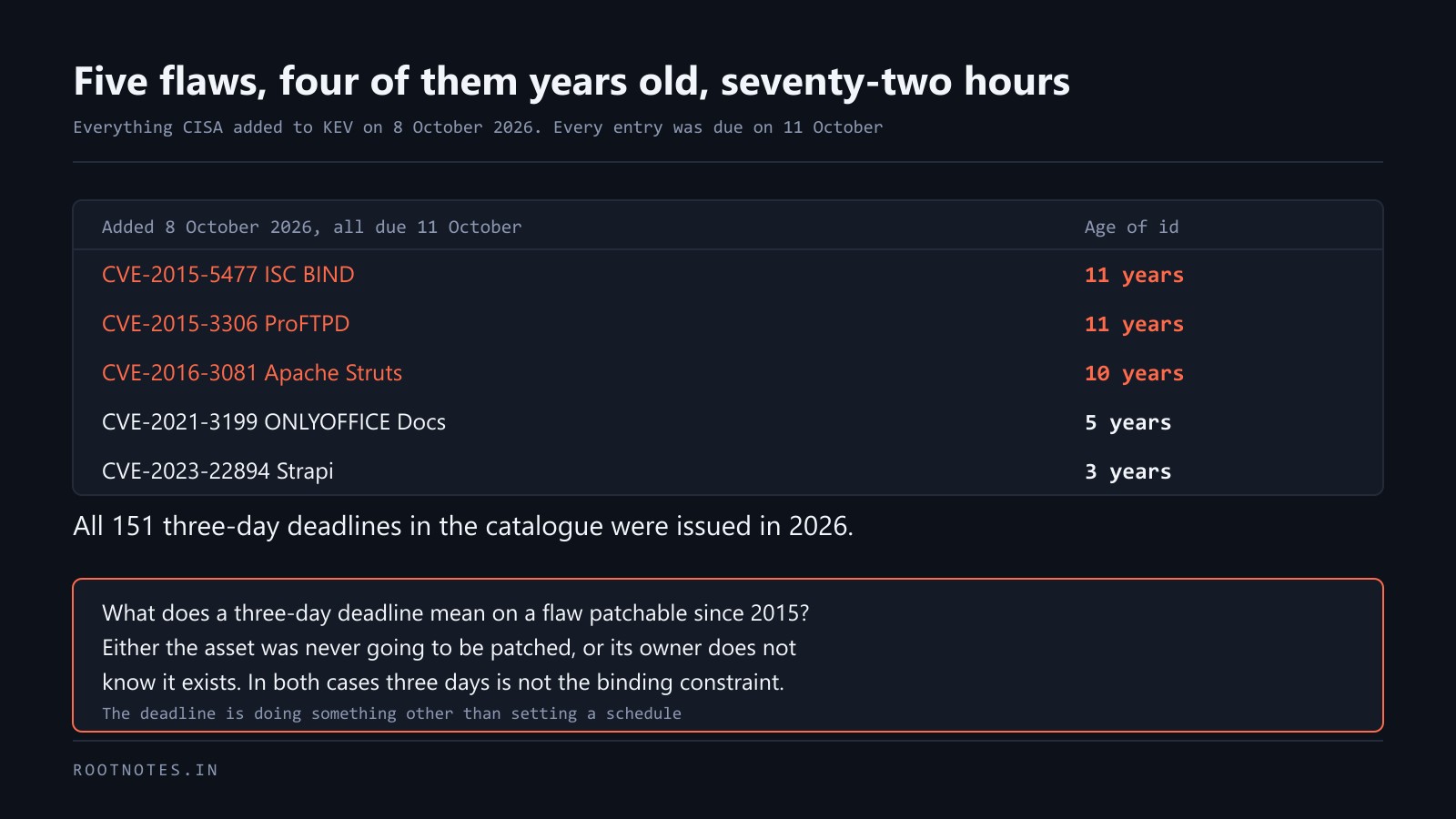
The back-filled old flaws. A substantial share of 2026's additions carry pre-2026 CVE identifiers. An eleven-year-old flaw added this year is unlikely to pick up a fresh ransomware attribution.
Ransomware attribution itself got harder. Access brokers sell to multiple operators, initial access is frequently credential-based rather than exploit-based, and the link between a specific CVE and a specific ransomware campaign is harder to establish than it was in 2021.
A worked example of the failure
Take an organisation that patches on this rule: anything flagged as known ransomware use goes in the emergency window, everything else goes in the monthly cycle.
Run that rule against 2021's additions and 27 per cent of the catalogue lands in the emergency window. The rule is doing real work, pulling a quarter of entries forward.
Run the identical rule against 2026's additions and 9.2 per cent lands there. The organisation has not changed its policy, its risk appetite or its capacity. The rule simply stopped firing, because the data it reads stopped being populated at the same rate.
Nobody will notice this, because nothing breaks. The queue just gets quieter and the monthly cycle gets longer, and the explanation for both looks like good news.
What this means if you use the field
It means the ransomware flag is a historical record, not a triage input.
If you prioritise this quarter's patching by whether the entry is flagged, you are prioritising on a field that is structurally close to empty for this quarter's entries. The flaw being exploited against you right now will not be flagged, because nobody has finished the investigation that would flag it. By the time the field is accurate about an entry, the entry is old news.
The field is genuinely useful for the thing it can do: looking backwards and asking which classes of product have historically been ransomware entry points. That is a real question with a real answer and this column answers it.
It is not useful for the question people actually ask it, which is "should I patch this one first".
The better question
If what you want is a signal about ransomware exposure, the flag is the wrong input, because it answers too late. The question worth asking instead is about the product, not the entry: is this the kind of thing that has historically been a ransomware entry point, and is it exposed?
That question can be answered on the day an entry appears rather than a year later, which is the difference between a useful input and a historical note.
We tried to answer it from this data and could not, which is worth reporting. A crude keyword classification of the 361 flagged entries puts about two thirds of them in remote access, file transfer and management categories, but the same test puts 56 per cent of the entire catalogue there too, largely because the word "remote" appears in almost every description of a remote code execution flaw. The gap between those two figures is real but far too small to build a rule on, and our method is not good enough to say whether a properly classified version would show a stronger pattern.
So we are left recommending the question without being able to hand over the answer. Doing it properly needs a product taxonomy applied by hand across 1,779 entries, which nobody appears to have published and which we have not done.
What is not established
- The counts are ours, from feed version 2026.11.10, grouped by date added rather than by CVE year. The catalogue is edited, so a later feed will give slightly different figures, and the 2026 number in particular should be expected to move upward.
- We cannot quantify how much of the fall is lag. The 2024 against 2025 comparison is suggestive, not conclusive, and a different distribution of incident types across those years would produce it too.
- CISA does not publish the criteria for setting the flag, or the evidence standard it applies.
- Whether the catalogue's composition shift is large enough to explain the residual. We have described the mechanism; we have not measured its contribution.