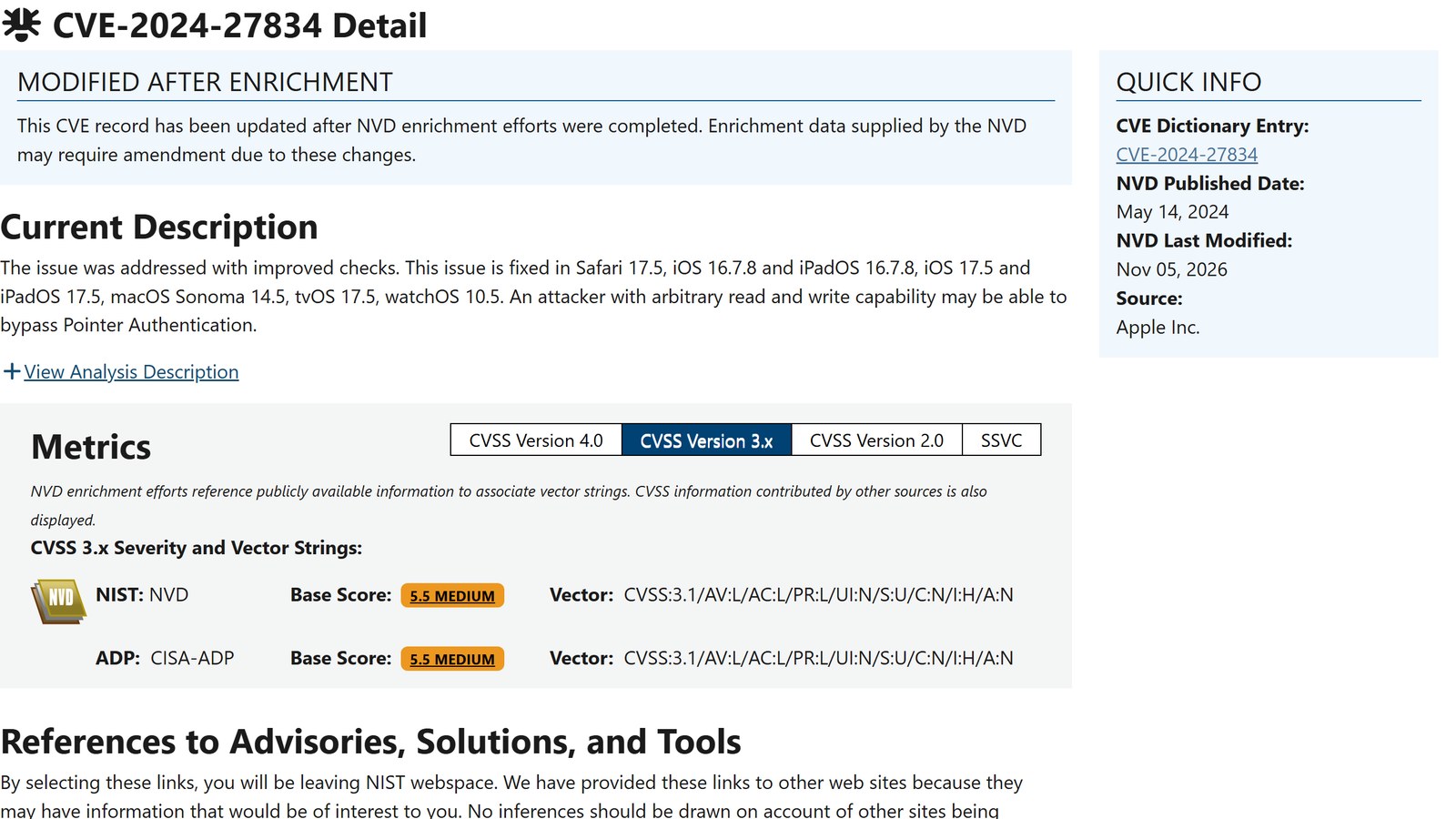
Prettier is in CISA's Known Exploited Vulnerabilities catalogue.
Prettier formats code. It puts the semicolons in the right places. It is in the catalogue of vulnerabilities that the United States government says are being exploited in the wild, as CVE-2025-54313, added on 22 January 2026.
So is Trivy, which is a vulnerability scanner. The tool you run to find out whether you have exploited vulnerabilities is itself a catalogued exploited vulnerability, as CVE-2026-33634, added 26 March.
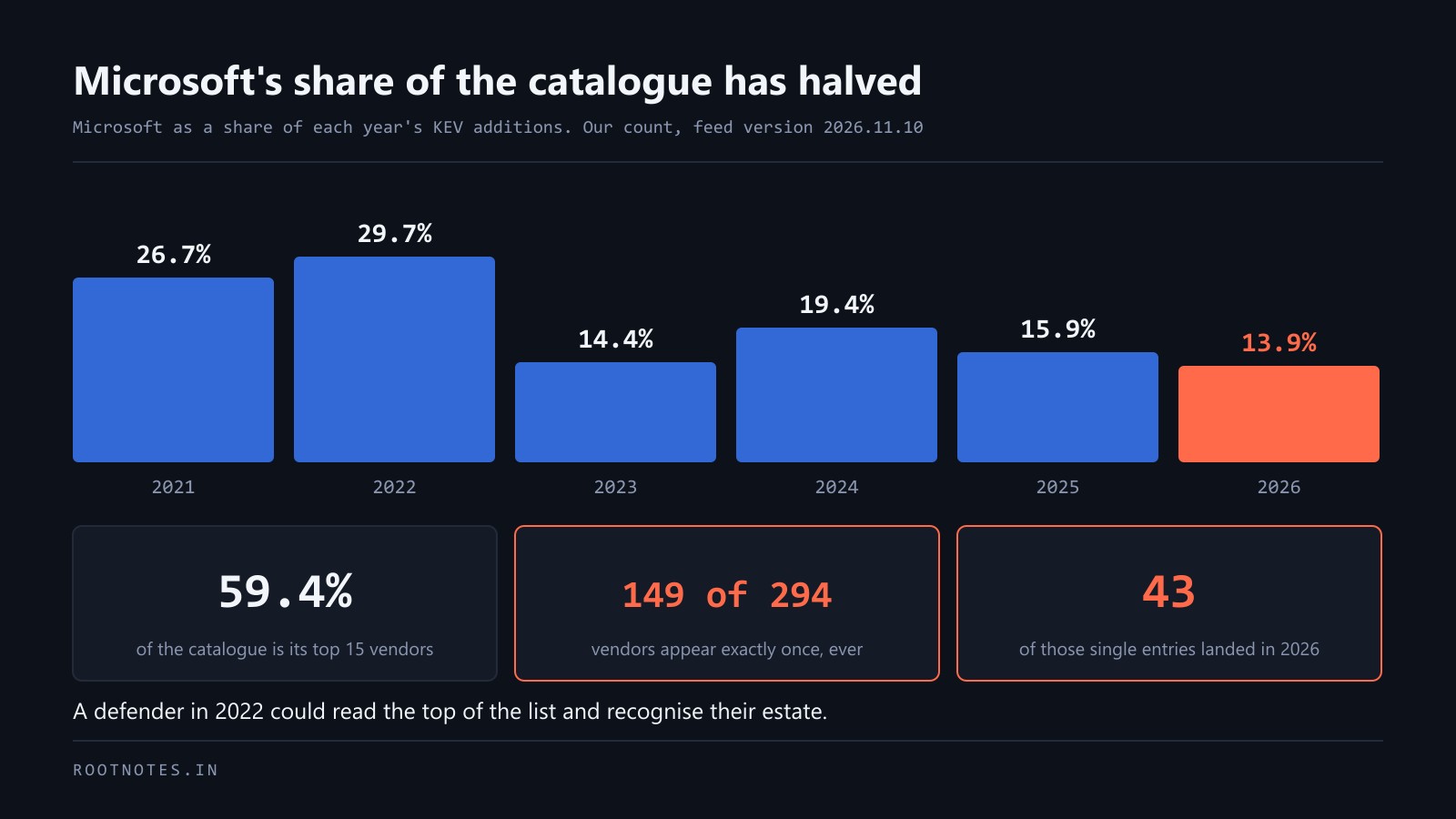
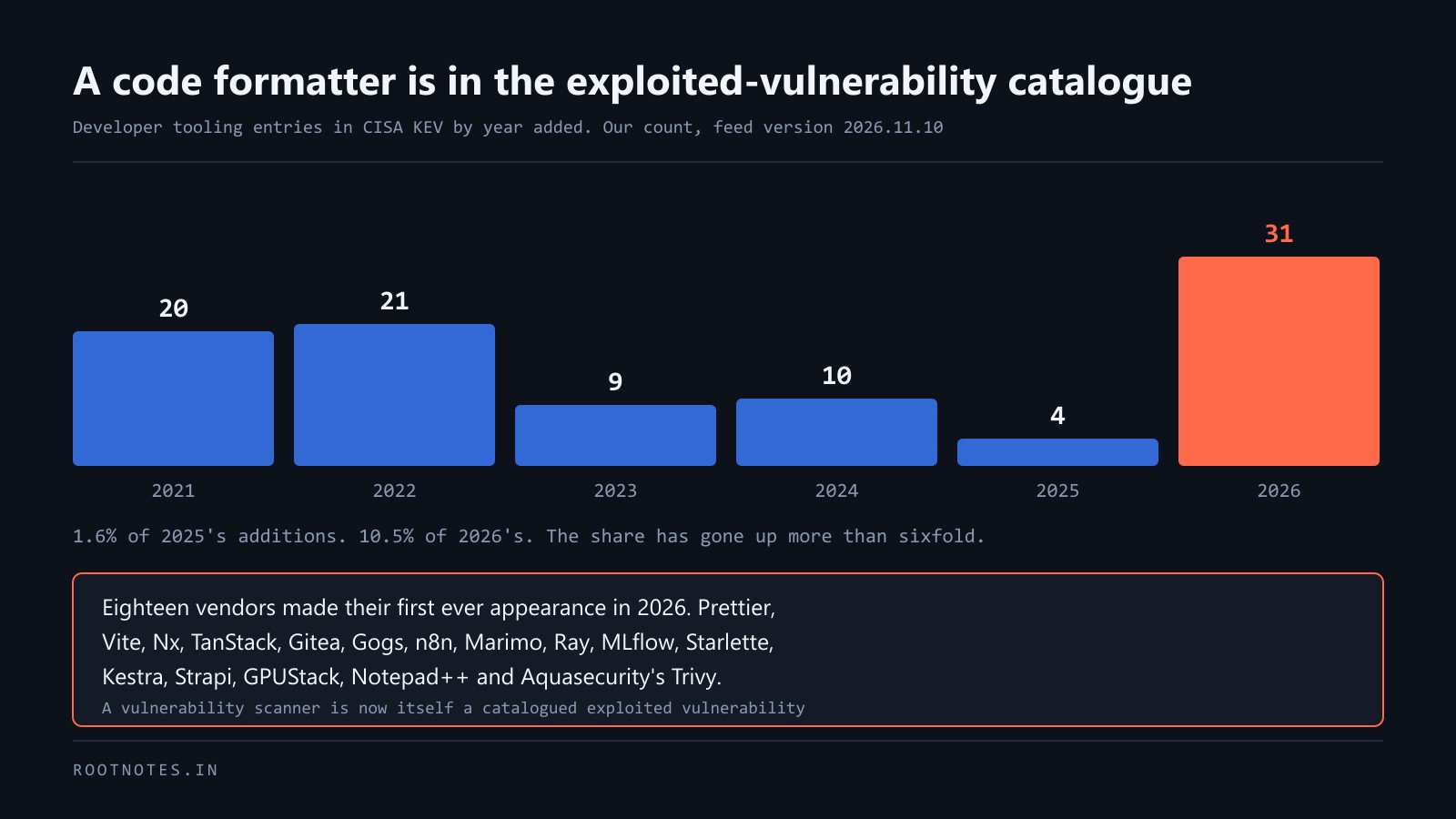
We downloaded the KEV feed, version 2026.11.10, 1,779 entries, and counted every entry belonging to developer tooling, build systems, CI platforms and development infrastructure. Here is what the count looks like by year of addition.
- 2021: 20
- 2022: 21
- 2023: 9
- 2024: 10
- 2025: 4
- 2026: 31
Thirty-one is the highest on record and nearly eight times 2025's four. As a share of each year's total additions it is starker still: 4 of 245 in 2025 is 1.6 per cent. 31 of 295 in 2026 is 10.5 per cent. The share has risen more than sixfold in one year.
Eighteen vendors who had never been there before
Every one of these made its first appearance in the catalogue in 2026, and every one is something a developer installs rather than something a company deploys at its edge:
Gogs. Vite. Prettier. React Native Community CLI. Notepad++. n8n. Trivy. Marimo. Nx Console. TanStack. Ray. MLflow. Gitea. Ajax.NET Professional. Starlette. Kestra. Strapi. GPUStack.
Read that list as a description of a working day. It is a formatter, a bundler, a notebook, a git server, a workflow engine, a scanner, an ML experiment tracker and a web framework's plumbing. None of them is an internet-facing enterprise service. All of them run either on a developer's own machine or inside a pipeline with credentials attached to it.
Why this is a different kind of entry
For most of the catalogue's life it described the perimeter. Fortinet, Ivanti, Citrix, SonicWall, Microsoft Exchange, Apache HTTP Server. Things with a public IP address and a login page, where the attacker is outside and wants in.
A formatter has no login page. Nobody attacks Prettier across the internet. What makes it worth exploiting is what it is standing next to: a checkout of source code, a package registry token, a CI runner with deployment rights, an engineer's SSH agent and whatever else is sitting in that environment.
That changes the entire shape of the defence. Perimeter flaws are found by scanning your own address space, which is a solved problem with a mature tooling market. Toolchain flaws are found by knowing what is in your lockfiles and what your pipeline installs at build time, which almost nobody has a complete answer to, because the dependency tree of a modern build is thousands of packages deep and nobody reads it.
And the exploitation path is different too. A perimeter flaw is exploited against you. A toolchain flaw is exploited by something you chose to run, usually automatically, usually with less scrutiny than a browser gives a web page, often with more privilege than the application it is building.
The Trivy entry deserves its own paragraph
A vulnerability scanner sits in a specific position. It is given broad read access by design, it is run in privileged contexts by design, it reaches out to update its feeds by design, and it is trusted by definition, because its output is what the organisation uses to decide what to worry about.
An attacker who reaches the scanner is in a place with excellent visibility and excellent credentials, inside a process whose network activity and filesystem access nobody will look twice at.
This is the same structural argument we made about internal AI tooling and about remote management panels. The pattern repeats because the property is the same: anything that is useful because it can reach everywhere is dangerous for exactly that reason.
What to do about it, concretely
- Know what your pipeline installs. Not your direct dependencies, which you know. The transitive ones, the globally installed CLI tools, the actions and the containers your CI pulls on every run.
- Pin and verify. A build that resolves a version range at build time is a build whose contents you cannot describe after the fact.
- Scope the pipeline's credentials the way you would scope a service account that you expected to be stolen, because the honest assumption now is that it might be.
- Stop treating the KEV catalogue as a list about edge equipment. One entry in ten this year was not.
What is not established
- Our vendor classification is a judgement call. We counted Apache, GitLab, Jenkins, Atlassian and JetBrains as development platforms. Someone drawing the line differently would get a different number. Note that this choice inflates the earlier years, which makes the 2026 rise we are describing more conservative, not less.
- Whether the rise reflects more exploitation or more attention. CISA adding an entry means CISA received evidence, and a change in what CISA looks at would produce the same curve.
- The exploitation details of any individual entry here. We are reporting that these flaws are in the catalogue and what that collectively means, not how each one is being used.
- Whether 2026 is a step change or a spike. One year is one year. The 2021 and 2022 figures were also high, for a quite different reason: those were the catalogue's founding years, when a large back-file was loaded at once.