Google Threat Intelligence has published its vulnerability trends report for the AI era. In it, the group says it tracked 2,076 cumulative AI-related CVEs, with more than 1,500 of them arriving between January and August 2026, and that only a handful have been confirmed exploited in the wild.
A handful is not a number. So we counted it.
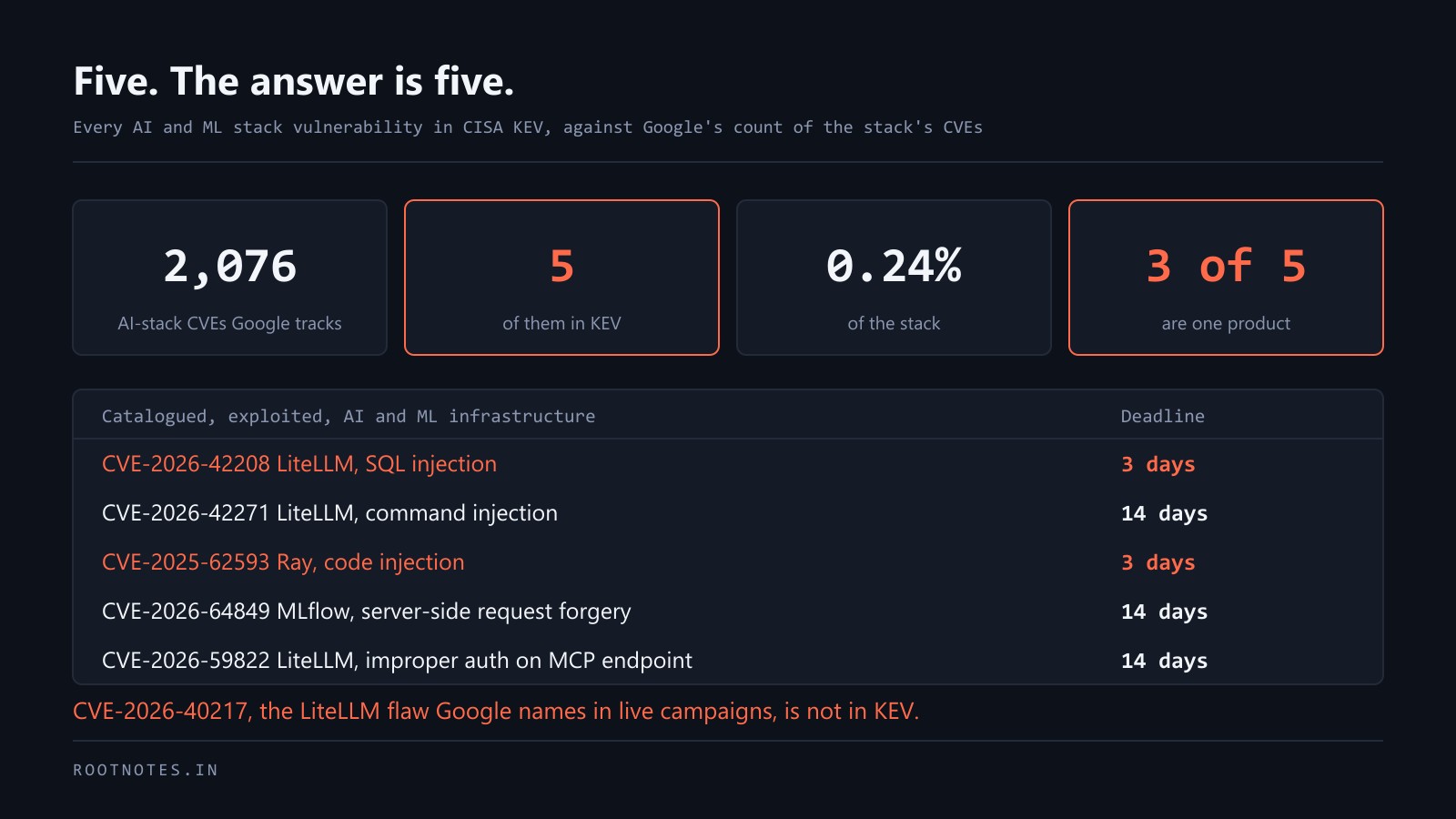
We took the CISA Known Exploited Vulnerabilities feed, version 2026.11.10, 1,779 entries, and pulled out every entry belonging to AI or machine-learning infrastructure. There are five.
- CVE-2026-42208, BerriAI LiteLLM, SQL injection. Added 8 May 2026. Three-day deadline.
- CVE-2026-42271, BerriAI LiteLLM, command injection. Added 8 June 2026. Fourteen days.
- CVE-2025-62593, Ray, code injection. Added 17 August 2026. Three-day deadline.
- CVE-2026-64849, MLflow, server-side request forgery. Added 19 August 2026. Fourteen days.
- CVE-2026-59822, BerriAI LiteLLM, improper authentication on the MCP streamable HTTP endpoint. Added 2 September 2026. Fourteen days.
Five of 2,076 is 0.24 per cent. Roughly one in four hundred.
And three of the five are the same product. LiteLLM alone is 60 per cent of the entire exploited AI stack as the catalogue records it.
The finding
Google's other report, on LLMjacking, names a specific flaw as a vector in campaigns it responded to: CVE-2026-40217, in LiteLLM's key-regeneration endpoint, which allows an ordinary virtual key to be elevated to proxy administrator.
CVE-2026-40217 is not in the KEV catalogue.
Three older LiteLLM flaws are. The one that Google says is being used in live incidents right now is not. A defender using KEV as their trigger for emergency patching has no signal on it.
We are not saying this is a scandal. There is a process, evidence has to meet a bar, and a vendor's incident response write-up is not the same thing as the evidence CISA requires. But it is a clean illustration of a gap that people do not account for: the catalogue is a lagging record, and the lag is exactly where you are exposed.
The deadlines make no visible sense
Two of the five got three days. Three got fourteen.
Look at which. The Ray entry got three days, and CISA's own description of it says "developers using Ray as a development tool may be exposed to this vulnerability". A development tool got a 72-hour federal remediation clock. Meanwhile an improper-authentication flaw on LiteLLM's MCP endpoint, which is a network-facing gateway holding model credentials, got fourteen.
We have now looked at the three-day deadline three times from three directions and we still cannot find the rule. Every one of the 151 three-day deadlines in the catalogue was issued in 2026. They are being applied to products with wildly different exposure profiles, and nothing in the published record explains the selection.
What one product being 60 per cent actually tells you
The temptation is to read it as "LiteLLM is badly written". That is probably unfair and definitely not supported by this data.
A more careful reading: LiteLLM is a proxy that sits in front of model providers and holds the keys. That is the single most valuable position in an AI deployment. It is also one of a small number of products that occupy it, so attention concentrates there the way attention once concentrated on a handful of VPN appliances.
Researchers look where the keys are. Attackers look where the keys are. And the three flaws in the catalogue are a SQL injection, a command injection and an authentication bypass, which is the signature of a project that grew very fast around a feature set rather than a threat model. That is not a moral failing. It is what every successful piece of infrastructure software looks like in its first two years, and the ones that survive spend the next three years fixing it.
The two numbers, held together
2,076 known vulnerabilities in the AI stack. Five that anyone can point to being exploited.
Most writing on this topic picks one of those numbers. Pick the first and you get an alarming piece about a catastrophically insecure ecosystem. Pick the second and you get a reassuring piece about how the panic is overblown.
Both are true and the gap between them is the actual story. Two thousand flaws with no evidence of exploitation means the ecosystem is being audited faster than it is being attacked, which is the correct order and a genuinely good sign. Five exploited flaws concentrated in gateways and orchestration means that when attackers do come, they come for the credential layer, not the models.
What is not established
- Our classification of what counts as the AI stack. We counted LiteLLM, Ray, MLflow and nothing else. GPUStack, added 9 November as CVE-2026-102895, is arguably a sixth and is a genuinely marginal call; including it would make the figure six and the LiteLLM share 50 per cent.
- Google's 2,076 is Google's count on Google's definition, which we cannot reproduce and which almost certainly differs from ours.
- Whether CVE-2026-40217 is under consideration for the catalogue. We have no visibility into that.
- What the exploitation of any of the five actually achieves in practice. The catalogue records that exploitation occurred, not what it did.