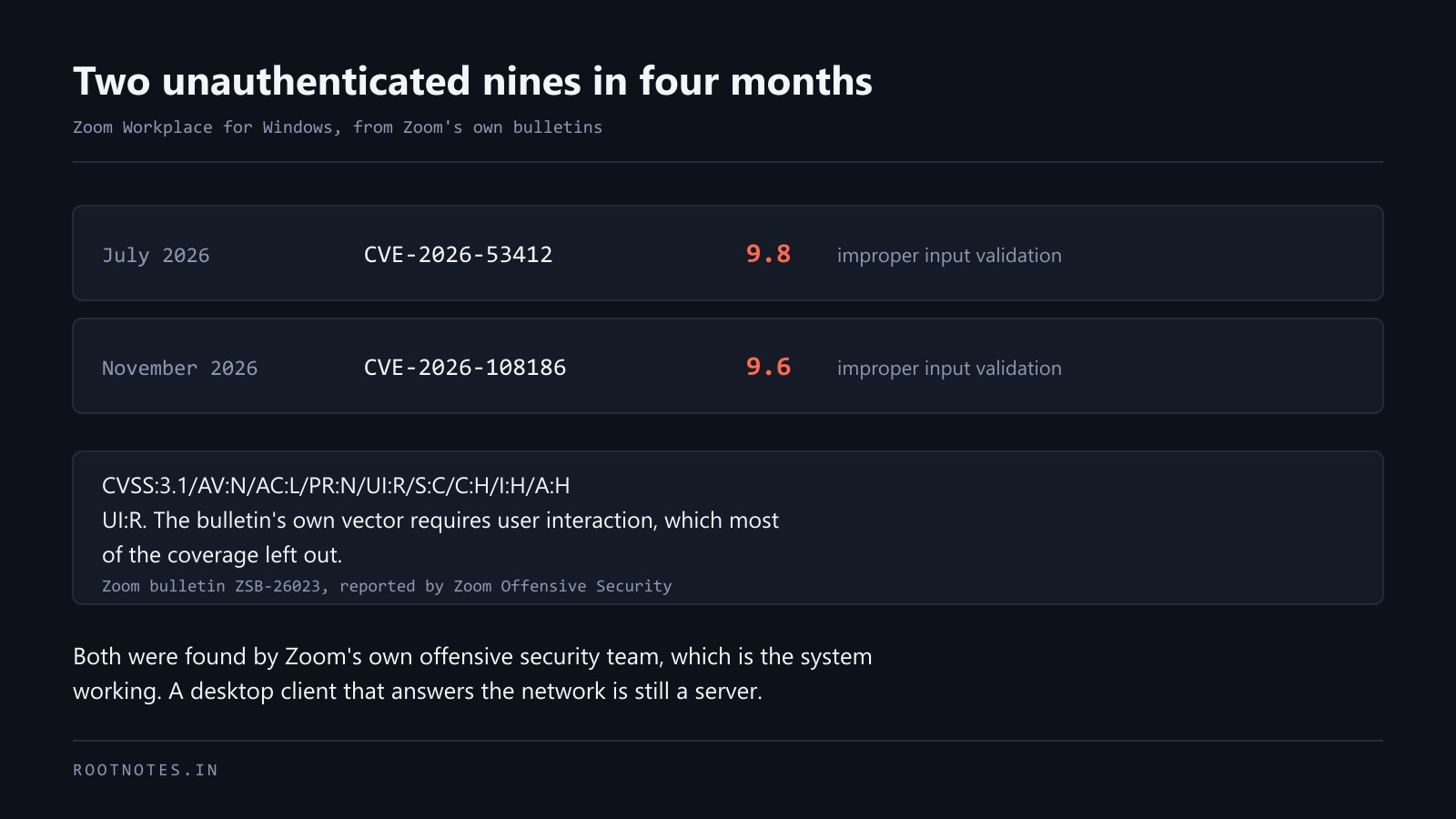
CVE-2026-108186 is rated Critical by Zoom, CVSS 9.6. From bulletin ZSB-26023: "Improper Input Validation in Zoom Workplace for Windows may allow an unauthenticated user to conduct an escalation of privilege via network access."
Affected: Zoom Workplace for Windows from 7.1.0 and before 7.1.8. Reported by Zoom Offensive Security, which is to say Zoom found it itself. Zoom says there is no evidence of exploitation.
Alongside it, CVE-2026-108187, CVSS 8.1, an origin validation flaw permitting the same outcome.
One thing the coverage left out
The full vector on Zoom's bulletin is:
CVSS:3.1/AV:N/AC:L/PR:N/UI:R/S:C/C:H/I:H/A:H
UI:R. User interaction is required.
Almost every account of this describes it as unauthenticated remote privilege escalation and stops there, which is accurate and incomplete. An attacker needs no credentials, and needs the user to do something. That is a materially different exposure from a flaw that fires at a listening socket with nobody present, and it is the difference between patching this tonight and patching it this week.
The S:C is the other half: scope changed, which is why a privilege escalation scores 9.6 rather than something lower. Whatever the attacker reaches is not confined to the thing they started in.
In July, the same weakness in the same product
CVE-2026-53412, CVSS 9.8, improper input validation in Zoom Workplace for Windows, allowing an unauthenticated attacker to take control of accounts.
Two unauthenticated nine-point-something flaws, same weakness class, same product, four months apart.
The reading that is probably correct, and that we should say plainly: this is Zoom's own offensive security team working through a surface and finding things. A company that discovers its own 9.6, writes a bulletin and ships a fix before anybody exploits it is doing the job properly. Products whose vendors never find anything are not safer products; they are products with nobody looking.
What is worth noticing is the surface rather than the cadence. A desktop client that accepts and parses input arriving from the network, without authentication, is a server. It is installed on most corporate laptops in the world, it is not in anybody's asset inventory as an exposed service, and it is patched on whatever cadence the user tolerates.
What to do
Get to 7.1.8 or later. On managed fleets, check whether Zoom updates are centrally controlled or left to users, because this is one of the applications most often left to users.
What is not established
- The affected range for CVE-2026-108187. Published accounts conflict, and we only read the bulletin for 108186.
- Whether the two November flaws are related to each other, or to the July one.
- What the user interaction actually is. The bulletin says UI:R and does not describe it.
- Whether Zoom has commented on the pattern.


