Git 2.56.1 shipped on 10 November carrying six security identifiers. The one that matters is CVE-2026-111760, and Git's own release notes describe it in two sentences:
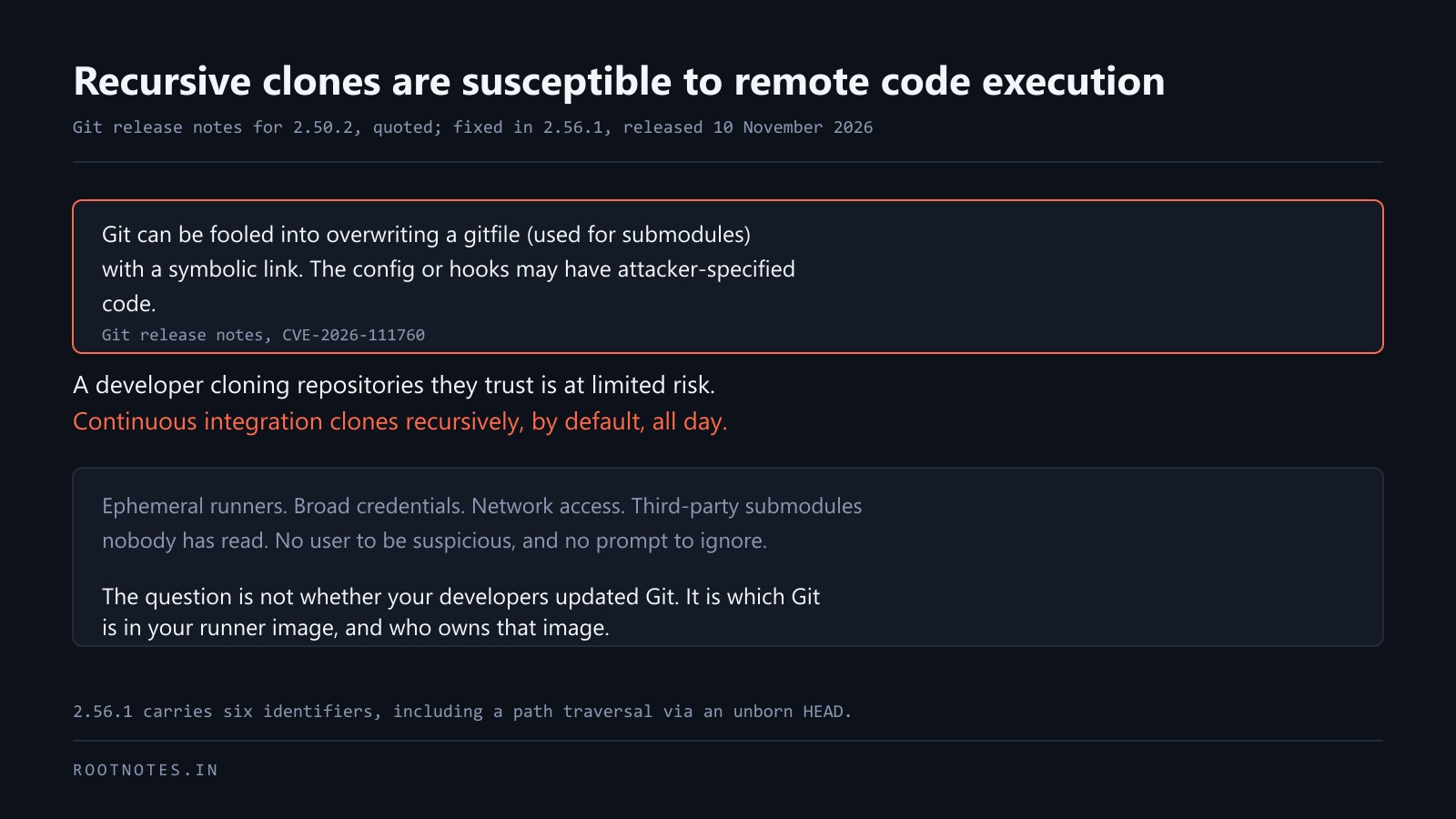
"Recursive clones are susceptible to Remote Code Execution." And: "Git can be fooled into overwriting a gitfile (used for submodules) with a symbolic link. The config or hooks may have attacker-specified code."
So: a crafted repository arranges for the file that tells Git where a submodule's real git directory lives to be replaced by a symlink pointing at a directory the attacker controls. Git then reads configuration and runs hooks from there during submodule setup. Hooks are shell scripts that Git executes by design. Nothing is being exploited in the memory-corruption sense; Git is being pointed at the wrong directory and doing its job.
A second flaw in the same release, CVE-2026-113408, is a path traversal: "it is possible for a server to advertise an unborn HEAD that contains path-traversal characters", such as a ref name with dot-dot segments in it, which with the files ref backend can cause ref-updating actions to write to files the user did not intend to change.
A correction while we are here. Several accounts of CVE-2026-111760 describe it as an integer truncation in how Git handles its index. That description is not in Git's release notes, and we are not repeating it.
Who is actually exposed
A developer cloning repositories they already trust is at limited risk. You would have to clone something hostile, recursively, for this to reach you.
Continuous integration does exactly that, by default, continuously.
GitHub Actions, GitLab CI and Bitbucket Pipelines perform recursive clones as routine. They do it on ephemeral runners, which means nothing persists to be noticed afterwards. They do it with broad credentials, because the pipeline needs to deploy. They do it with network access. And in a great many pipelines they do it against repositories that pull in third-party submodules nobody on the team has ever read.
There is no user in that loop. Nobody is suspicious, nobody is prompted, and the runner does exactly what it was built to do: fetch everything and run what it finds.
So the population at risk is not people, it is pipelines, and the credentials in scope are usually the ones that reach production.
The question to actually ask
It is not whether your developers have updated Git. Most of them will, eventually, through a package manager.
It is: which version of Git is in your runner image, and who owns that image?
For hosted runners the answer is the provider's, and the fix arrives when they rebuild. For self-hosted runners and custom container images, which is most regulated environments, the answer is you, and nothing will prompt you. A runner image built in August is running August's Git until somebody rebuilds it.
If you maintain those images, this is a good week to check, and a better week to find out how long it takes you to ship a change to them, because that number is your exposure window for everything of this kind.
What is not established
- Whether this has been exploited. No reports have appeared.
- Which runner images currently carry a fixed Git. Nobody appears to have surveyed it.
- The details of the remaining four identifiers in 2.56.1. Git's notes list them and point to the point-release notes for each.
- Who reported either flaw. The release notes we read do not credit anyone.