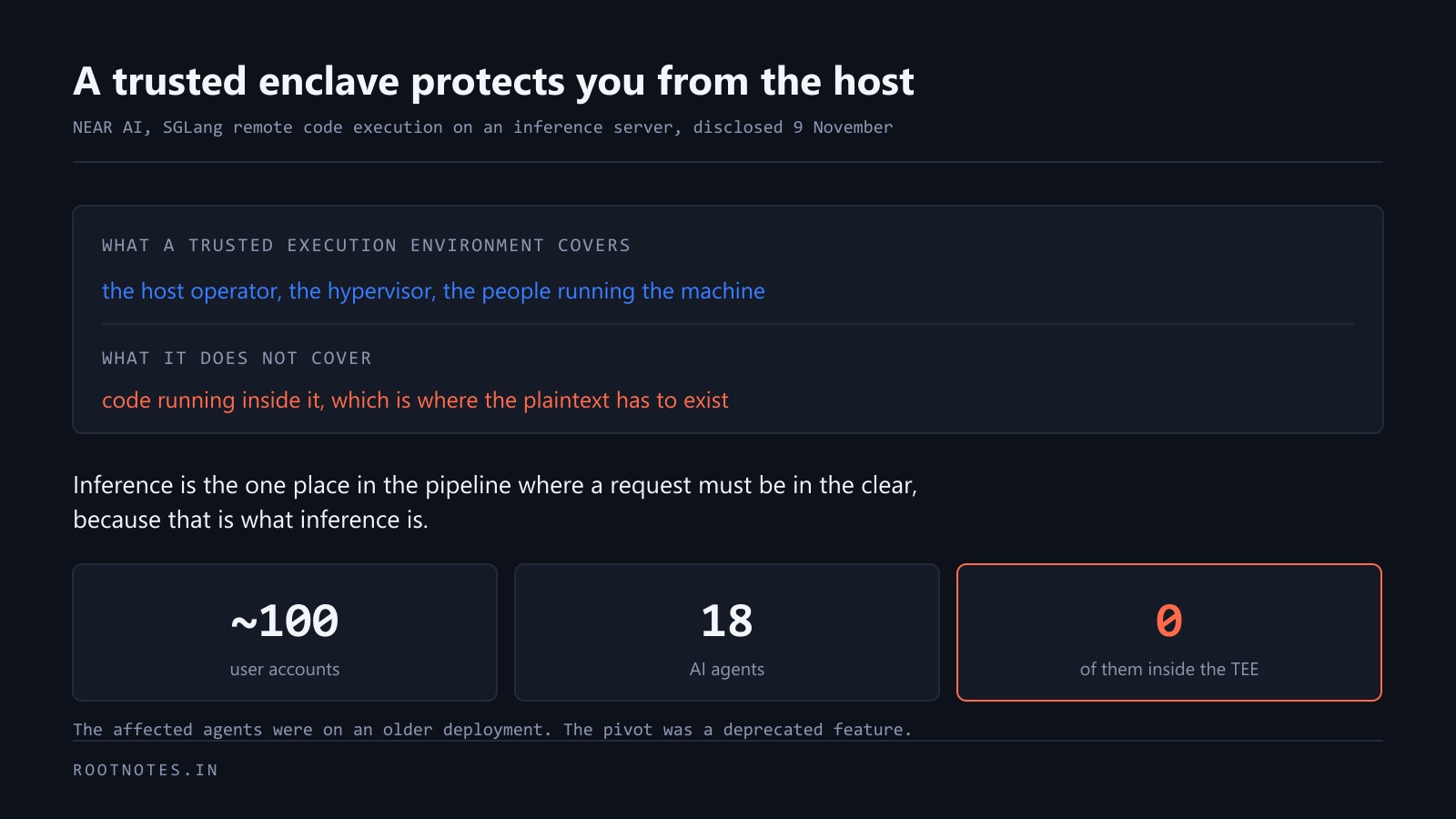
NEAR AI disclosed on 9 November that an intruder used a remote code execution flaw in SGLang to run code on one of its inference servers. From there, the attacker could observe requests in flight on that server, including requests made in confidential mode.
Reported scope: account information for about 100 users and data from 18 AI agents. Those agents were on an older deployment that did not run inside the company's trusted execution environment, and the pivot is reported to have gone through a deprecated Private Chat feature. Two customers' API keys were exposed in logs and have been revoked.
NEAR AI has fixed the flaw across its inference servers, rotated credentials, completed a forensic review and restored access.
This is the limit, not a failure
It is worth being precise here, because the obvious framing is that confidential computing was oversold, and that is not quite right.
A trusted execution environment protects the workload from the host. From the hypervisor, from the operator, from the people with physical access to the machine and root on it. That is a genuinely hard problem and TEEs solve it well. It is the reason anybody can run sensitive inference on hardware they do not own.
It does not protect the workload from code running inside the enclave. It was never claimed to.
And inference is the one stage of the pipeline where the plaintext of a request has to exist, because turning a request into tokens and tokens into an answer is the thing being done. You can encrypt a prompt at rest, encrypt it in transit, and attest the machine that will handle it, and at the moment of inference it is in memory, in the clear, inside the enclave, because there is nowhere else for it to be.
So an attacker who achieves code execution on the inference server has reached the one location where confidentiality cannot be arithmetic. "Confidential mode" was accurate about the threat it was built for and silent about this one.
That is not a reason to avoid confidential inference, which remains much better than not having it. It is a reason to know what you bought. Most people buying it believe it means nobody can see their prompts. What it means is that the operator cannot see their prompts, assuming nobody gets code execution inside.
The part that is an ordinary lesson
The affected agents were on an older deployment outside the TEE, and the way in ran through a deprecated feature.
The protection existed. The things that were hit were the ones that had not been moved under it, and the entrance was something that was still running because nobody had turned it off.
That has nothing to do with AI. It is the oldest shape in this business: new control, incomplete migration, old thing still listening.
What is not established
- NEAR AI's disclosure itself, which we did not retrieve. The details here come through reporting of it.
- The CVE or the SGLang version. NEAR AI has named neither, which means nobody else running SGLang can tell whether they are exposed.
- The detection date and the dwell time, both undisclosed.
- Whether stored conversations or uploaded files were accessed. NEAR AI says it found no sign of it.
- How the attacker reached the inference server in the first place.
- Whether the confidential-mode requests the attacker could observe were actually captured, as against merely observable.