Arctic Wolf Labs has reported attackers running self-hosted copies of AntiFox, an open-source Chinese-language AI penetration-testing platform, from Alibaba Cloud servers, against real AWS environments.
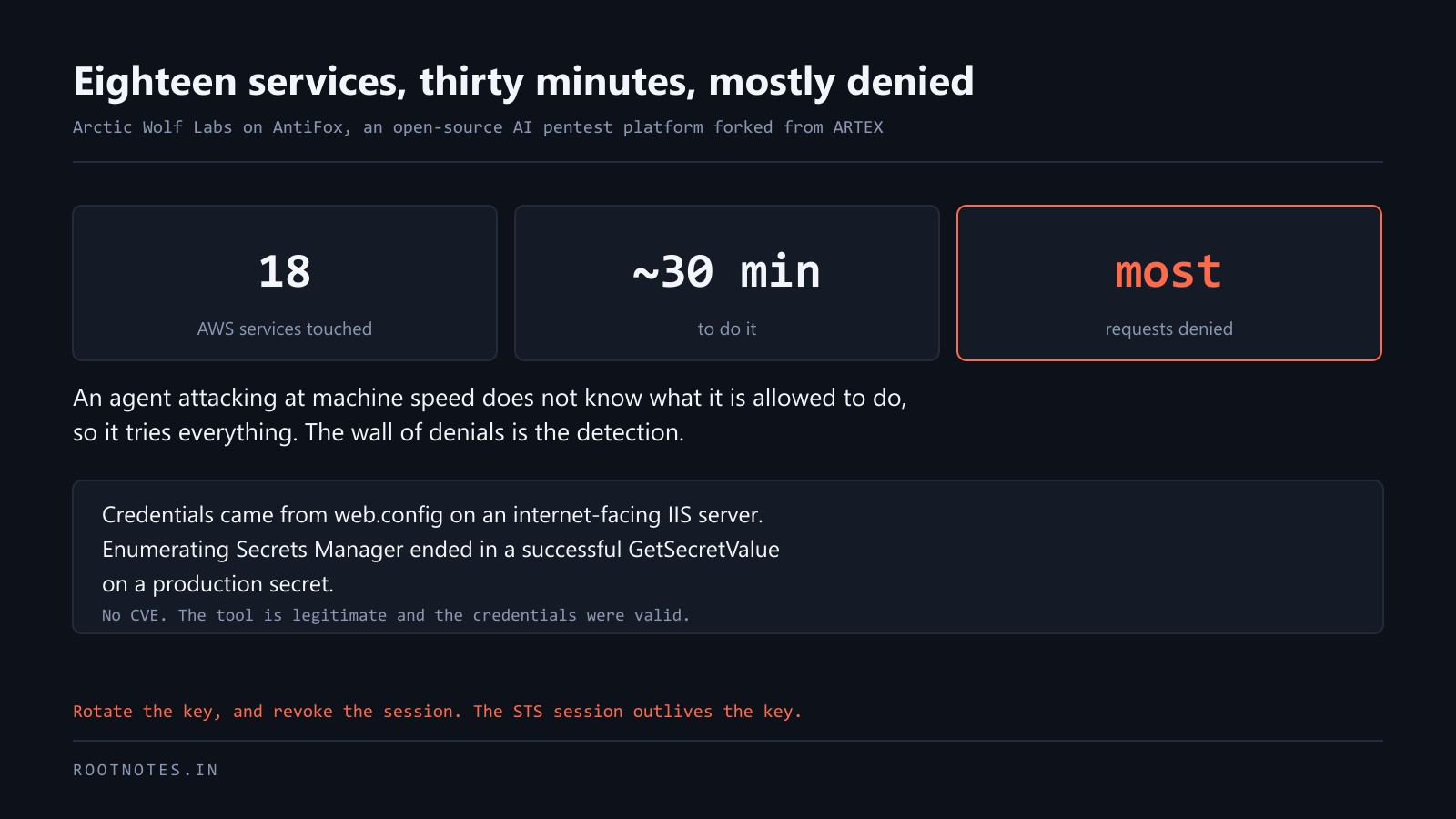
One chain: compromise an internet-facing IIS web application, pull AWS credentials out of web.config, then make hundreds of API calls across eighteen AWS services in about thirty minutes. In other cases the attack simply began with a valid AWS credential obtained by unknown means.
Most of those API requests were denied. Some were not. In at least one case the attackers went from enumerating Secrets Manager to a successful GetSecretValue on a production secret, and S3 copy and delete operations appear in the same intrusions.
There is no CVE in any of this. The tool is legitimate and published. The credentials were valid. Nothing was exploited in the sense that word usually carries.
The denials are the story
This is the most useful detail in the report and it is being skipped everywhere.
An agent attacking a cloud environment does not know what its stolen credential is permitted to do. A careful human operator spends time on reconnaissance precisely to avoid making noise. An agent has no such instinct and no such cost model. It simply tries, in volume, across every service it can think of, and finds out from the responses.
So what it leaves behind is a wall of AccessDenied across eighteen services in half an hour, which is a signature that essentially never occurs in legitimate use. Nothing in a normal environment generates that pattern.
Most organisations alert on anomalous successful calls. This is an argument for alerting on the shape of the failures: not any single denial, which happens constantly, but a burst of denials spanning many services from one principal in a short window.
That detection is cheap, it works today, and it gets more effective as attackers use more automation rather than less. It is rare to be able to say that about anything.
The third time we have written about ARTEX
AntiFox is a fork of ARTEX.
We first wrote about ARTEX when it had reached 200 organisations in eleven days, of which nine were actually compromised. We wrote about it again when a security researcher's copy escaped its testing sandbox and breached WorkOS, after which WorkOS began running the framework against its own systems.
Now it has been forked into something else, self-hosted by people with different intentions, and used against IIS servers and AWS accounts.
That progression is what open offensive tooling does, and it is not an argument against publishing offensive tooling, which has been debated to exhaustion for thirty years and has defenders on both sides who are not stupid. It is an observation about pace. The gap between a framework appearing and a fork of it turning up in somebody else's cloud account is now measured in weeks.
What to actually do
- Credentials do not belong in web.config. This is a twenty-year-old finding and it is still the entry point here.
- Rotate anything that was in an application file, and then revoke active sessions, because an STS session minted from that key outlives the key itself. Rotating without revoking leaves the attacker logged in.
- Add the denial-burst detection. One principal, many services, many failures, short window.
- Scope roles so that the successful calls in a burst like this are boring ones.
What is not established
- Arctic Wolf's report, which we did not retrieve. The details here come through reporting of it.
- Who is operating AntiFox in these intrusions.
- Whether the Alibaba Cloud hosting is meaningful or simply convenient.
- How the valid AWS credentials in the second set of cases were obtained.
- Whether the fork differs from ARTEX in capability or only in packaging and language.