Binance has published how the $6.43 billion theft happened. It was not a breach. It was a campaign that ran for about four months, and it has three stages worth separating.
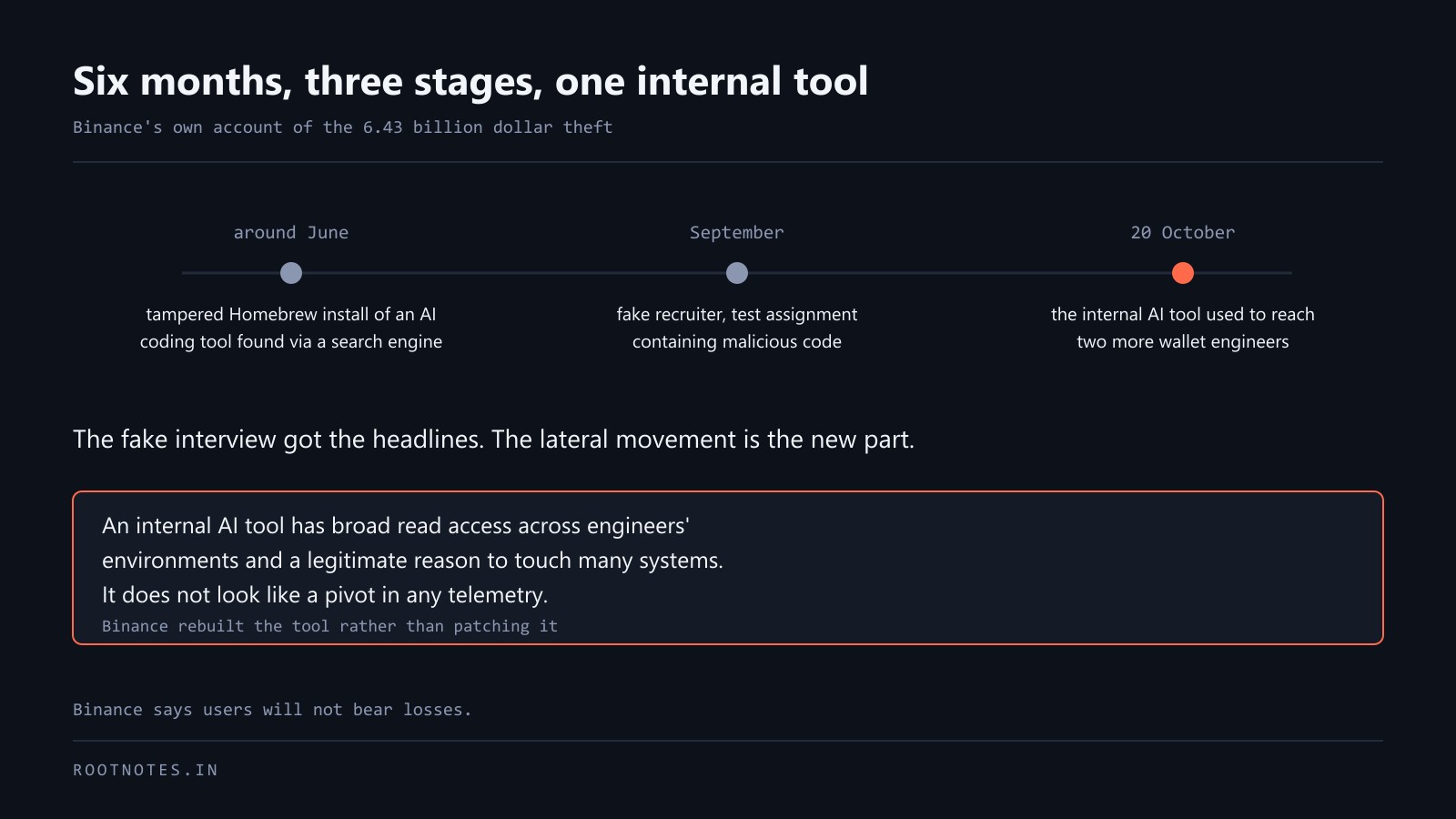
Around June. An engineer went looking for a popular AI coding tool, found it through a search engine, and installed it. The installation was a tampered Homebrew install.
September. A software engineer was approached on a job-hunting platform by somebody posing as a project director. The process ran its course and ended with a test assignment containing malicious code.
20 October. The attackers used that engineer's compromised computer and an internal AI tool to take control of the systems of two other wallet-team engineers.
Binance rebuilt the affected wallet system in a new environment and rebuilt its internal AI tool and access controls. Its co-CEO says users will not bear losses.
The headlines picked the wrong stage
Almost every account of this leads on the fake interview, and it is the least interesting part. Fake recruiters with malicious take-home assignments have been a documented technique for most of a decade. It works, it keeps working, and there is nothing new to say about it.
The new part is the third stage. The lateral movement vector was the company's own internal AI tool.
Think about what an internal AI tool is, structurally. It is a service with broad read access across engineers' environments, because that is what makes it useful. It has a legitimate reason to touch many systems, repositories and credentials. It is invoked constantly and unpredictably by many people. And it is, in most organisations, outside the mental model of what an attacker uses, so nobody has written a detection for it.
An attacker who reaches it is not pivoting through a server. They are pivoting through a thing whose normal behaviour is to reach everywhere, which means their activity is indistinguishable from the tool's baseline, because the tool has no baseline.
Binance rebuilt the tool rather than patching it. That is a strong signal about what they concluded. You patch a vulnerability. You rebuild something whose design was the problem.
And the entry deserves a second look too
A tampered Homebrew installation of an AI coding tool, found through a search engine.
That is search-result poisoning aimed squarely at developers, and the bait is the single most-installed category of software this year. Every engineering team on earth currently has people installing AI tooling they heard about an hour ago, from instructions they found by searching, frequently with a shell command pasted into a terminal with elevated rights.
The defence is unglamorous and specific: install developer tooling from the project's own documented source, not from the first search result, and treat a one-line install command the same way you would treat an executable emailed to you.
What this does not tell you
Binance has named nothing. Not the AI coding tool, not the search engine, not the internal tool, not the job platform. That is understandable while an investigation runs, and it also means nobody else can check whether they have the same exposure. A reader whose company uses the same internal tooling pattern, which is most of them, has no way to act on this beyond the general lesson.
Which is the general lesson: inventory what your internal AI tooling can reach, and ask what it would look like if somebody else were driving it.
What is not established
- Binance's primary report, which we did not retrieve. Everything here reaches us through reporting of it.
- The amount. Accounts give both $6.3 billion and $6.43 billion.
- The dates. Some reports describe the theft as 29 October while Binance describes 20 October as the compromise.
- Which tools were involved, at any stage. Binance has named none of them.
- Attribution. Some outlets attribute this to North Korean actors; that is a third-party claim and is not in Binance's account as quoted.
- How the internal AI tool was actually used, as against simply being present in the chain.