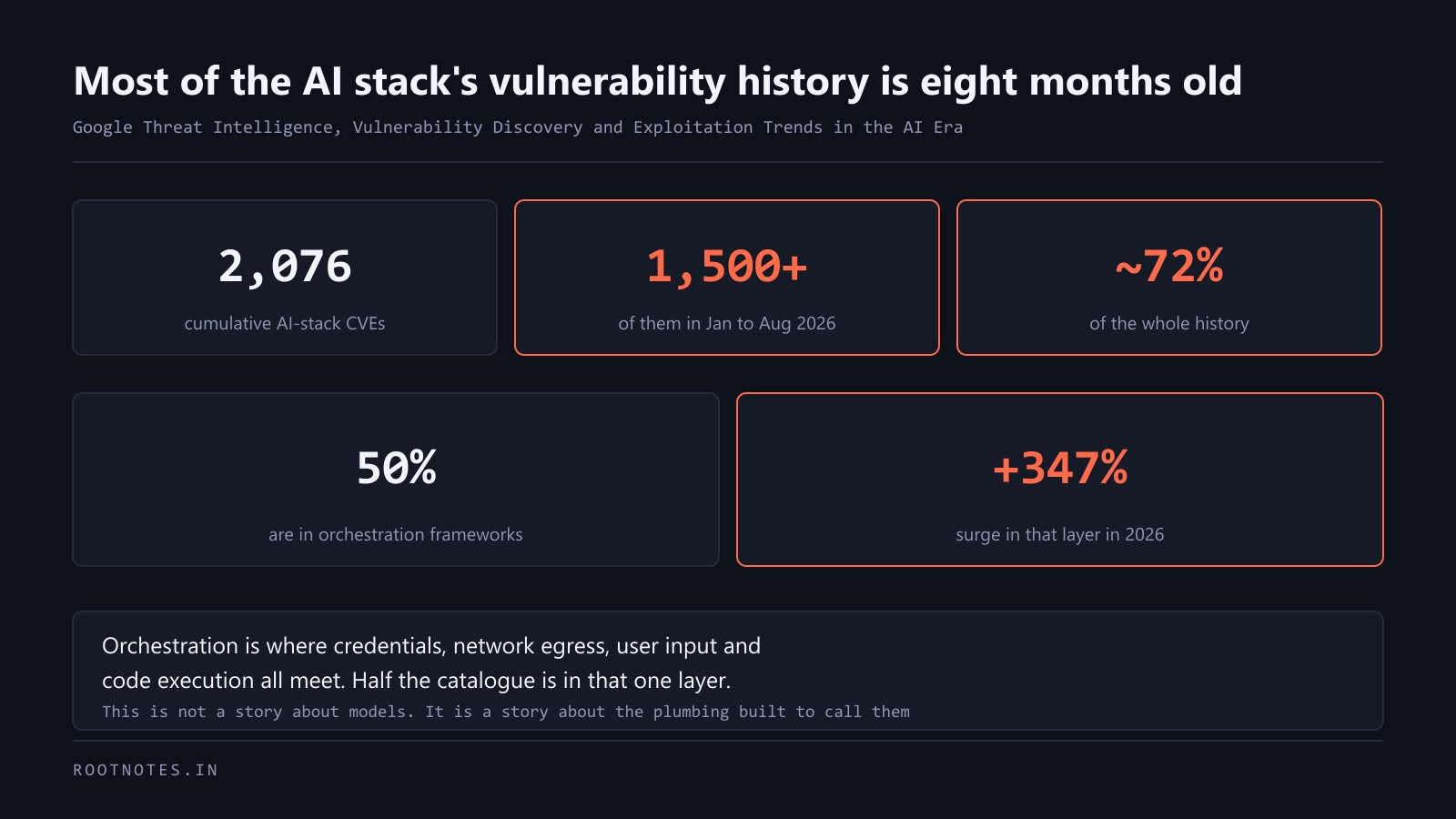
Google Threat Intelligence tracks 2,076 cumulative AI-related CVEs. More than 1,500 of them arrived between January and August 2026.
Our arithmetic on that: roughly 72 per cent of every AI-stack vulnerability ever recorded was recorded in one eight-month window.
And they are not spread evenly. Orchestration frameworks account for 50 per cent of AI-related flaws, with a 347 per cent surge in that layer during 2026.
This is not a story about models
The framing almost every discussion of AI security reaches for is about the model: can it be jailbroken, can it be poisoned, will it leak its training data, can it be made to do something it should not.
Those are real questions. They are not where the vulnerabilities are.
Half of the catalogue is in orchestration: the frameworks, proxies, gateways, agent runtimes and workflow engines written to call models, chain their outputs, give them tools and connect them to data. That is ordinary software with ordinary bugs. SQL injection. Command injection. Server-side request forgery. Authentication bypass. The same list as every other decade.
Which should be reassuring and is not, because of where that layer sits.
Why orchestration is the worst place for a bug
Think about what an orchestration framework has to have in order to do its job.
It holds credentials, because it calls paid APIs on your behalf. It makes outbound network requests, to model providers and to whatever tools it has been given. It accepts untrusted input, because the whole point is to process what users and documents say. And increasingly it executes code, because that is what an agent framework does.
Credentials, egress, untrusted input and code execution, in one process. There is no worse combination in software. Each is manageable alone and the combination means any single flaw tends to be immediately serious.
A server-side request forgery in a normal web application is a nuisance. The same flaw in a framework that holds cloud credentials and runs in a cloud environment reaches the metadata service, and the metadata service hands out credentials. That is precisely the MLflow flaw now in CISA's exploited-vulnerabilities catalogue.
Why the numbers are shaped like this
Seventy-two per cent of the history in eight months is not primarily a statement about how insecure this software is. It is a statement about when it was written and when anyone started looking.
Most of this layer did not exist three years ago. A great deal of it was written in 2025 and 2026, quickly, by small teams, against a moving specification, with adoption arriving before the second security review. That is not an accusation; it is the normal life cycle of successful infrastructure software, and the same curve exists in the early history of container runtimes, CI systems and JavaScript bundlers.
The 347 per cent surge probably reflects three things at once: more of this software existing, more people deploying it in places worth attacking, and researchers arriving in numbers because that is where the attention is. None of those is the same as the code getting worse.
Hold this next to the other number
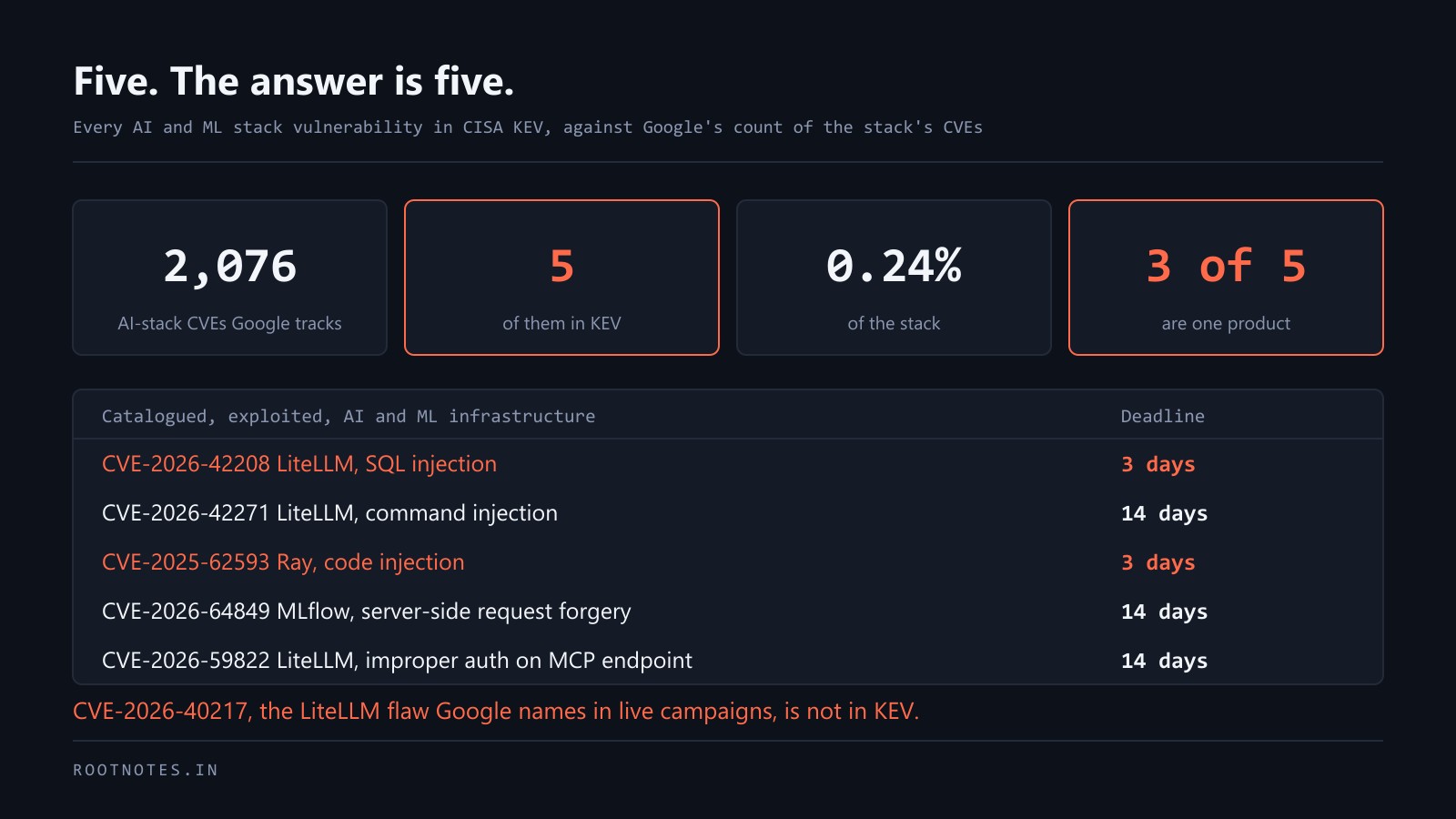
We counted the AI-stack entries in the exploited-vulnerabilities catalogue earlier this week. There are five.
Two thousand and seventy-six known flaws. Five with public evidence of exploitation.
That ratio is the single most useful thing in this data and almost nobody will quote it, because it does not support either available narrative. It means the ecosystem is currently being audited faster than it is being attacked, which is the right order for things to happen in and a genuinely good sign. And it means that when attackers do arrive, they arrive at the credential layer, because four of the five catalogued flaws are in gateways and experiment trackers that hold keys.
What to actually do
- Inventory the orchestration layer the way you would inventory internet-facing services, because functionally that is what it is.
- Assume the framework will be the thing that is vulnerable, not the model, and scope its credentials accordingly.
- Block egress to metadata services from anything running a framework that can be told where to send a request.
- Track this layer's advisories directly. Half the AI-related flaws in existence are in software most organisations do not have in a patch schedule at all.
What is not established
- Google's definition of AI-related is Google's. We cannot reproduce the 2,076 and it certainly differs from how anyone else would draw the boundary, particularly around what counts as orchestration.
- The 72 per cent is our arithmetic on Google's two published figures, 1,500 and 2,076. Google gives 1,500 as "more than", so the true share is slightly higher than 72 per cent.
- The 347 per cent surge is given without a baseline we can inspect.
- Whether the five exploited entries are the real total or the visible total. Exploitation that nobody detected is not in any catalogue, and this layer is young enough that detection coverage is thin.