For most of this year the industry has been making a claim without evidence: that models find the vulnerabilities people miss, and that the ones they find are more serious.
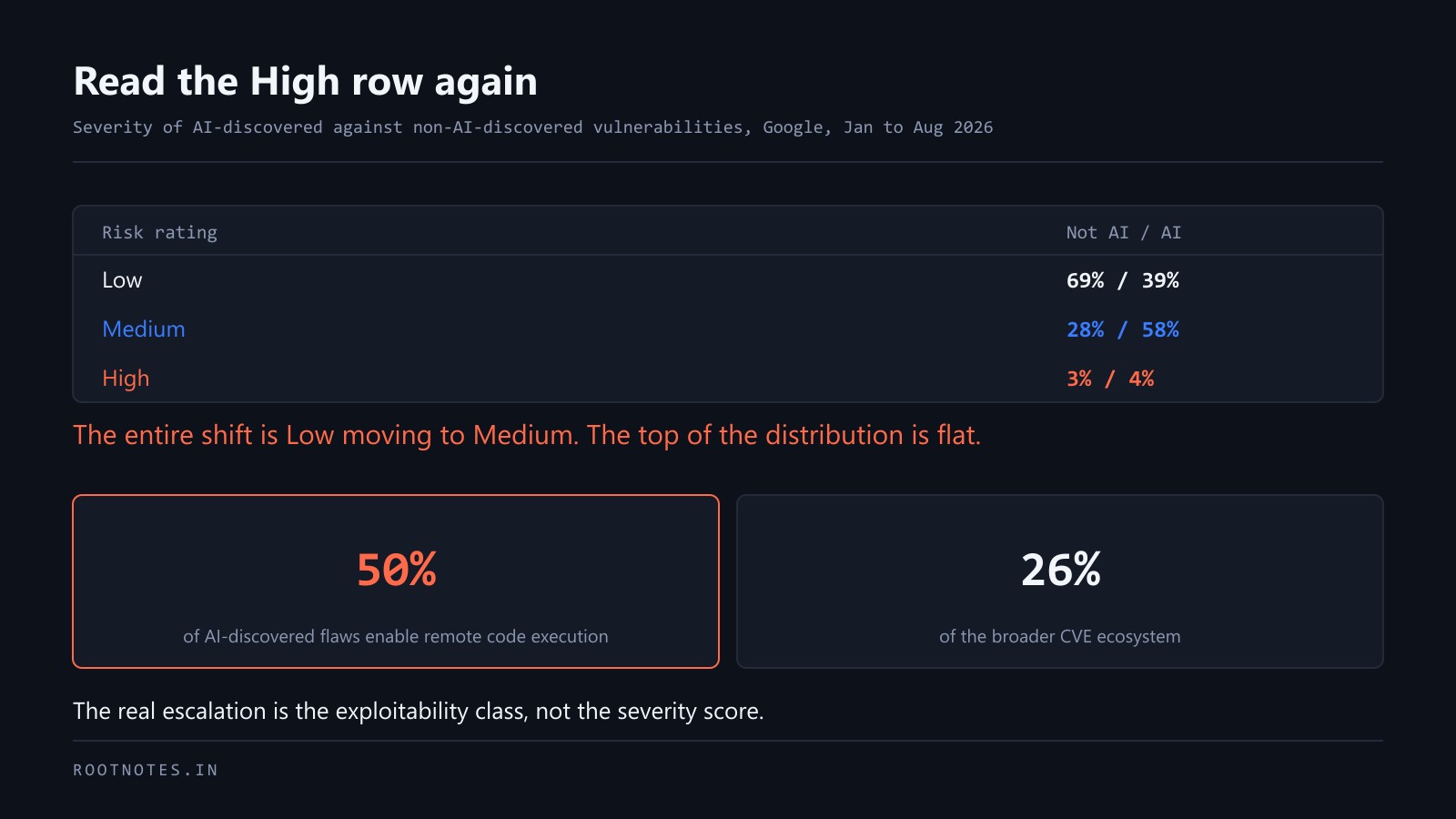
Google Threat Intelligence has now published a breakdown that lets anyone check it. Here is the severity distribution of AI-discovered vulnerabilities against everything else, January to August 2026.
- Low: 69 per cent not AI-discovered, 39 per cent AI-discovered.
- Medium: 28 per cent not AI-discovered, 58 per cent AI-discovered.
- High: 3 per cent not AI-discovered, 4 per cent AI-discovered.
Read the High row again. Three per cent against four per cent.
The headline everyone will write from this table is that AI finds more serious bugs. The table does not say that. The top of the severity distribution has barely moved.
What actually changed
The entire shift is Low moving to Medium. AI-discovered findings are less trivial, not more critical.
That is a real and meaningful difference, and it is worth being precise about what it means. A Low-severity finding is usually something that requires conditions an attacker cannot arrange, or yields something an attacker cannot use. A Medium finding is one that is genuinely exploitable under conditions that occur. Moving thirty points of distribution from the first category to the second means the output is substantially more useful to a defender triaging a report queue.
It does not mean the critical bugs are being found faster. On this data, they are being found at almost exactly the same rate.
The number that is genuinely alarming
There is one figure in the breakdown that represents a real escalation, and it is not a severity score.
50 per cent of AI-discovered vulnerabilities enable remote code execution, against 26 per cent of the broader CVE ecosystem.
That is nearly double, and it is a statement about class rather than severity. Remote code execution is the category that converts a finding into an intrusion with the least work. A Medium-rated RCE in something internet-facing is frequently more dangerous in practice than a High-rated information disclosure, whatever the score says.
So the correct summary of this data is not "AI finds worse bugs" and it is not "AI finds nothing important". It is: AI finds a great many bugs of middling severity, disproportionately of the most directly weaponisable class, and no more critical-severity bugs than people do.
That is a more interesting finding than the headline version, and it is the one the data supports.
Why the High row probably stays flat
Worth speculating carefully, flagged as speculation.
High and critical severity ratings usually require a chain: a bug that is reachable, in a privileged context, without preconditions, in something exposed. Finding the bug is one step. Establishing that the rest of the chain holds is research work involving the whole system, not the function.
Current automated discovery is very good at the first part and much weaker at the second. It reads enormous quantities of code and recognises patterns that indicate a defect. Determining that a given defect is reachable from an unauthenticated network position in a real deployment is a different activity, and it is the activity that produces a High rating.
If that is right, the distribution we are seeing is exactly what you would expect, and it would change when tooling starts reasoning about reachability across a whole system rather than about code in isolation.
What this means for the advisories we have been covering
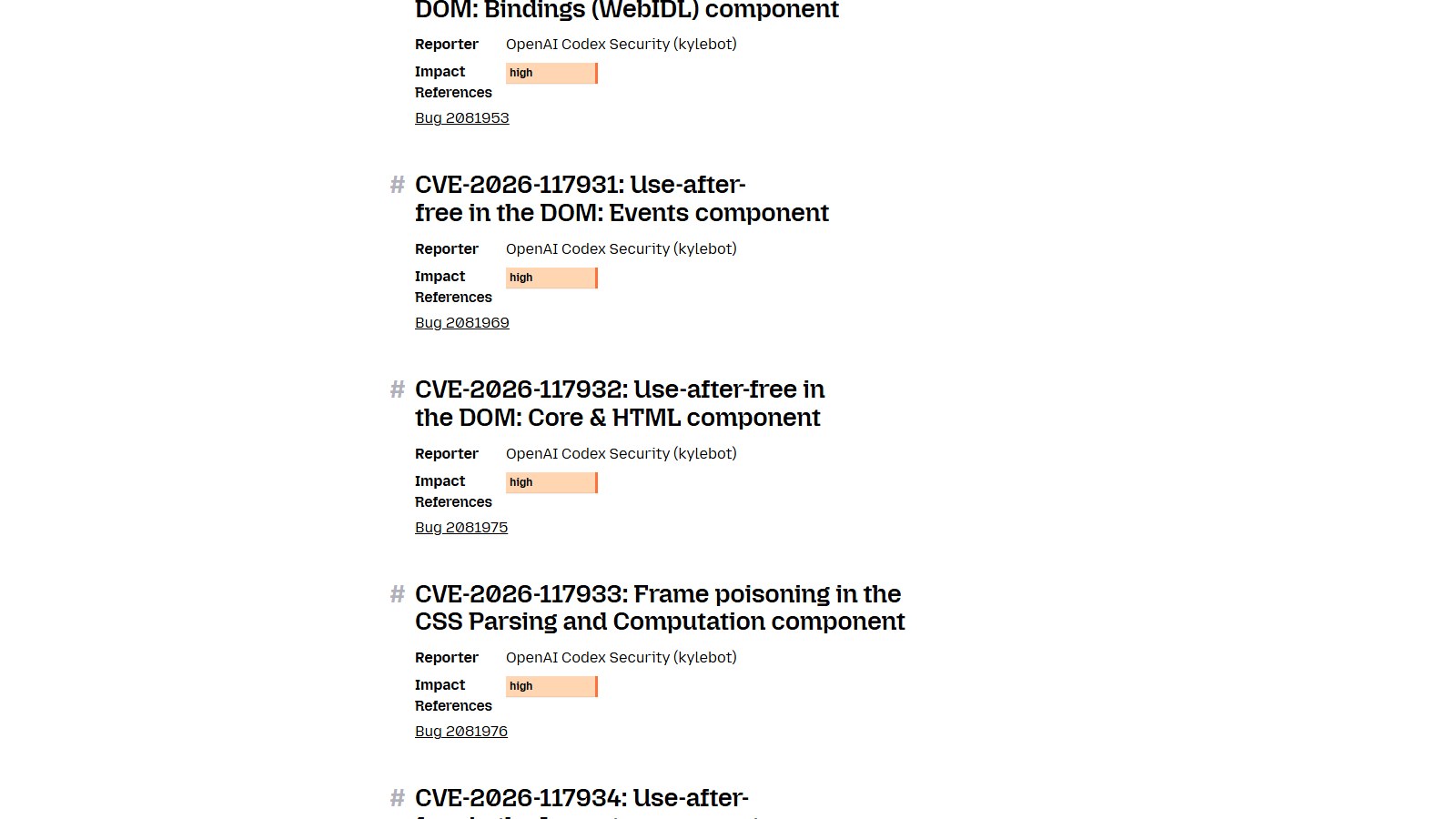
Over the past fortnight we have written about three different vendors handling AI-assisted disclosure three different ways: Mozilla's advisory, which says nothing about how the flaws were found; Microsoft's, which credits a researcher using a model by name; and Apache's, which names the scanner and gives the finding its own internal identifier.
This data says something useful about what those advisories are describing. The volume is real. The counts being quoted are not inflated. But a vendor saying "a model found forty of these" is reporting forty mostly Medium-severity findings with an unusually high proportion of code execution among them, not forty catastrophes.
That is still a substantial contribution. It is not the thing the press releases imply.
What is not established
- The sample is whatever happened to be labelled. Google says AI-attributed discoveries are likely undercounted because there is no standardised AI-attribution metadata in public CVE records. The AI-discovered set is therefore self-selected by whoever chose to disclose the method.
- The rating scale is Google's own. These are GTIG risk ratings, not CVSS scores, and the mapping between them is not published here.
- Whether the comparison set is like for like. AI-discovered findings skew toward the kinds of software that attract this research, which is not a random sample of all software.
- The percentages do not sum to 100 in the source and we have reproduced them as given.
- Whether the gap closes. This is eight months of data on a technology that changed substantially inside those eight months.