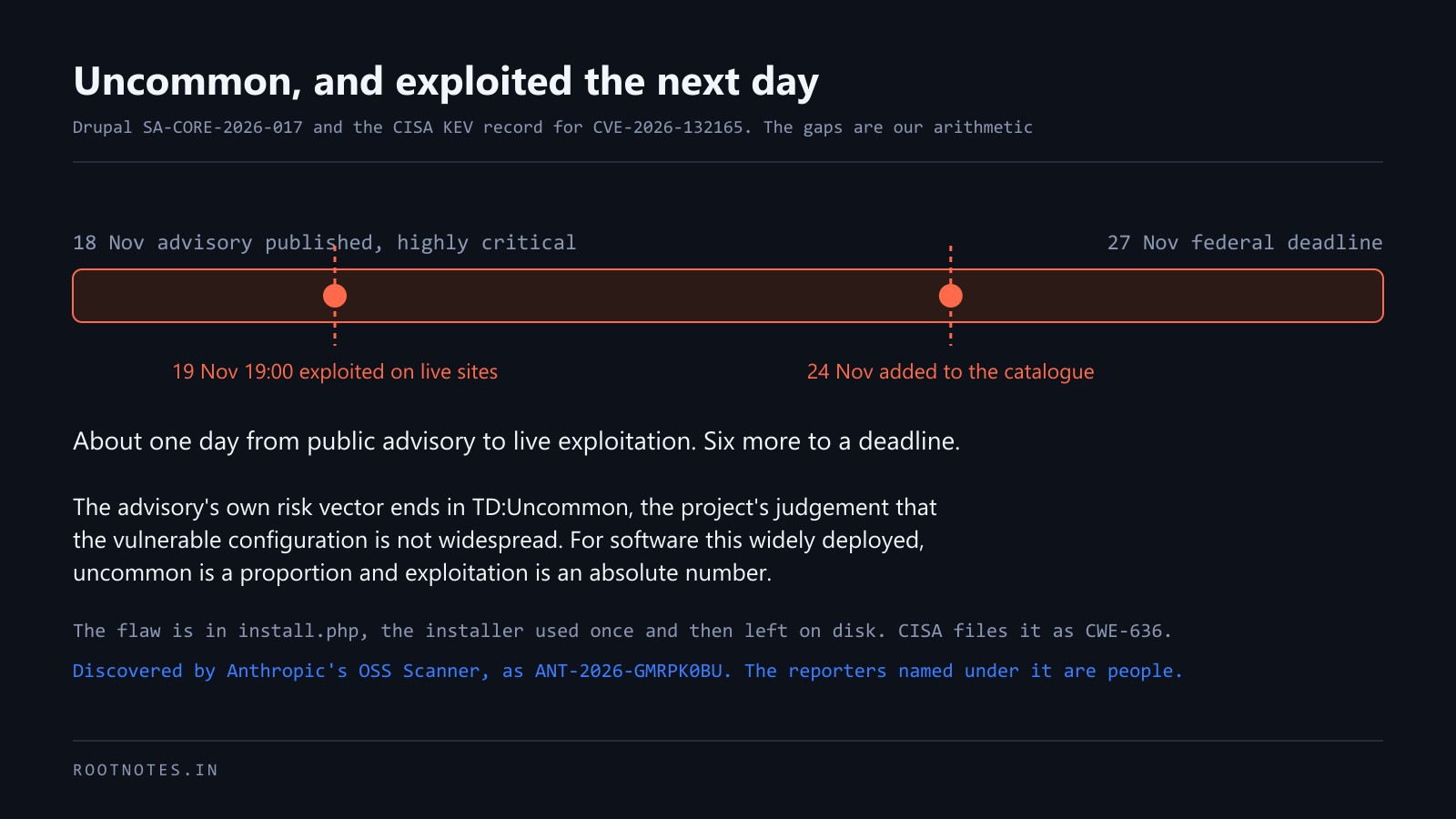
Drupal published SA-CORE-2026-017 on 18 November 2026. Highly critical, scored 20 out of 25, remote code execution in Drupal core.
The advisory's own risk vector ends with TD:Uncommon, which is the project saying that the configuration needed to exploit this is not widespread.
The advisory now carries an update at the top. The Security Team has a report that it was exploited on live sites as early as 19 November at 19:00 UTC.
That is roughly a day.
The file that only matters once
Drupal core ships with an installer, install.php, which exists to set a site up. It is used once, before the site exists, and then it is finished.
It stays on disk.
Under specific conditions, the advisory says, an attacker can use that installer to attempt to reinstall Drupal on a live site. The consequence is site takeover or arbitrary code execution, which is the same thing by a different route: whoever reinstalls the site chooses the first administrator.
CISA's catalogue classifies it as CWE-636, not failing securely. That is the precise name for it. The installer is not being tricked into doing something it was never built for. It is doing its job, on a site that already has one.
The condition that softens it, and the one that does not
The advisory names a mitigation that will already be true for many sites: some, though not all, exploit paths are closed if the web server cannot write to or change permissions on the site's settings file.
That is a real reduction and it is the kind that tends to hold on managed hosting and fail on self-managed servers that were set up quickly years ago.
The other half of the advice is the part worth reading twice. Alongside upgrading, the Security Team recommends securing the installer after installation.
That is guidance about removing reachability from something that has no further purpose. It is the third time in two weeks this site has written down the same shape of fix: N-able ended the N-central chain by deleting the Legacy API rather than patching it, Mandiant's resolution for a defunct ASP.NET module is to take it out of the configuration, and now Drupal's advice next to the patch is to make the installer unreachable.
Uncommon, and exploited anyway
A project rating its own flaw's target distribution as uncommon is making a reasonable claim. The vulnerable path needs conditions that most sites will not meet.
The gap between that and what happened is the useful part. The advisory is dated 18 November. The earliest exploitation the Security Team has been told about is 19 November at 19:00 UTC. CISA added it to the exploited-vulnerabilities catalogue on 24 November with a 27 November deadline and a forensic-triage marker.
So: public advisory, then roughly a day to live exploitation, then six days before the federal catalogue carried a deadline against it.
None of those three organisations did anything wrong in that sequence. It is simply what the clock looks like now. An attacker reading a highly critical advisory for a content management system with a very large installed base does not need the configuration to be common. They need it to exist somewhere, and a scan to find it.
Uncommon is a statement about proportion. Exploitation is a statement about absolute numbers, and for software this widely deployed the two are not close to each other.
An AI scanner found it
The credit line is worth quoting in full, because it is not a line that existed in advisories two years ago.
The flaw was discovered by Anthropic's OSS Scanner, carrying its own tracking identifier, ANT-2026-GMRPK0BU.
The reporters named below it are human: members of the Drupal Security Team. So the sequence is a machine finding a candidate and people confirming it, writing the advisory and shipping the releases.
This site has covered several versions of that arrangement this month, and the pattern holding across them is that discovery is becoming the cheap end of the process. The expensive parts are triage, the fix, the release engineering across three supported branches, and getting sites to apply it. None of those got faster.
What to do
Upgrade to 10.6.22, 11.3.22 or 11.4.13, depending on the branch. Everything below 10.6.x, and 11.2.x and below, is end-of-life and receives no security coverage, which is its own exposure statement.
If an upgrade cannot happen today, follow the project's instructions for securing the installer. Sites using Drupal Steward, the project's own protection service, are described as already protected from known attack vectors, with the caveat the advisory itself makes: that is about vectors known today.
What is not established
- The exploitation report reached the Security Team; the advisory does not say who reported it, how many sites, or what the attackers did after gaining access.
- The specific conditions under which the installer can be reached are not fully enumerated in the advisory, which is normal for a live exploitation event and makes it harder for an operator to self-assess.
- No link has been established between the exploitation and any named actor or campaign.
- The advisory credits the discovery to an automated scanner. It does not say how long the flaw existed, which versions first carried it, or whether anyone else had found it earlier.
- Our arithmetic on the gaps uses the advisory's own stated dates and the catalogue's entry date. Both are published figures; the inference drawn from them is ours.