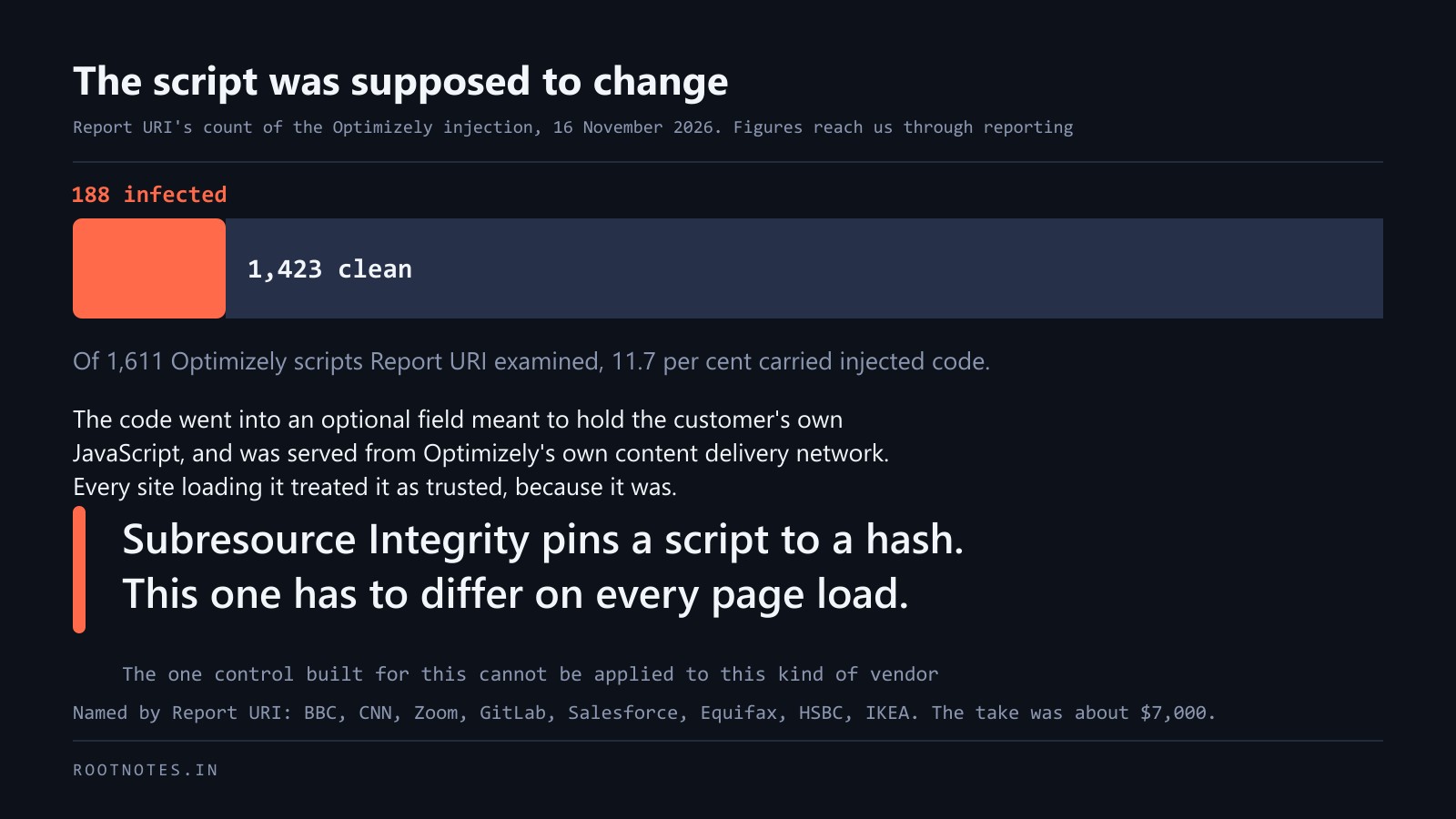
When injected code started going out through Optimizely's content delivery network on 16 November, the part nobody could answer was how the attacker got the ability to put it there.
The answer is now public, and it is smaller than people expected.
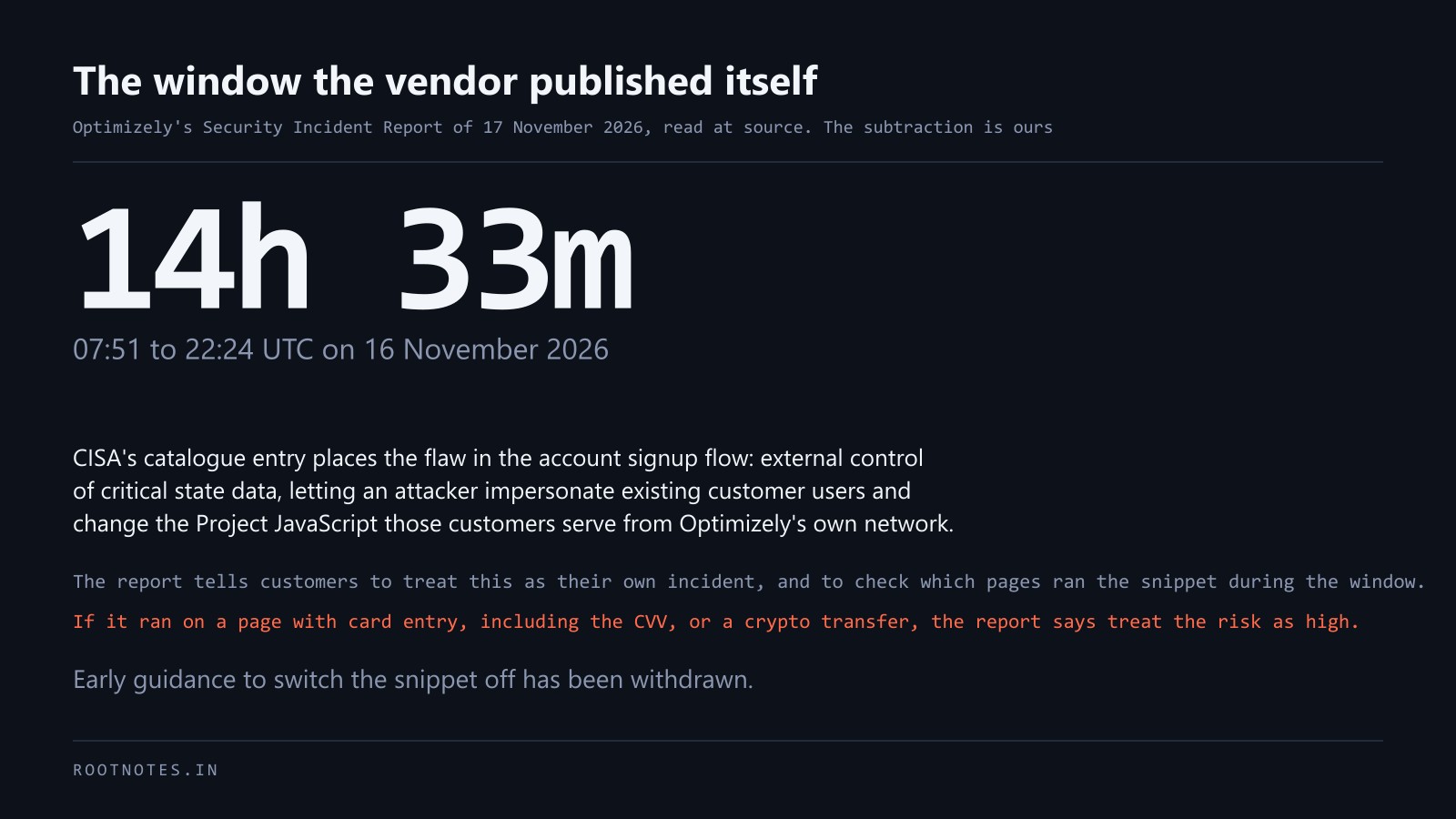
CISA added CVE-2026-132224 to the Known Exploited Vulnerabilities catalogue on 24 November, with a deadline of 27 November and a forensic-triage marker. The entry places the flaw in the account signup flow, and describes it as external control of critical state data that allowed an attacker to impersonate existing customer users and modify Project JavaScript.
The weakness class is CWE-642, external control of critical state data.
What that means in practice
Optimizely's product includes a field where a customer can place their own JavaScript, to run on every page of their site. That is the feature, not a loophole, and this site wrote about it last week.
What was missing was the step before. Knowing that a customer can change their own script does not tell you how somebody else changed it.
The catalogue says the signup flow did. A flow whose job is to create a new account ended up accepting enough caller-controlled state to act as an existing one. From there the attacker was not breaking into anything: they were a customer, editing a customer's script, which Optimizely then served from its own origin to every page that loads it.
That is why the usual controls did nothing. The script arrived from the allowed vendor's allowed content delivery network, signed by nothing, because it is never signed. Subresource Integrity cannot be applied to a file whose purpose is to differ on every page load.
The vendor's own window
Optimizely published a Security Incident Report dated 17 November 2026. It is worth reading as a document, because it does something unusual: it tells customers to treat the event as their incident rather than the vendor's.
The exposure window it gives is 07:51 to 22:24 UTC on 16 November 2026. That is 14 hours and 33 minutes.
The first action in its table is to treat this as a security incident and investigate the impact on your own site. The second is the one that will decide how bad this was for any given customer:
Confirm which pages the snippet was running on during the window. If it ran on any page with credit card entry, including the card verification value, or a cryptocurrency transfer, treat the risk as high.
That is a vendor telling its customers, in a numbered table, to check whether its own script was loaded on their checkout pages.
The guidance that was withdrawn
Buried in the same document is a detail that says a lot about how the first day went.
Early guidance on 16 November advised turning the snippet off. That guidance has been withdrawn. The report now says it is safe to re-enable, and offers removal only as an option for customers who want to finish their review first.
Advice that reverses inside a day is not a failure. It is what an unfinished investigation looks like when a vendor chooses to publish during it rather than after. The alternative, silence until the picture is complete, would have left customers running the snippet through the window without knowing.
The report also says not every customer was targeted, that Optimizely has confirmed directly with each customer whether they were affected, and that anyone who has not heard should ask their account manager. An external forensics firm is running an independent investigation alongside the company's own.
What customers are being asked to keep
Two of the eight recommended actions are about evidence rather than remediation: review Content Security Policy violation reports and outbound browser requests to unfamiliar domains during the window, and retain web server, content delivery network, firewall, policy-report, payment and fraud-monitoring logs covering at least 16 November.
That is the right instruction and it has an awkward property. The evidence that would show whether a given visitor's card details left the page lives in the customer's logs, not the vendor's, and policy-violation reporting is exactly the thing most sites do not collect.
An organisation that was running the snippet on a payment page and has no reporting configured cannot answer the question it has just been asked.
What is not established
- The catalogue entry establishes that the flaw was exploited and describes the mechanism. It does not say how the signup flow failed in technical detail, when the weakness was introduced, or how long it was reachable.
- No figure has been published for how many end users loaded the injected script, or how many card or wallet details were taken, if any.
- The incident report is dated 17 November and states the investigation is continuing. The root cause and indicators of compromise are promised rather than published.
- Optimizely's exposure window begins at 07:51 UTC. Figures published through reporting, including Report URI's account of the injection, do not match that start time exactly. We have not been able to reconcile the two from primary sources, and this piece uses the vendor's own window.
- Whether any customer has confirmed fraud resulting from the window is unknown.