On 16 November at 04:21 UTC, according to Report URI's timeline, malicious JavaScript began appearing in scripts served by Optimizely, the experimentation and A/B testing platform.
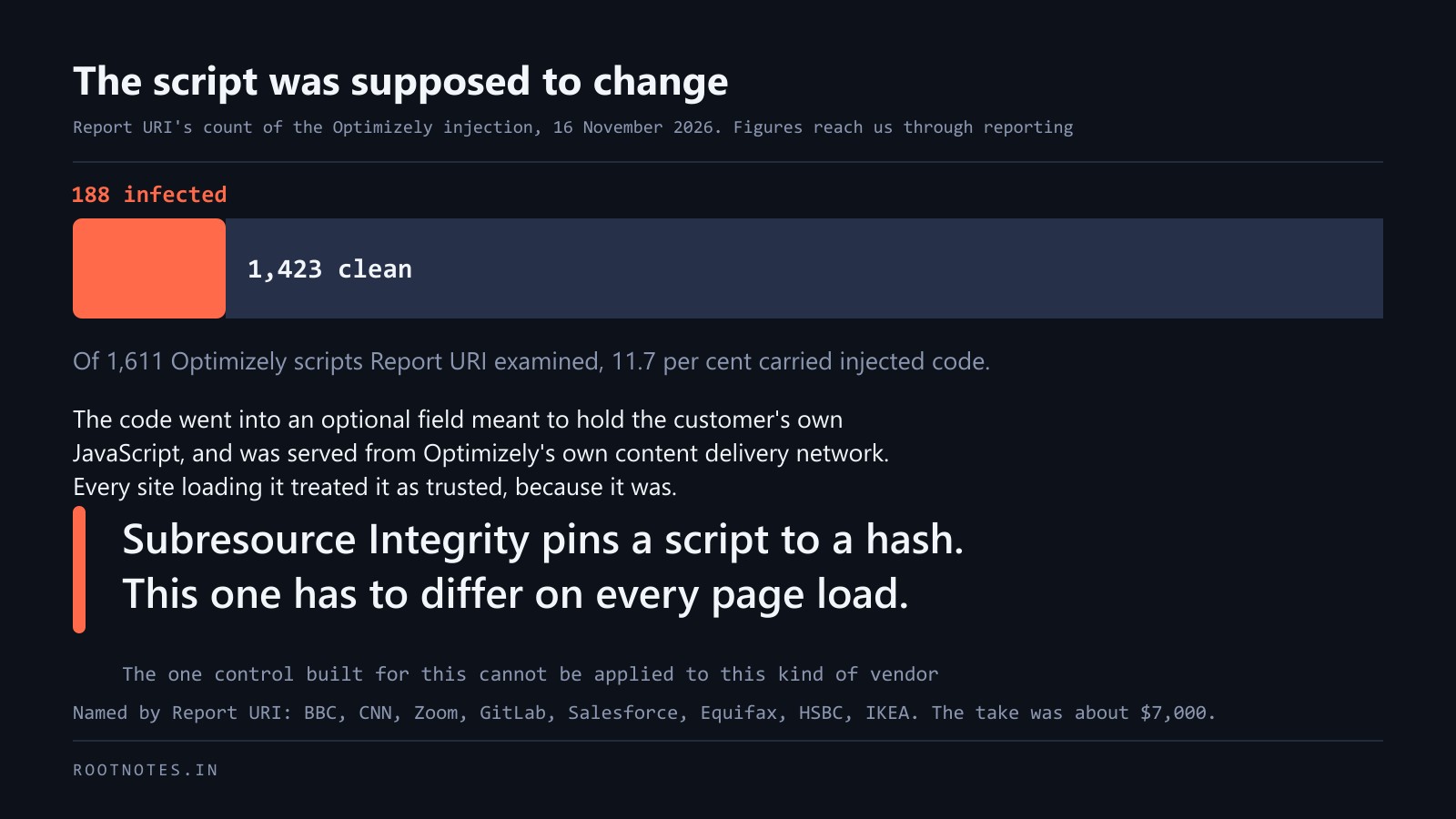
Report URI examined 1,611 Optimizely scripts and found 188 of them carrying injected code, belonging to 178 organisations. The names it published include the BBC, CNN, Zoom, GitLab, Salesforce, Equifax, HSBC and IKEA.
That is 11.7 per cent of the scripts it looked at.
Nothing was subverted
The mechanism matters more than the list, and it is almost disappointingly mundane.
Optimizely's product includes an optional field where a customer can put their own JavaScript, to run on every page of their site. That is not a loophole. It is a documented feature, and it is most of the reason to buy an experimentation platform: you want to change what the page does without shipping a release.
The attacker put code in that field.
The result was then served from Optimizely's own content delivery network, which means every site loading it treated it as trusted — correctly, by every rule those sites had. The script came from the host it was supposed to come from, over TLS, from a vendor under contract.
There is no moment in that chain where a defender's control should have fired. The vendor's infrastructure was not breached in the sense of someone getting into a datacentre. A field that accepts JavaScript accepted JavaScript.
What it did to visitors
The injected code reportedly replaced cryptocurrency wallet addresses with the attacker's own, skimmed payment card details, and collected cookies and screenshots of the page.
On iPhones and iPads, Report URI says visitors were served the Coruna and DarkSword iOS exploit kits. Hudson Rock, which also looked at this, was careful about that part, saying the current evidence does not establish a zero-day or successful device exploitation. That caution is appropriate and worth carrying forward: being served an exploit kit and being exploited are different events, and only the first is established.
One detail is more operationally important than the rest. Some of the poisoned scripts reportedly carried a full copy of the payload embedded locally, which would execute if the remote file failed to load. Hudson Rock's warning follows directly: blocking the attacker's domain is not sufficient. The standard first move in an incident like this — sinkhole the callback domain, consider it contained — produces a system that is still running the payload.
The control that cannot be used here
Here is the part that is not in the coverage.
The web has a purpose-built defence against exactly this attack. Subresource Integrity lets a page declare the cryptographic hash of a third-party script it is about to load. If the file changes by a single byte, the browser refuses to execute it. A tampered vendor script simply does not run.
It would have stopped this completely, at every one of the 178 organisations.
It is also unusable on an experimentation platform, and not because anyone was lazy.
Subresource Integrity pins a file to a hash. An experimentation platform exists to serve a script that differs — between experiments, between variants, between visitors, and whenever a marketer changes a test in a dashboard without telling anybody. A hash that must be updated every time the vendor changes the file is a hash that cannot be maintained, and a vendor whose product changes the file continuously cannot be pinned at all.
So the single control built for third-party script tampering is structurally unavailable for the entire category of vendor whose scripts change. Analytics, tag managers, experimentation, personalisation, session replay, consent platforms, chat widgets. Those are also, not coincidentally, the scripts most likely to be on every page of a site, including checkout.
Content Security Policy constrains where scripts may be loaded from, which does not help when the malicious script arrives from the allowed vendor's allowed CDN. It can limit where data may be sent, and a strict connect-src would have made exfiltration harder. Almost nobody runs one that strict, because every third-party script on the page wants to talk to somewhere.
This is not an argument that the 178 were negligent. It is an argument that the industry has agreed to a trust relationship it has no technical means to verify, and has been calling that agreement "vendor management" for about fifteen years.
The number at the end
Roughly seven thousand dollars in cryptocurrency reached the attacker, according to Report URI.
Hold that against the reach: 178 organisations, among them a global broadcaster, two of the largest news sites in the world, a bank, a credit bureau, and a video conferencing platform used by a large fraction of office workers.
Seven thousand dollars.
Crypto-clipping monetises terribly. It needs a victim who is making a transfer, at that moment, by pasting an address, on an affected page. Card skimming needs a checkout. The reach was extraordinary and the yield was a few thousand dollars, which tells you this was opportunistic monetisation of access that could have been used for a great deal more.
Whoever held this had read-and-write JavaScript execution on the BBC and HSBC for part of a day. They used it to swap wallet addresses.
To Optimizely's credit, the cleanup was fast: by 21:52 UTC on the same day, Report URI's count was down to a single uncleaned script — 17 hours and 31 minutes from first injection. Optimizely says it has fixed the vulnerability, removed the injected code, secured affected accounts and introduced additional protections.
The part that suggests this is bigger
Hudson Rock reportedly also found scripts from Kissmetrics, StorifyMe and Minute-ly serving a small loader to the same iOS infrastructure, with the earliest observation dating to 13 November — three days before the Optimizely injection.
If that holds, this is not one vendor's bad day. It is a campaign against the analytics and experimentation layer as a class, and Optimizely is simply the one with the customer list that made it news.
Optimizely also disclosed a separate incident in February, when an attacker reached its systems through a voice phishing call.
What is not established
- We did not retrieve Report URI's post, Hudson Rock's analysis, or Optimizely's status page at source. Everything here reaches us through reporting of them.
- The vulnerability has not been described. Optimizely says an unauthorised party exploited a vulnerability in Experimentation. There is no CVE, no flaw class, and no account of how the attacker reached the field.
- How many customers were affected. Optimizely has not said. The 178 figure is Report URI's count from the scripts it monitors, which is a sample, not the population.
- Whether any iOS device was actually exploited. Hudson Rock says the evidence does not establish it.
- Whether the Kissmetrics, StorifyMe and Minute-ly activity is the same actor. Reporting says the route into those scripts is unclear.
- Our reading of Subresource Integrity's unavailability here is an argument, not a vendor statement. Neither Optimizely nor any of the researchers raised it in the material we read.