Grand Theft Auto VI shipped on 19 November 2026, for PlayStation 5 and Xbox Series X and S. There is no PC version. Rockstar has not announced one.
That single fact does something security advice is almost never able to do. It produces a rule with no exceptions.
Every Windows installer offered for this game is malicious. Not "probably". Not "check the source carefully". There is no legitimate file of that description anywhere, so any file of that description is a lie, and the person offering it knows it.
Compare that to the advice we normally give. Check the sender. Hover the link. Verify the certificate. All of it requires judgement, all of it has false negatives, and all of it fails against a sufficiently good forgery. Here the judgement is removed entirely: the category is empty, so anything in it is fake.
It is worth saying plainly, because the campaigns are substantial and the people most exposed are the ones least likely to read security coverage.
What is actually circulating
Several vendors have published findings, and the samples differ in interesting ways.
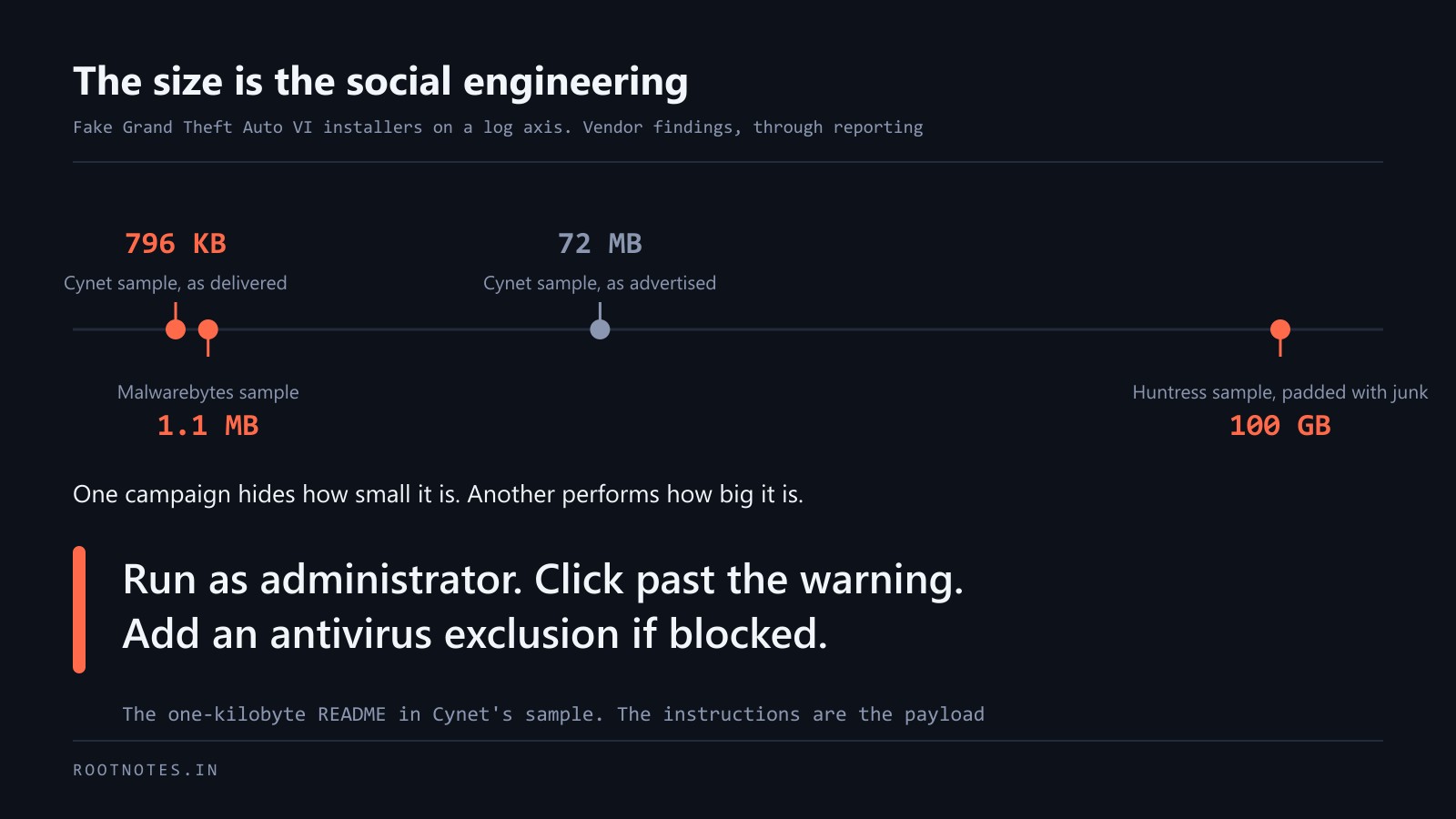
Cynet, reported through Help Net Security, traced a lure from a Google Colab notebook advertising a download, through to a page styled as a "Windows Software Hub" carrying a version number, a download count and badges reading Virus Free, Secure and Verified. The page advertised 72 MB. What arrived was an archive containing a 796 KB executable and a 1 KB README. The binary was a loader for the WARDEN Stealer: saved passwords, browser cookies, Steam and Roblox credentials, cryptocurrency wallet data. It checks for virtual machines, injects into browser processes, and replaces cryptocurrency addresses copied to the clipboard.
Malwarebytes found lookalike Rockstar sites with a Play Now button delivering a 1.1 MB file carrying the Vidar infostealer, which ESET also flagged in the same window.
Huntress analysed something different in kind: fake "leaked" images padded past 100 GB with junk data, bundling remote access trojans, an open-source infostealer, and a wiper built on the Chaos ransomware family — with no apparent way to pay and recover, which makes it destruction rather than extortion. The installer shows a fake licence error while the malware runs.
KnowBe4 reported that GTA-related lures made up 9.6 per cent of observed phishing volume in the week beginning 26 October. Nearly one phishing message in ten, in that sample, for a video game — three weeks before it shipped.
The size is the social engineering
Put the file sizes next to each other and something becomes visible that none of the individual reports comment on.
One campaign claims 72 MB and delivers 796 KB. Another pads junk data until the file passes 100 GB.
Those are opposite tactics, and they are solving the same problem from opposite directions. The victim has an expectation about how big a modern game is. The small sample has to get past the download before the number is noticed. The padded sample has to survive the question of why a flagship release is only a few megabytes.
What is being counterfeited is not the game. It is plausibility. The attacker is manufacturing a number that matches what the victim already believes, and the direction of the lie depends on which part of the process the victim is in when they check.
Which also means file size is useless as a defensive signal in both directions, and anyone teaching "a tiny installer is suspicious" has taught half a rule.
The README is the payload that has to work
The most instructive artefact in any of this is the one-kilobyte text file in Cynet's sample.
It tells the victim to run the file as administrator, to click past the security warning, and to add an antivirus exclusion if the file is blocked.
That is the actual attack. The binary is replaceable — Huntress noted that the components in its sample were old and unsophisticated and that an up-to-date Windows Defender should catch them before execution. The thing that has to succeed is not the code. It is the paragraph that persuades a person to disable the control that would have stopped the code.
And it is written to be unremarkable. Anyone who has installed a game modification, an emulator, or a piece of older software has followed instructions that look exactly like this, and they worked, and nothing bad happened. The instruction is not asking the victim to do something strange. It is asking them to do something familiar.
This is why detection rates are a weak defence here. The user has been handed a script for overriding detection, and has been given a reason to follow it that feels like competence rather than risk.
Who this reaches
The pattern around a major launch is predictable and it is worth naming the shapes: fake early access sold for cryptocurrency, pre-order pages harvesting PlayStation, Xbox and Rockstar credentials, QR codes in social posts, and search results poisoned for exactly the phrases an impatient person types.
The audience is young, motivated, in a hurry, and sitting at a machine that very often is not theirs alone. A stolen Steam session is an annoyance. The same infostealer takes the browser cookie jar, which on a shared or family machine routinely includes a parent's email session, and increasingly includes a work account on a personal device.
There is one more thing worth remembering about this particular title. In September 2022, Rockstar itself was breached and early GTA VI footage was leaked — an intrusion later attributed to a teenager associated with the Lapsus$ group. The game has been a target for four years. It is fitting, in a bleak way, that it ships into the largest consumer malware campaign of the quarter.
What to actually tell people
Two sentences, which is all anyone will retain:
There is no PC version. If a site offers you one, it is malware.
And the second rule, which outlives this game: if the installation instructions tell you to disable your antivirus, the instructions are the attack. No legitimate software needs that, ever, and the moment you are asked, the question is already answered.
What is not established
- Every vendor finding here reaches us through reporting. We did not retrieve the Cynet, Malwarebytes, ESET, Huntress or KnowBe4 reports at source, and the indicators in them should be taken from the originals.
- The KnowBe4 share is a share of one vendor's observed volume, not of global phishing. We do not know the sample size or composition.
- Victim counts are unknown. No vendor we read published one, and none of these campaigns appears in CISA's exploited-vulnerabilities catalogue, which does not track this category.
- Whether the various campaigns share an operator. The samples differ substantially in malware family and in technique, which suggests several unrelated actors working the same lure.
- Whether a PC version has been privately planned. Rockstar has announced nothing, and past releases are a pattern, not a commitment.
- The 2022 Rockstar breach attribution is widely reported and we have not re-verified it here.