Grand Theft Auto V was released on 17 September 2013. Grand Theft Auto VI was released on 19 November 2026.
That is 4,811 days.
For scale: the gap between Grand Theft Auto IV and V was 1,967 days. This one is two and a half times longer, and it is the longest wait the series has ever imposed.
Most of the coverage is about the wait. What interests us is what happened during it, because the two launches rhyme in a way that makes thirteen years of change unusually easy to measure.
The same hole in the product line
Grand Theft Auto V shipped to consoles only. The PC version arrived on 14 April 2015 — 574 days, a little over eighteen months, after the console release.
Grand Theft Auto VI shipped to consoles only. There is no PC version and none has been announced.
So both launches created the same situation: an enormous, loudly marketed game that a very large number of people wanted, and an entire platform that could not have it, for a period measured in years.
That gap is not a marketing problem. It is an attack surface. It is a population of motivated people searching for a file that does not exist, which is the most reliable precondition for malware distribution there is, because the victim arrives already wanting to be convinced.
In both years, something rushed into that gap. The difference is what.
2013: it installed a different game
As the console version shipped, a torrent began circulating claiming to be the leaked PC build.
Bitdefender looked at it, and the finding was reported at the time: the installer delivered a modified copy of The Cave, a side-scrolling puzzle-platformer released earlier that year.
That is the whole payload. Someone built the lure, wrapped it, seeded it, and what the victim got was a different, smaller, entirely legitimate video game.
It is hard to read that now without a certain nostalgia. There was no credential theft. There was no persistence. Nobody's cryptocurrency went anywhere, because in September 2013 almost nobody had any to take. The economic model behind the file barely existed, so the file did something close to nothing.
2026: it takes everything
The same lure, in the same gap, now delivers what the vendors have been publishing for weeks.
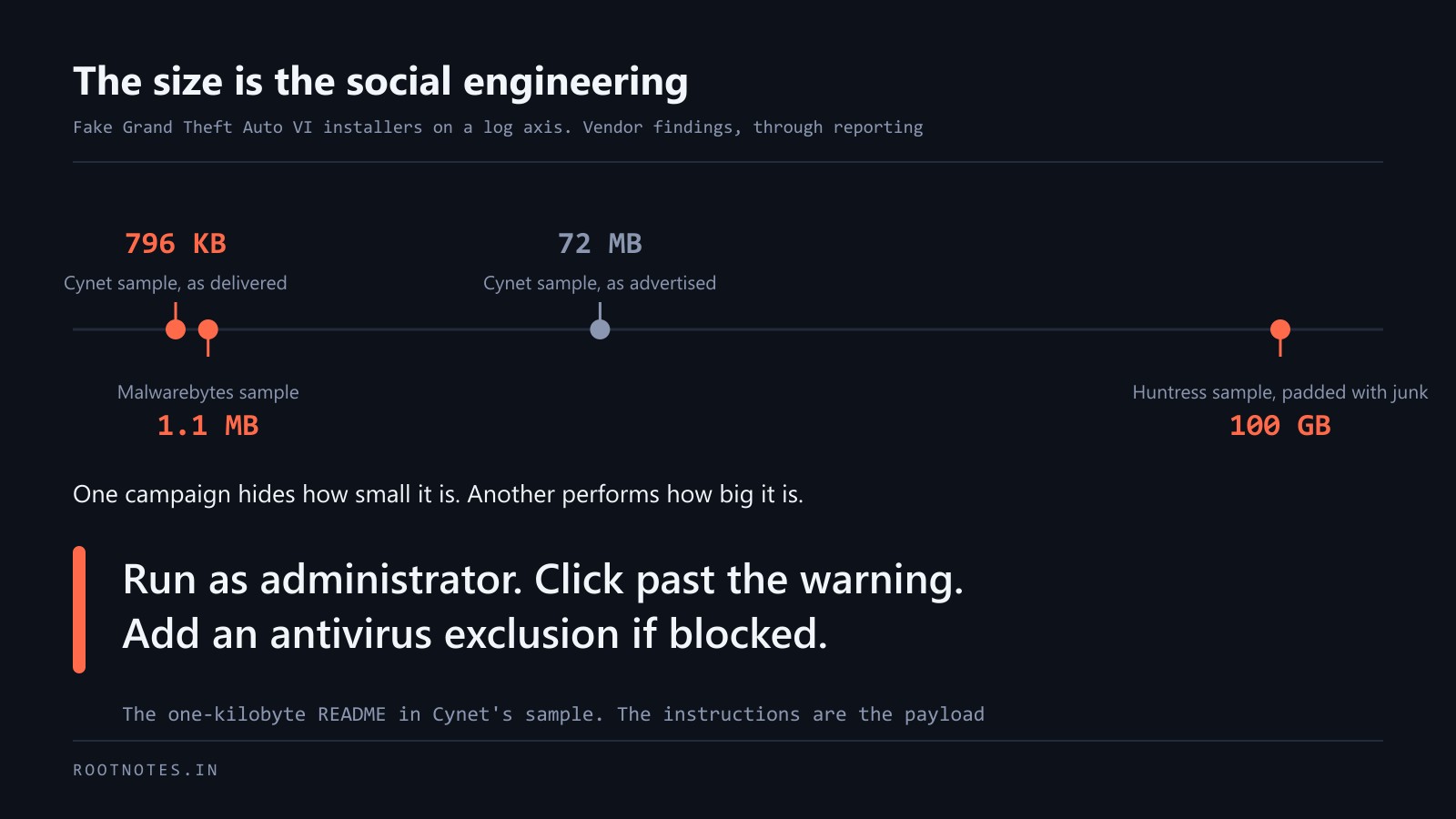
Cynet traced a page advertising a 72 MB installer that delivered a 796 KB loader for an infostealer taking saved passwords, browser cookies, Steam and Roblox credentials and cryptocurrency wallet data, and replacing wallet addresses copied to the clipboard. Malwarebytes and ESET found samples carrying Vidar. Huntress analysed fake images padded past 100 GB bundling remote access trojans, a stealer, and a wiper built on the Chaos ransomware family with no apparent way to pay and recover.
And the industrial detail: NordVPN has reported a scam kit sold on the dark web for around two hundred dollars — the lure packaged as a product, for people who do not need to understand any of it.
Same franchise. Same missing platform. Same impatient audience. The only variable that moved is the economy standing behind the download, and it moved from a prank to a supply chain.
What filled in the middle
If you want a marker for when the thing in between was built, there is a tidy one.
CryptoLocker's first samples appeared around 5 September 2013 — twelve days before Grand Theft Auto V shipped.
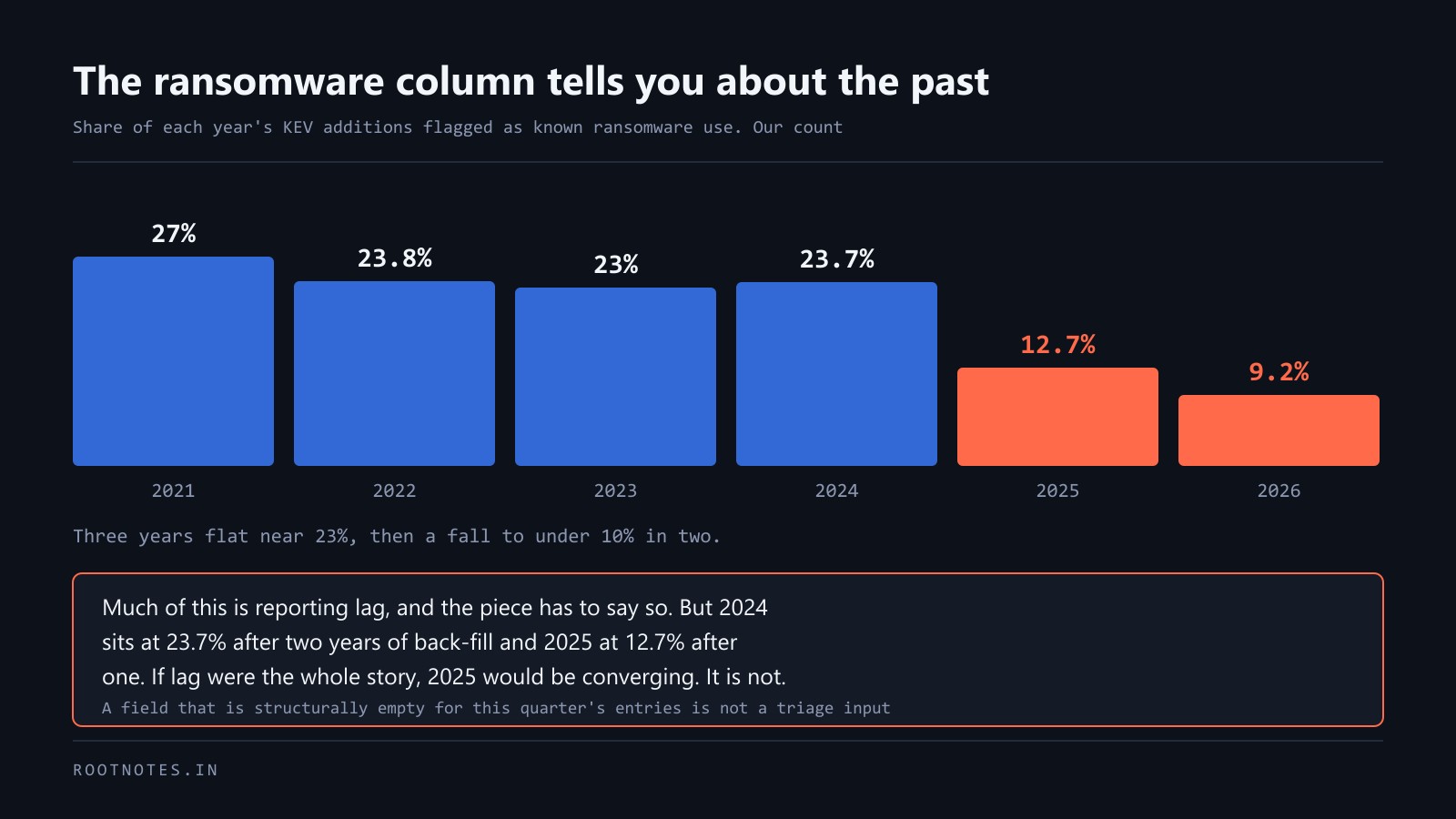
CryptoLocker is the campaign most people point to as the beginning of the modern ransomware era: file encryption, cryptocurrency payment, and an operation industrial enough that taking it down required an international effort. It is a framing rather than a fact, and proof-of-concept ransomware long predates it. But as a milestone it is a fair one, and the coincidence of timing is almost too neat: the month this series last shipped a game is roughly the month the criminal economy around malware found its business model.
Everything that makes the 2026 file dangerous was built in the gap. Commodity infostealers sold as a service. Browser cookie theft as the standard route around multi-factor authentication. Cryptocurrency as something ordinary people hold on the machine they game on. Affiliate structures that let someone with no technical skill buy a kit for two hundred dollars.
None of that existed in a usable form when the fake GTA V torrent was seeded. All of it exists now, and it is pointed at the same group of people, through the same hole, using almost the same words.
The franchise did not get through it untouched
Two things happened to Rockstar itself in the gap, and both are worth recording.
In September 2022, Rockstar was breached and early Grand Theft Auto VI development footage was leaked publicly — an intrusion later attributed to a teenager associated with the Lapsus$ group. The game was a security incident before it was a product.
In early 2023, a remote code execution issue in the Grand Theft Auto Online PC client was used by cheat developers to corrupt other players' accounts, altering in-game balances and statistics. Rockstar patched it in a title update that introduced a new network data protocol. The fix then broke connectivity for some players running additional firewall or port restrictions, which is its own small lesson about what emergency security changes cost.
That second one marks the deeper shift. Grand Theft Auto V launched in 2013 as a product that happened to have an online mode. It spent the next decade becoming infrastructure: persistent, monetised, always connected, and therefore permanently in scope. Grand Theft Auto VI is being launched as that from day one.
A disc had a threat model that ended when you finished the game. A live service has one that starts at launch and never closes.
The thing worth taking from it
Thirteen years is long enough for the attack to be rebuilt from the ground up and for the lure to not change at all.
Nobody needed a new idea. "Here is the PC version early" worked in 2013 and works now, because it is not really a technical claim — it is an offer to let someone skip a wait they resent. The attacker did not have to improve the pitch. They only had to wait for the market to supply better things to steal, and for a kit that would let anyone run the operation.
Which is the uncomfortable general case. Defences change constantly. Lures almost never do. If you are looking for what the next launch of anything will be abused for, the answer is usually whatever it was abused for last time, carrying whatever the economy has built since.
What is not established
- The release dates are published and the day counts are our arithmetic. 4,811 days, the 2.45 ratio and the 574-day PC gap are ours and are easy to check.
- The 2013 fake torrent reaches us through reporting of Bitdefender's finding. We did not retrieve the original analysis.
- CryptoLocker as the start of the modern ransomware era is a common framing, not an established fact. Ransomware predates it by decades, and the date of first samples is approximate.
- The 2022 Rockstar breach attribution is widely reported and we have not re-verified it here.
- The 2023 Grand Theft Auto Online issue is reported with a CVE identifier that we could not confirm against a primary source, and accounts differ on whether it permitted full code execution or only manipulation of game data. We have described it in the weaker terms.
- Whether a PC version of Grand Theft Auto VI is planned. Rockstar has announced nothing, and the 574-day precedent is a pattern, not a commitment.
- The 2026 vendor findings all reach us through reporting, and are set out with their sources in our companion piece on the launch campaigns.