Red Hat has disclosed a flaw in Quay, its container registry, rated 9.8 and tracked as CVE-2026-123710. It was found internally, by Red Hat's own Dave O'Connor. According to the bug report, the logic responsible has been in Quay since the product's first public commit.
The flaw is worth understanding precisely, because it is not a coding mistake in the ordinary sense. Nothing is unescaped, nothing overflows, no check is implemented incorrectly. Every check that exists works. The problem is the one that was never written.
What the endpoint asks
Quay signs the access tokens that govern who may pull and push which images. There is an endpoint for rotating those signing keys, and that endpoint is naturally privileged: anyone who can add a key to the trusted set can mint tokens the registry will honour.
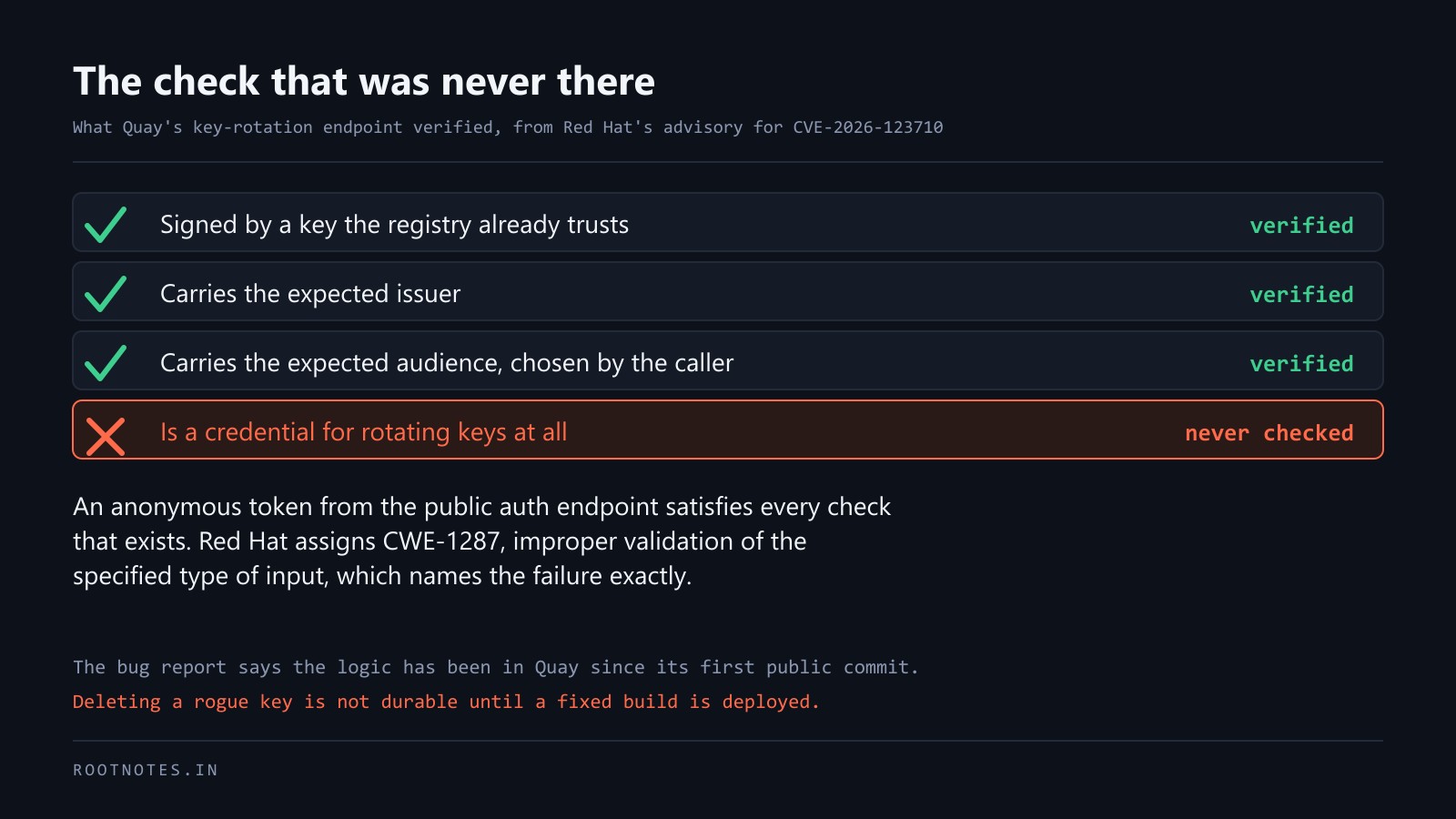
So it checks the caller's token. It verifies that the token is signed by a key the registry already trusts. It verifies the issuer. It verifies the audience.
It does not verify that the token is a key-rotation credential.
That sounds like a small omission. It is the whole thing, because Quay has a public endpoint, the registry auth endpoint, that hands out anonymous tokens to unauthenticated callers. Those tokens are signed by a trusted key, because Quay signed them. Their issuer is correct, because Quay issued them. And their audience is correct because — in the detail that completes the chain — the caller chooses the audience.
An unauthenticated client asks the public endpoint for a token, specifies the audience the privileged endpoint expects, and presents the result. Three checks, three passes.
Red Hat assigns CWE-1287: improper validation of specified type of input, which names the failure with unusual accuracy. The code validated the token thoroughly. It never asked what kind of token it was.
What follows from one planted key
Once an attacker has installed a signing key, the registry accepts tokens signed with that key for any repository. The reported consequences, in rough order of seriousness:
Read every private image, along with whatever is baked into those images. In practice that frequently includes credentials, since build-time secrets in container layers remain one of the most durable bad habits in the industry.
Push and overwrite images, including replacing the image behind an existing tag. This is the supply-chain consequence and the reason the CVSS is where it is. Nothing needs to be exploited downstream; the next deployment that pulls the tag collects the attacker's image through the normal, trusted, entirely working mechanism.
Persist. Reporting indicates the planted key can be added without an expiry and survives restarts.
Deny service, by deleting the keys the running instances legitimately use, which breaks ordinary pushes and pulls.
Two details from Red Hat's own guidance are more operationally important than any of that.
The first: turning off anonymous access does not protect you. A key already planted keeps working regardless, and password resets and robot token rotation do not touch it.
The second, and this is the one to act on: deleting a rogue key is not durable until a fixed build is deployed. The cleanup does not hold while the hole is open, because the attacker can simply add another. The usual instinct — contain first, patch during the next maintenance window — produces a system that looks cleaned and is not. Here the patch has to come first, or at least simultaneously.
Red Hat's interim mitigation is to restrict the keys endpoint at the proxy or load balancer so only trusted internal components can reach it, and to search audit logs for key rotation and key deletion events where the expiry is null.
The second one is a classroom exercise
Reported alongside it, by the same person, is CVE-2026-110697, rated 9.9, and it is the more instructive bug of the two.
The code that lists robot accounts builds a SQL LIKE pattern from the namespace name — and does not escape the wildcards. In SQL LIKE, an underscore matches any single character. So a tenant who creates a namespace with an underscore positioned correctly can make the pattern match another tenant's namespace, and the query returns that tenant's robot accounts with their tokens decrypted.
What makes this worth noting is that it is not SQL injection in the way anyone checks for SQL injection. The query is presumably parameterised. The value is bound, not concatenated. Every lint rule and every scanner that looks for string-built SQL sees nothing wrong, because nothing is wrong with the SQL. The injection is into the pattern language that LIKE interprets after the parameter is safely bound — a second, smaller grammar that sits inside the value and that almost nobody treats as attacker-controlled input.
In an environment where Quay is the integrated registry for OpenShift, stolen robot credentials are a route into CI/CD pipelines.
The part that should change how you read "critical"
The rotation flaw has reportedly been present since the first public commit.
This was not introduced by a refactor, a dependency bump, or a rushed feature. It is not a regression that better tests would have caught, because there was never a moment when the behaviour changed. The registry has trusted its own anonymous token as a key-rotation credential for as long as there has been a registry.
That is the uncomfortable category. Vulnerability management is built around change: scan after deploys, diff dependencies, watch for regressions. A flaw that has been constant since the beginning generates no signal in any of that machinery. It sits in the part of the system that everyone stopped reading years ago because it has always worked.
It was found, eventually, by someone inside Red Hat reading the code. That remains the only method that finds this class of bug, and it does not scale, and there is no substitute for it.
What is not established
- We retrieved Red Hat's CVE page for CVE-2026-123710 at source. The mechanism detail, the attack consequences, and everything about CVE-2026-110697 reach us through reporting of the bug report and the upstream commit, and should be checked against Red Hat's advisories.
- Fix status is unclear. Red Hat has reportedly released fixed builds across eight Quay 3 branches, but reporting notes that none of those eight advisories list CVE-2026-110697, and that the CVE page showed packages as affected with no fix when checked.
- No exploitation has been reported. Neither flaw appears in CISA's exploited-vulnerabilities catalogue as of the latest feed we analysed, version 2026.11.20.
- Which specific versions are fixed. We did not obtain the list.
- Whether Quay.io, the hosted service, was ever exposed. Reporting says it is fixed; we found no statement about the period before the fix.
- "Since its first public commit" comes from the bug report as described in reporting. We did not verify it against the repository history.