On 20 November 2026 GL.iNet found that somebody had been using its own cloud service to install malware on its customers' devices.
The service is GoodCloud, the remote management platform for GL.iNet routers and KVM units. The company blocked the attack path the same day, shipped security firmware, and published a notice that it has been updating since.
What it has not published is a CVE identifier, because none has been assigned yet.
The authorization error
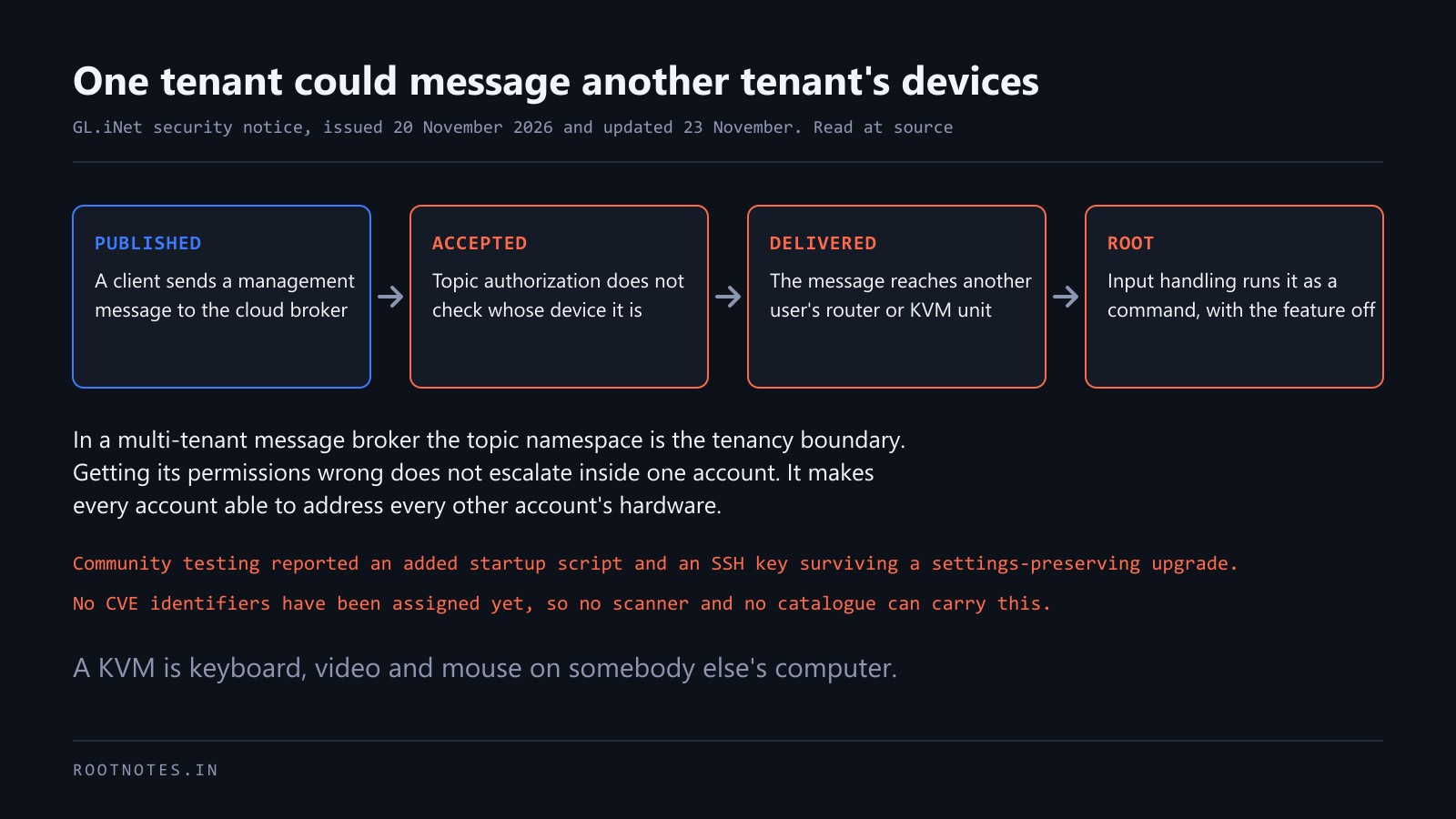
The notice is unusually specific about the cause. Its message-authorization finding is that a client could send management messages to other users' connected devices without the required permission.
GoodCloud's device-messaging layer is MQTT, deployed on a broker whose topic authorization was configured wrongly. In a multi-tenant message broker, the topic namespace is the tenancy boundary. Getting the permission rules wrong does not produce a privilege escalation inside one account. It produces a service in which every account can address every other account's hardware.
The company identifies version 3.19.13 of the service as affected and 3.19.14 as fixed, and is careful to say this is a finding about its own deployment rather than about the broker software in general. That caveat is correct and it is also the whole lesson: the broker did what it was configured to do.
The second flaw, in a feature that was turned off
A separate finding concerns input handling in the router's SD-WAN component. Insufficient validation could cause management input to be executed as commands with root privileges.
The notice adds five words that change the shape of the advice: this applied even when the feature was turned off.
A disabled feature that still parses input is not disabled in the sense operators use the word. It is the same failure that keeps appearing in this category, and it is why "we do not use that feature" is not an answer to an exposure question about remote-management agents.
A third finding concerns the remote-terminal component: if certain startup arguments can be modified, the intended server-certificate verification can be bypassed, allowing a device to connect to an attacker-controlled terminal server and hand over root.
Three separate weaknesses, in a service and a firmware whose job is to be the trusted path to a device.
The update is not the recovery
GL.iNet's notice draws a line that most incident notices blur, and it draws it repeatedly.
The cloud fix blocked the path. The firmware cleanup removes the known malware from this incident. Neither undoes past access, and neither revokes a credential that was already copied.
Then comes the detail that should decide how operators act. Community testing on a KVM unit reported that an added startup script and an SSH key survived a configuration-preserving upgrade.
So the comfortable option, updating with settings kept so remote access is not lost, is the option that can keep the attacker's key. The notice says so and recommends reinstalling without settings for any device where compromise is known or suspected.
That is a genuinely hard instruction to follow. These devices are often the only way their owner can reach a remote site. Reinstalling without settings means losing that access and rebuilding the configuration by hand, possibly from a different location.
The KVM is the part people will underrate
A compromised router is a compromised network path. A compromised KVM is something else.
A KVM over IP is keyboard, video and mouse attached to another computer. It exists so that somebody can operate a machine that is not in front of them, including before that machine has booted.
The notice tells owners of an affected KVM to check the attached computer for unfamiliar accounts, software, browser extensions and startup items, and says plainly that this is a precaution rather than a finding. GL.iNet also says it is still determining whether computers connected to affected KVMs were reached.
One owner's report, carried in reporting rather than in the notice, describes a device making daily connections to roughly 1,800 residential addresses. That is the shape of a proxy network, not of a targeted intrusion, which fits the pattern of an opportunistic actor monetising whatever it landed on.
No identifier to track it by
GL.iNet says it has submitted CVE reports and that identifiers are pending. Until they exist:
- No scanner will flag an affected device by CVE.
- No catalogue can carry a deadline against it.
- No procurement questionnaire that asks about known CVEs will return anything.
The vendor has published GitHub reports for each finding and firmware tables listing minimum security versions per model, which is more than many vendors do. But the tracking identifier that the rest of the industry runs on is absent, and the exposure is live.
Credit where it is due: the notice is one of the more carefully hedged incident documents published this year. It repeatedly states what the evidence does not establish, tells readers that receiving the notice is not evidence their device was accessed, and warns that a check cannot rule out earlier access. That is the right register for an investigation that is still running.
What is not established
- GL.iNet has not said how many devices were affected, when the activity began, or what the malware was for.
- The notice records that some community-reported file dates predate 20 November, and says those reports do not establish the initial entry path or a connection to this incident. Reporting elsewhere has suggested a much longer window. Neither is confirmed.
- The relationship between the three technical findings and the actual intrusion is not fully established. The notice says the router command-injection flaw should not be assumed to explain every KVM compromise.
- Whether computers attached to affected KVMs were reached is explicitly open.
- The 1,800-address figure is one owner's report carried through reporting, not a vendor finding.
- CVE identifiers are pending, so nothing here can be cross-checked against NVD yet.