WhatsApp patched three security issues in late November 2026. The coverage has been about the first one. The interesting thing is the set.
Each of the three comes with a different statement about whether it was exploited, and the three statements rest on three different kinds of evidence. Most advisories only ever offer one of them.
One: believed used
CVE-2026-23871 is a URL validation flaw in ad-reply handling on WhatsApp for Android and WhatsApp Business for Android.
As reported, an attacker could send media referencing an attacker-controlled address inside a crafted ad-reply message. When the application displayed that message in a conversation, the attacker learned the recipient's IP address.
WhatsApp's team is reported to have found it while breaking up a scam campaign, and to believe a scammer used it to make messages look more credible.
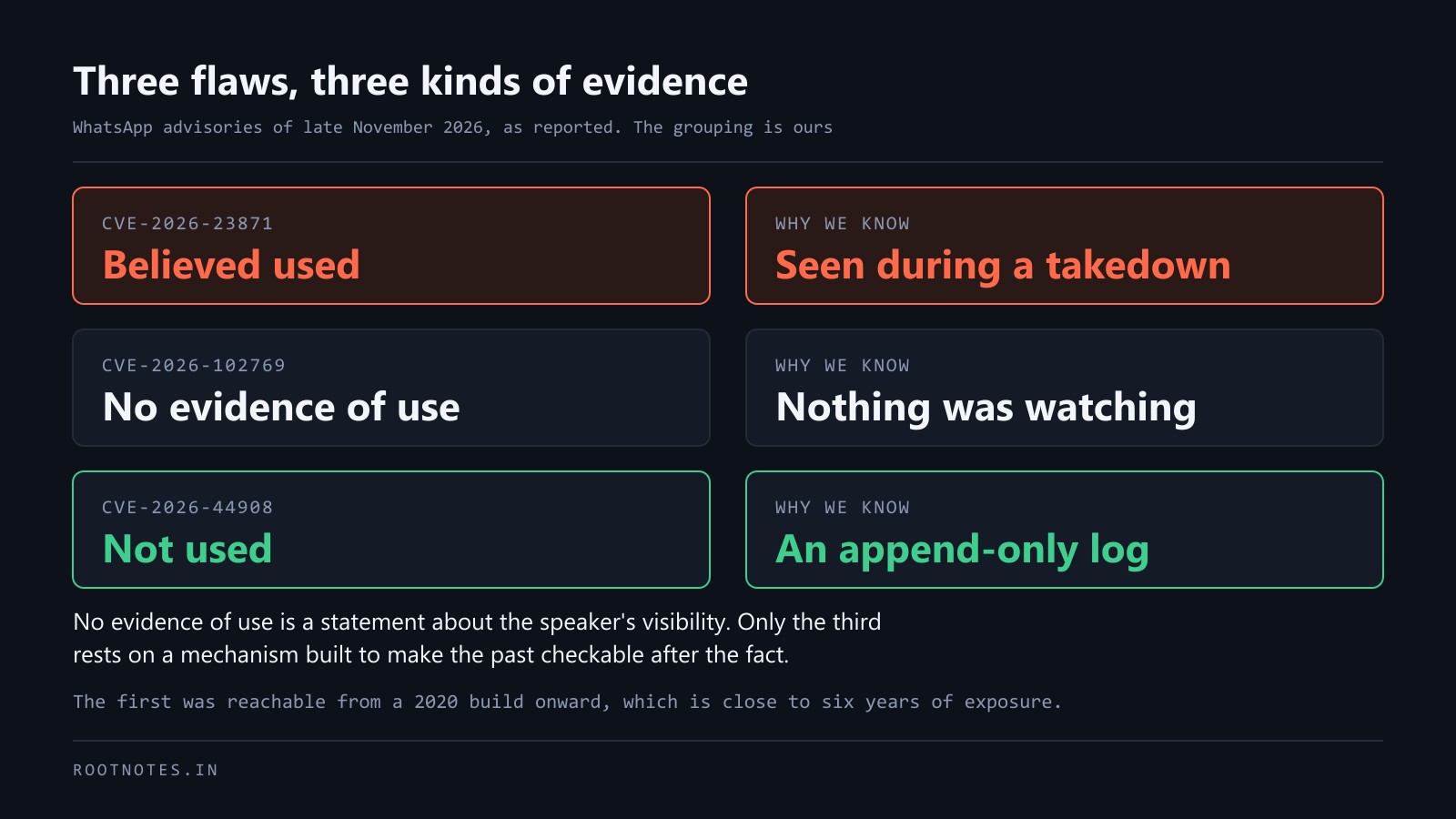
The affected range is the detail nobody has stopped on. It runs from version 2.20.198.3 up to, but not including, 2.26.17.4. That lower bound is an Android build from around 2020. The flaw was reachable for something close to six years.
An IP address is not a device compromise. It is a rough location and a network, and in a social-engineering operation that is enough to make an invented story land. This is the low end of impact and the high end of certainty: a disclosure that exists because somebody was watching an operation that used it.
Two: no evidence
CVE-2026-102769 is an SQL injection on Android, fixed in 2.26.35.74.
As reported, a maliciously crafted order-details message sent from an unofficial client could, when tapped, delete WhatsApp files stored on the device. Reporting disagrees on the full impact, with at least one account describing data leakage through timing side channels on older Android versions in addition to file deletion.
WhatsApp says it has found no evidence that anyone exploited it.
That phrase is the standard one and it is weaker than it sounds. It is a statement about the limits of the speaker's visibility. For a flaw triggered by a message from an unofficial client, on a user's own device, there may be very little telemetry that could ever carry the evidence.
Three: ruled out
CVE-2026-44908 is a trust-validation issue in the verifier for Meta AI's confidential computing infrastructure.
WhatsApp says its certificate transparency evidence confirmed the flaw had not been exploited.
That is a different class of claim. Not "we did not see it". Something closer to "the log would have recorded it, and it does not".
Confidential computing deployments of this shape publish the identities they will attest to into an append-only, publicly auditable log, precisely so that a client can check that the thing it is talking to is the thing the operator said it would be. If an attack against the verifier requires getting an unexpected identity accepted, and every accepted identity is in a log that nobody can edit after the fact, then the log is evidence about the past rather than a record of what somebody happened to be watching.
This is what the architecture was for. Most of the time confidential computing is sold on confidentiality. Here the useful property turned out to be auditability: the ability, after a flaw is found, to go back and demonstrate a negative.
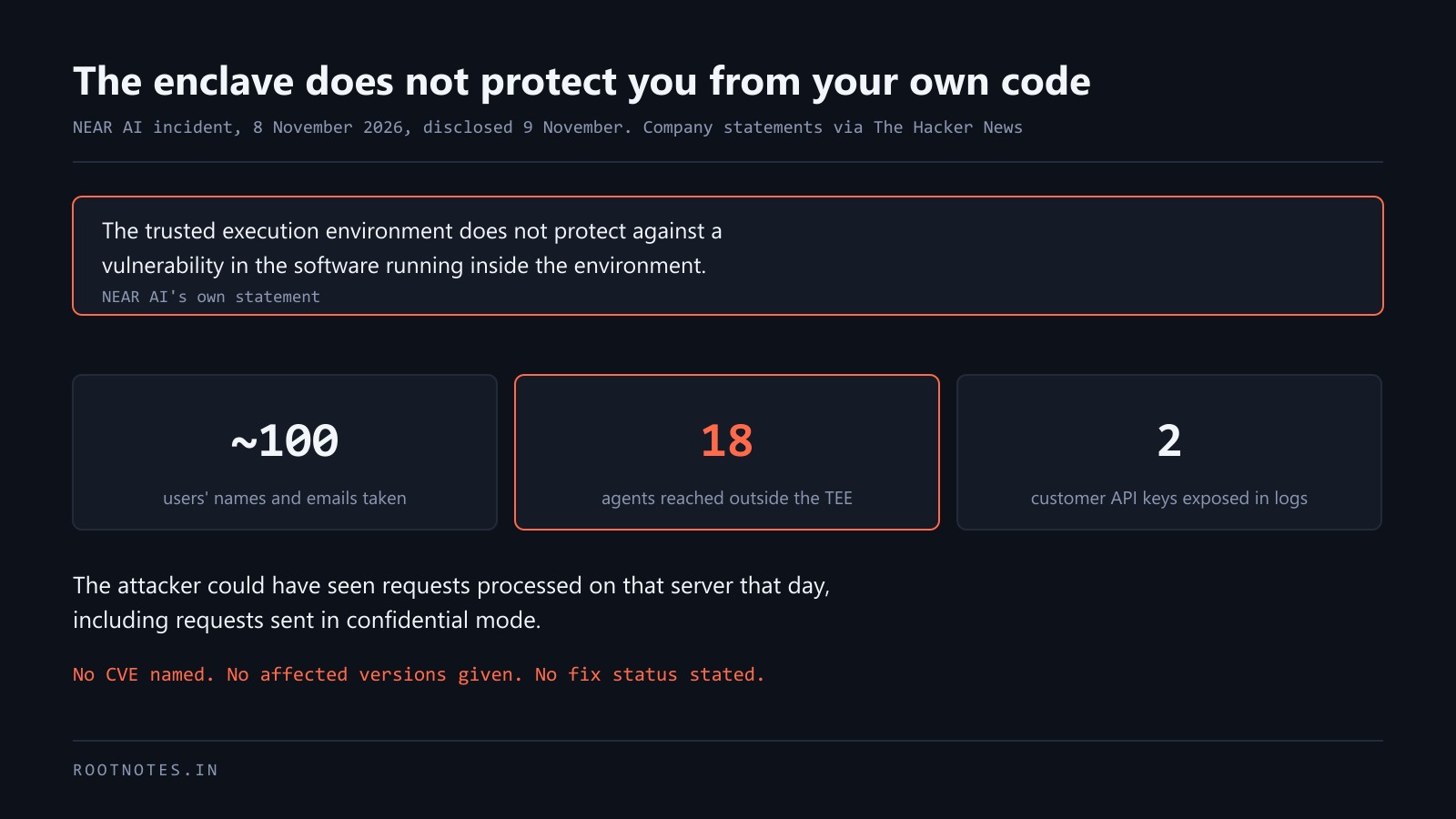
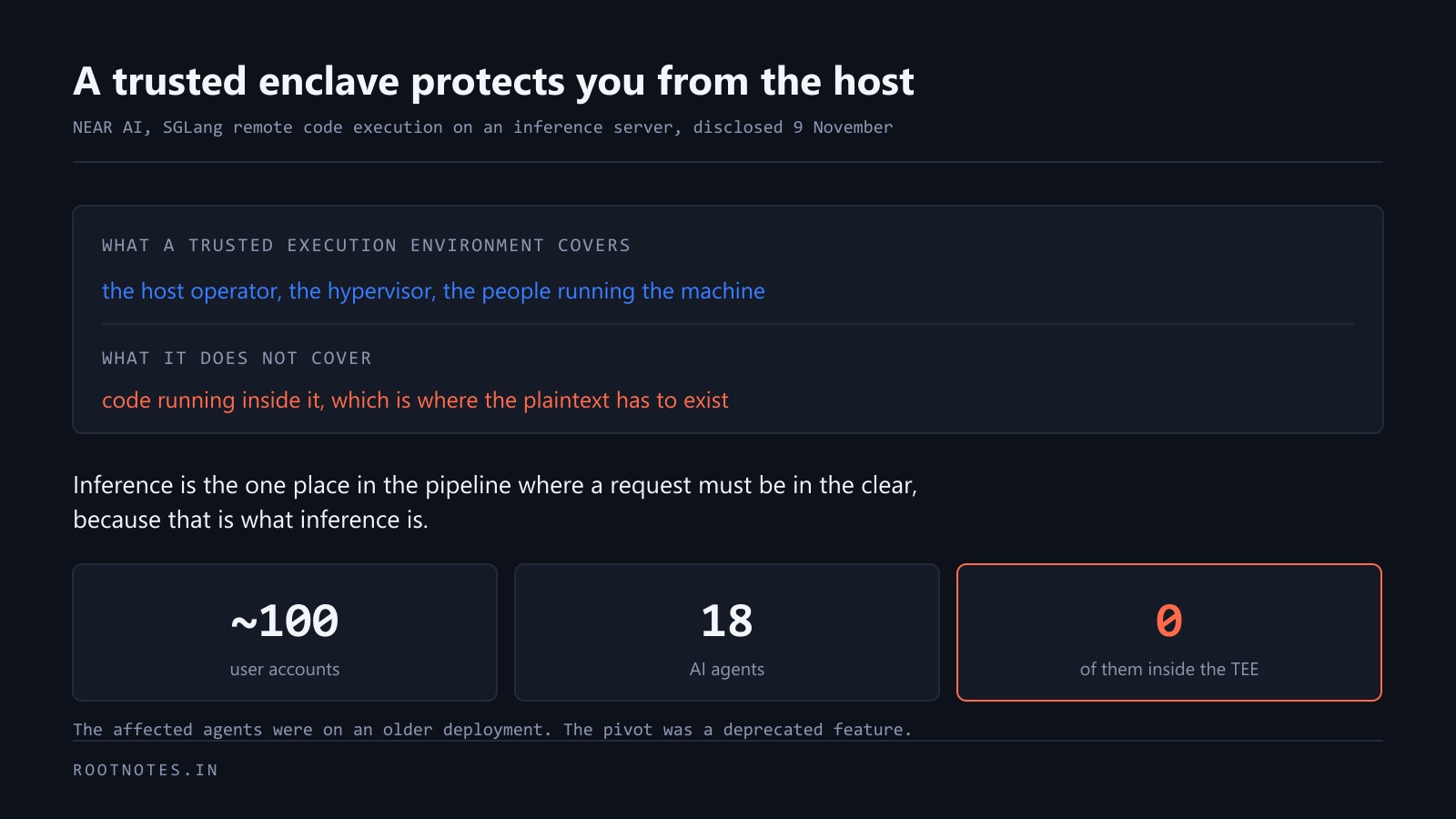
Two weeks ago this site covered the other edge of the same technology, when NEAR AI disclosed an incident and had to explain that a trusted execution environment does not protect against a flaw in the software running inside it. Both things are true. The enclave did not stop the bug. The log can still settle whether the bug was used.
Why the set is the story
Put the three next to each other and you have a small taxonomy of what a vendor can actually know.
- Observed in use. Strongest, and usually accidental: somebody was investigating something else.
- No evidence of use. Weakest. Compatible with heavy exploitation that nobody could see.
- Demonstrably not used. Rare, and only available when the system was built to produce a record.
Readers tend to flatten all three into "was it exploited or not". Vendors rarely distinguish them either, because the middle one is the comfortable default and sounds like the third.
The practical use of the distinction is triage. A flaw with no evidence of exploitation in a component with no telemetry deserves more suspicion than the same sentence attached to a component that logs everything.
What is not established
- We could not read Meta's advisories at source. The identifiers, the affected version ranges and the quoted characterisations reach us through reporting, and any of them could be imprecise.
- Meta has not published a technical write-up of the scam campaign. The number of people whose addresses were disclosed is unknown.
- Exploitation of CVE-2026-23871 is reported as believed, not confirmed. One account notes the company has not confirmed successful exploitation.
- Reporting disagrees on the impact of CVE-2026-102769. File deletion is common to the accounts; the side-channel description is not.
- Our reading of what certificate transparency evidence means here is an inference from how such systems are normally built. WhatsApp has not published the reasoning behind the claim, and without that the strength of the third statement cannot be independently checked.
- The six-year exposure window for CVE-2026-23871 is derived from the reported affected range. It describes when the code was present, not when anybody could or did use it.