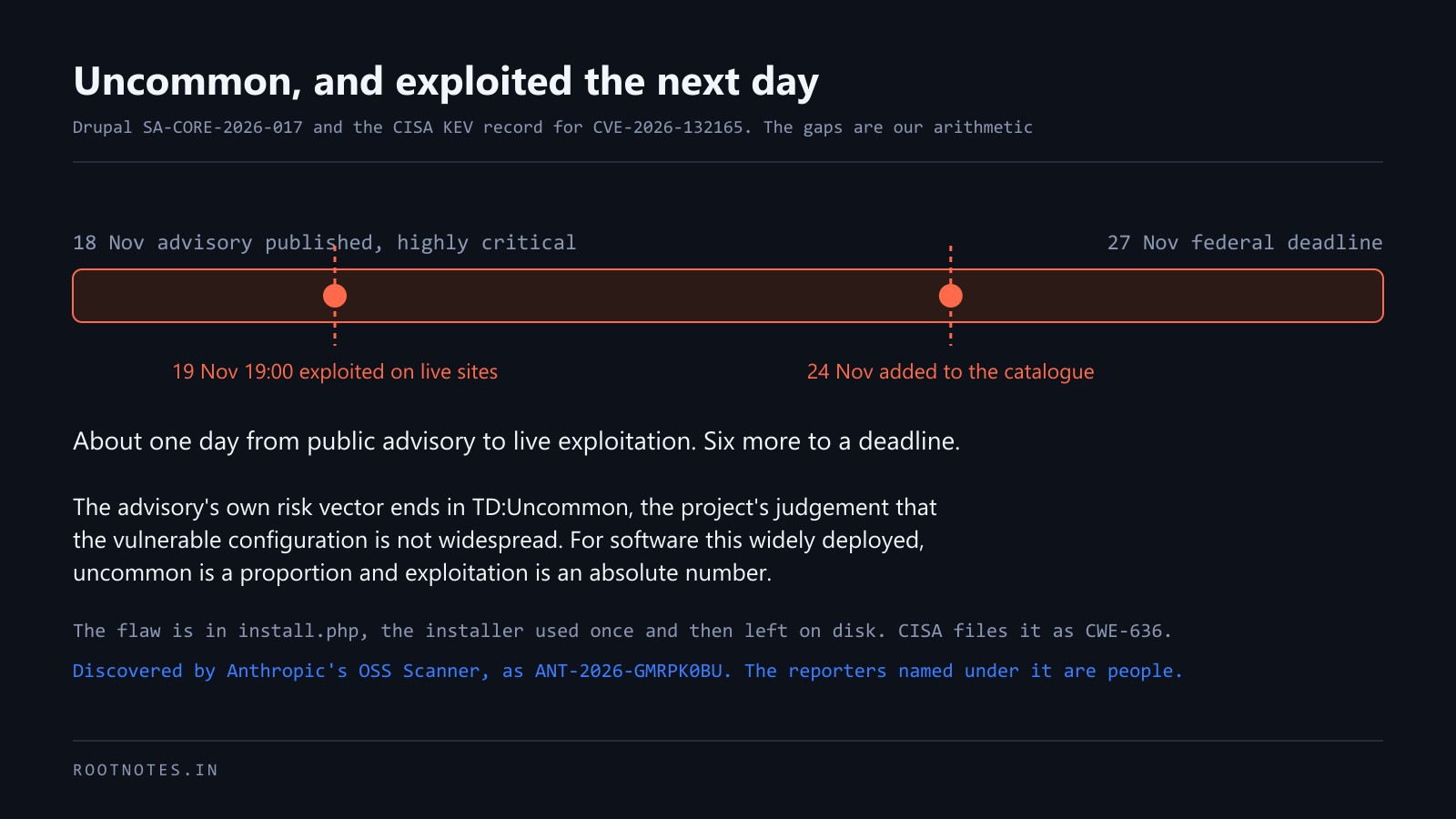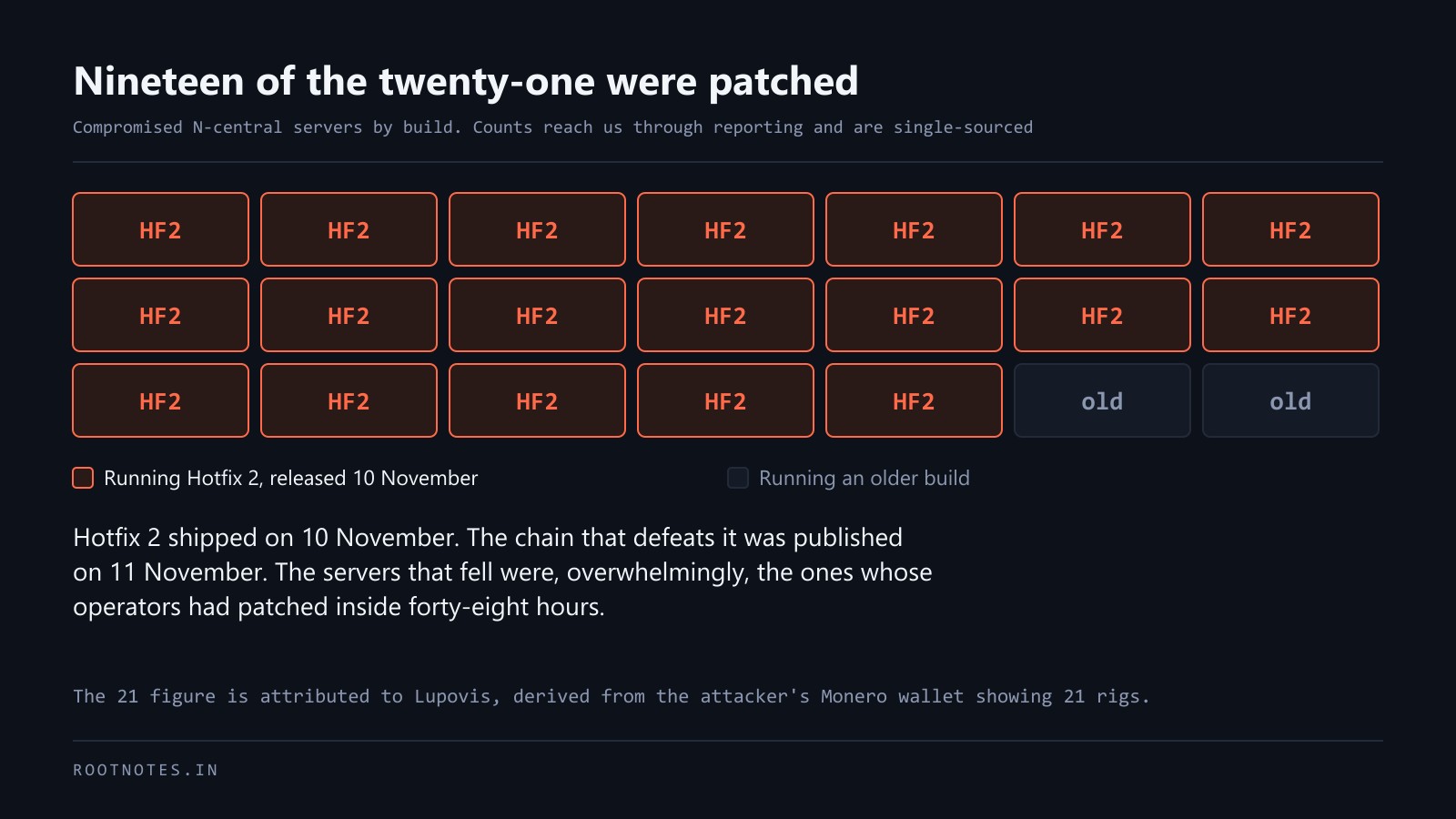
CVE-2026-90436 is the Apache Axis flaw this site wrote about last week, as the first link in the chain used against N-able N-central servers. CISA catalogued it on 18 November with a three-day deadline.
N-central was not the only thing using Axis.
Rapid7 has described exploitation of the same flaw against Atlassian Confluence Data Center, in a customer environment, flagged on 13 November 2026. Confluence uses the Axis library for its XML-RPC and SOAP remote API.
Off by default, on somewhere
Atlassian's own statement, quoted in the reporting, draws the boundary clearly. To be vulnerable, an instance must have the remote API enabled. That setting has been off by default for new installations since Confluence 3.0, and the feature was removed entirely in Confluence 10.0.
Read that as an exposure statement rather than as reassurance.
A setting that has defaulted to off since version 3.0 is not a setting anyone turned on recently. It is a setting that was turned on a long time ago, for an integration that somebody needed, by a person who has probably left. It has survived every upgrade since, because upgrades preserve configuration.
This is the second time in a week the same sentence has described a different vendor. GL.iNet's notice said its router command-injection flaw applied even when the affected feature was switched off. Here the feature has to be on, and the population that has it on is defined by age rather than by choice.
The first clock: three minutes
The detail worth stopping on is the pace.
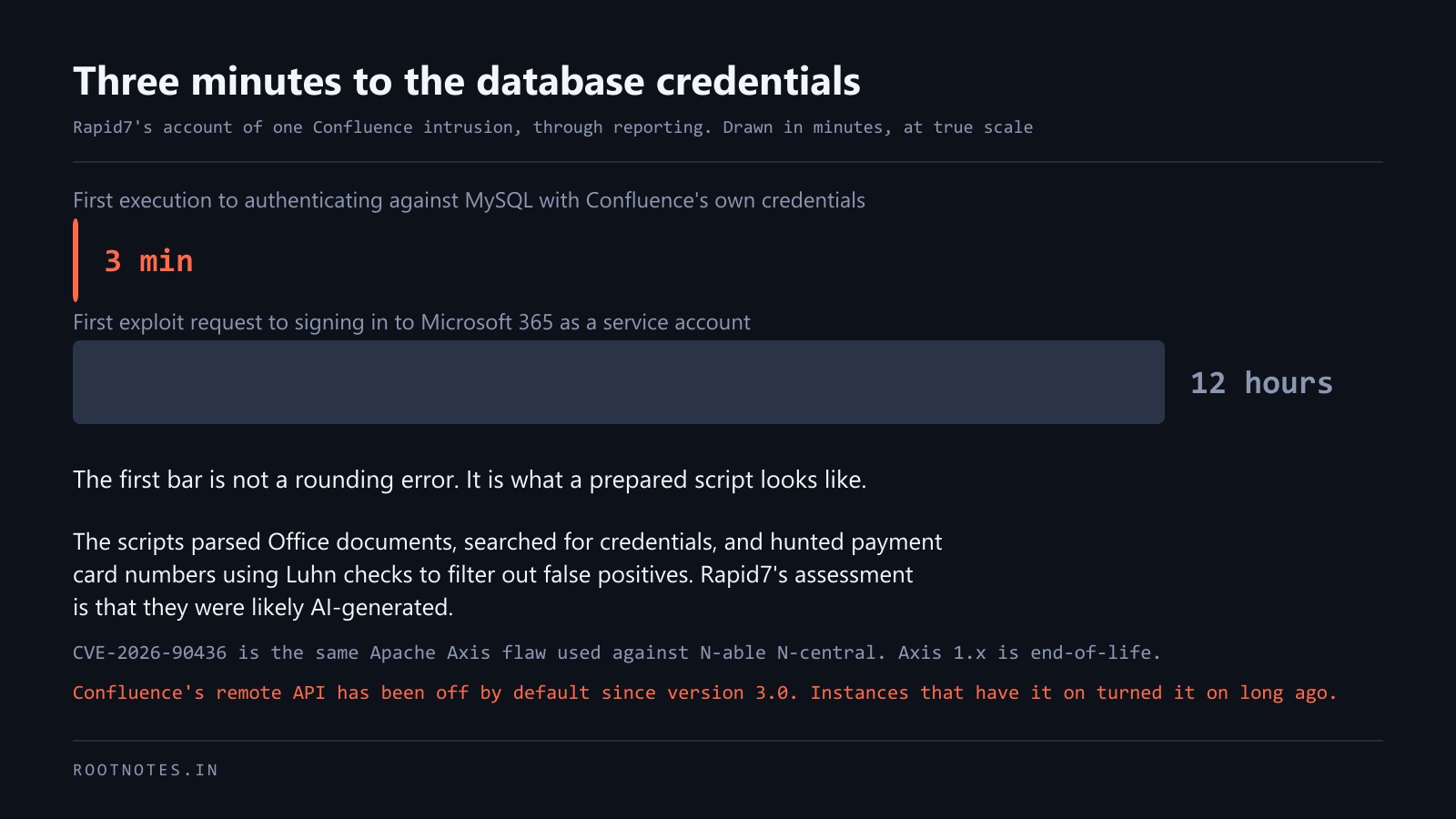
Rapid7's account, as quoted, says that just over three minutes after the first observed execution, the attackers were authenticating to MySQL using Confluence's own database credentials and querying page bodies, application links and attachments whose names suggested credentials, tokens, VPN configurations and private keys.
Three minutes is not a human reading output and deciding what to try next. It is a script that already knew where Confluence keeps its database credentials, what the schema looks like, and which attachment names are worth pulling.
Rapid7's assessment is that those scripts were likely AI-generated.
The supporting detail is the one that makes the claim concrete rather than decorative. The scripts parsed Office documents, searched for credentials, and hunted for payment card numbers using Luhn checks to filter out false positives.
Luhn is the checksum that validates a card number. Applying it is not clever; it is the obvious thing to do if you are writing a card-number scraper and you care about precision. What it shows is an operator who built a tool that reduces its own noise, in a wiki whose contents they had never seen.
The second clock: twelve hours
After the database, the account goes outward rather than deeper.
The attackers mapped internal services, used a Confluence application credential to query the internal Atlassian Crowd API for users and group memberships, and attempted AS-REP Roasting, a Kerberos technique for pulling crackable material from accounts that do not require pre-authentication. That attempt failed.
They did obtain a service account credential and used it to query a production cloud data warehouse.
Then, about twelve hours after the first exploit request, they signed in to Microsoft 365 as an integration service account, using legacy authentication.
The route from a wiki to the tenant is not an exploit chain. It is a credential chain. Confluence held the material, and the destination accepted an authentication method old enough to skip the controls that would have stopped it.
Legacy authentication is the part a defender could have closed without knowing anything about Axis.
Nothing to patch
CVE-2026-90436 affects Axis 1.x, which is end-of-life. There is no fixed release.
The options, as reported, are to migrate to a different SOAP engine such as Axis2, or to build Axis yourself with a patch from a commit dated 12 July 2026.
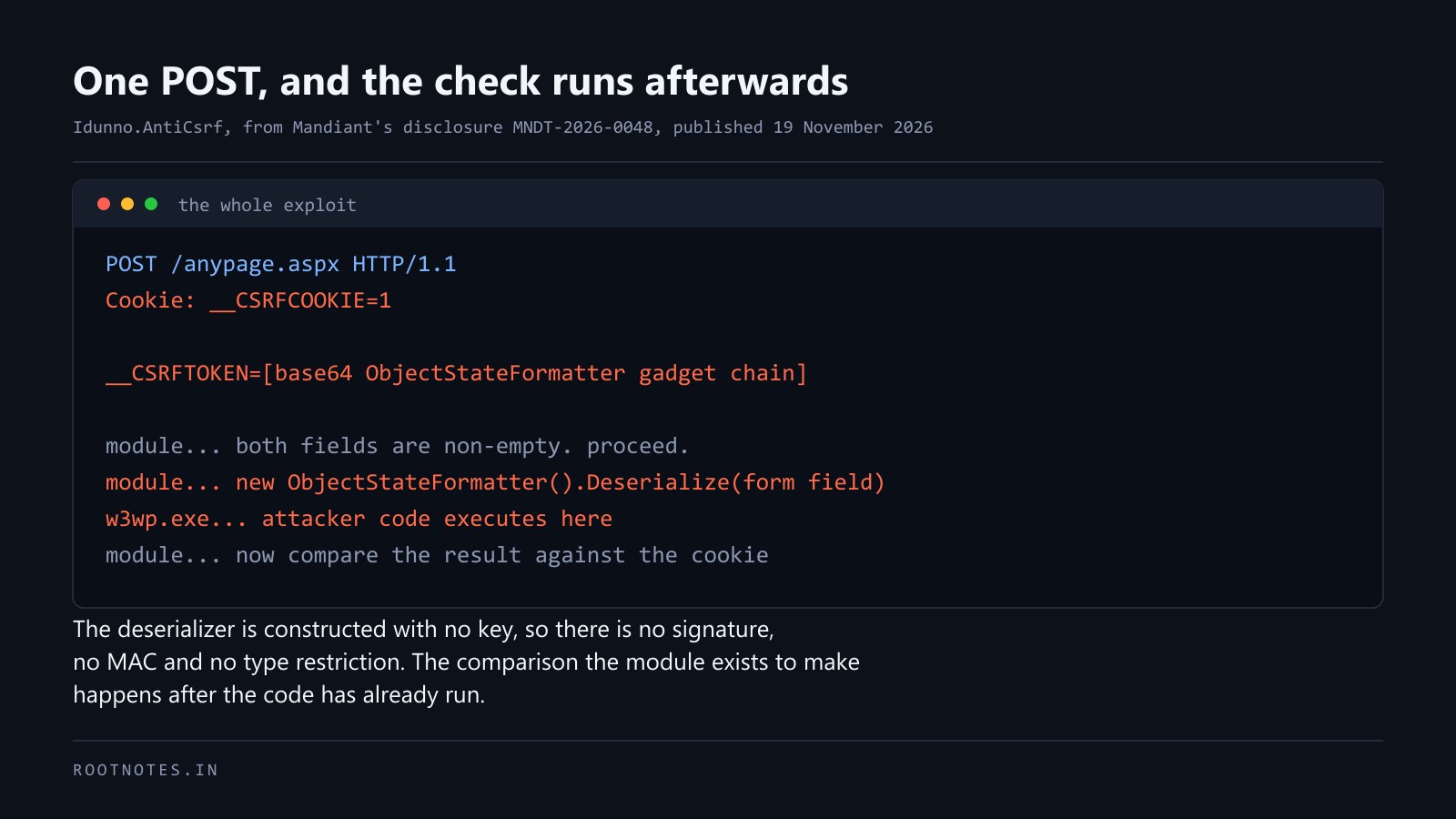
That makes three components this month whose remediation is not a patch: the N-central Legacy API, which the vendor deleted; a 2008 ASP.NET anti-CSRF module with no maintainer, where the advice is removal; and now Axis 1, where the advice is migration or self-maintenance.
The common property is not age. It is that each one sat inside something larger, so the organisation running it did not know it was there. Nobody chose Axis. They chose Confluence, or N-central, and Axis came along.
What a defender can actually check
Three questions, in order of how fast they can be answered.
Is the Confluence remote API enabled. If the instance is on 10.0 or later the feature is gone; below that it is a setting, and on an old instance the honest default assumption is that nobody has looked.
Is legacy authentication permitted in the tenant. This is the control that turned an application compromise into an identity compromise, and it is independent of everything above it.
Do the service accounts that integrations use have the reach they were given years ago, or the reach they need now.
What is not established
- Rapid7's analysis reaches us through reporting. We have not read the original write-up, and the quoted figures, including the three minutes and the twelve hours, are as carried there.
- The assessment that the scripts were likely AI-generated is Rapid7's characterisation, not a demonstrated fact. No method for that attribution is given in the reporting.
- The victim is described as a customer environment. Nothing is published about sector, size or outcome, and no claim is made that data was taken.
- It is not established how many Confluence instances have the remote API enabled. Atlassian's statement describes defaults, not deployments.
- Whether this intrusion and the N-central activity share an operator is not established. They share a flaw and a software library, which is not the same thing.