Stanford's Hazy Research published Next-Concept Modeling on 12 October 2026. The headline claim is speed: text generated 10 to 31 times faster than strong diffusion baselines, at comparable or better quality, after seeing 4 to 5 times fewer training tokens.
The speed is the part being repeated. It is not the most interesting number in the post.
The table nobody is quoting
The team tested the model on Sudoku, on the reasoning that coarse-to-fine generation should help with problems that need a global plan before the details are filled in.
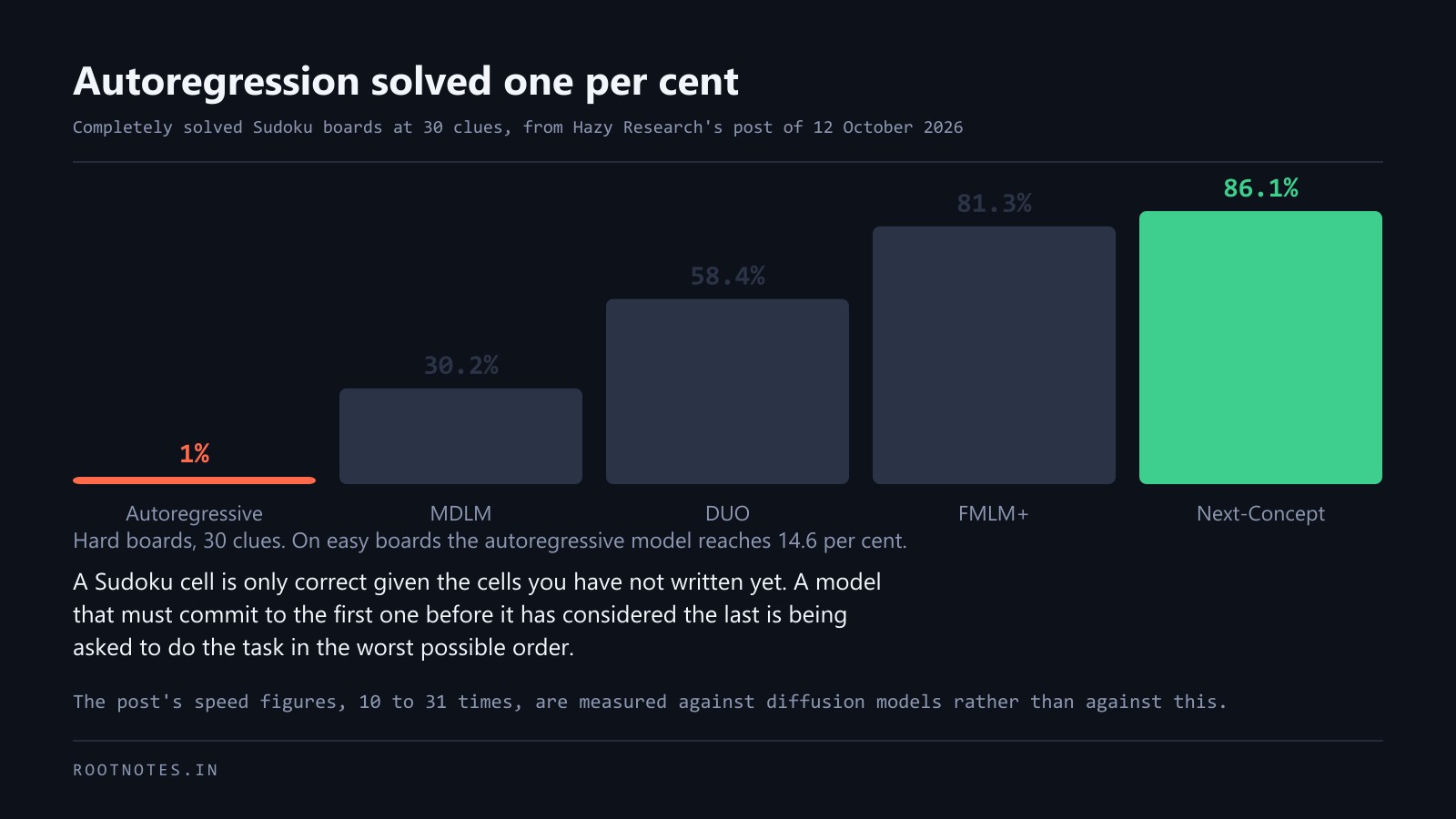
Here is the share of boards each model solved completely, at the hardest setting, 30 clues:
Autoregressive: 1.0 per cent.
MDLM: 30.2. DUO: 58.4. FMLM+: 81.3. Next-Concept Modeling: 86.1.
On easy boards, with 40 clues, the autoregressive model manages 14.6 per cent while everything else is above 92.
A Sudoku board is a constraint satisfaction problem. Nothing you write in the first cell is correct in isolation; it is only correct given the eighty cells you have not written yet. A model that must commit to cell one before it has considered cell eighty-one is being asked to do the task in the worst possible order, and the table is what that looks like.
That is a claim about what left-to-right generation is bad at, not about how fast it is. It is the sharpest result in the post, and it is the one the speed figure is burying.
What the model actually does
Two stages.
First, a multiscale tokenizer learns to represent a piece of text as a hierarchy of discrete codes that runs coarse to fine. The early levels are short and hold the broad structure. The later levels are longer and add detail.
Second, the tokenizer is frozen and a transformer learns to predict each level from the cumulative reconstruction of the levels before it. At generation time the model produces one level at a time, and every code within a level is predicted in parallel. The tokenizer's decoder turns the finished hierarchy back into text.
So the number of sequential steps is the number of levels, not the number of tokens. The post's translation example runs to eleven levels for a full sentence.
The post adds a detail that explains more of the speed than the parallelism does on its own: the early levels are short, so the early steps are cheap. A model that starts with a handful of codes and grows is not paying full sequence cost on every pass the way a diffusion model does.
The 31 times is against diffusion
This is the part that gets lost in summary, and the post is not hiding it.
Every wall-clock comparison in it is against diffusion language models. Unconditional generation runs 21 times faster than the strongest diffusion baseline on One Billion Word and 10 times faster on OpenWebText. Conditional generation matches the strongest diffusion baseline's ROUGE-L on XSum while running 31 times faster.
Diffusion language models are the thing being beaten. They are an alternative to autoregression that has not displaced it, and they are slower than people expected because they run many sampling steps over the full sequence each time.
There is no wall-clock figure in the post for a tuned autoregressive decoder. The only place an autoregressive model appears is the Sudoku table, on a task chosen because it is hostile to generating left to right.
None of that makes the work less interesting. It makes the headline a different headline. This is a result about the non-autoregressive frontier, not a measured threat to the way production models decode today.
They measured the clock instead of the function calls
One paragraph in the post deserves more attention than the speed figures it introduces.
The diffusion language modelling literature reports efficiency as the number of function evaluations. The team points out that this overlooks potentially substantial differences in the cost per evaluation, and benchmarks wall-clock generation time on a single NVIDIA H100 SXM 80GB instead.
That is a researcher saying their own field's standard metric does not measure the thing it is used to argue about. It is also why their numbers are harder than they look: the 11 times improvement they report in function evaluations is the softer figure, and the 10 to 31 times wall clock is the one that had to survive a stopwatch.
The idea came from image generation
The post says the tokenizer builds on VAR, which did next-scale prediction for images: generate a coarse version of the picture, then refine it at increasing resolution, rather than predicting pixels or patches in raster order.
Moving that to text took three specific changes, which the post names. Each level gets its own codebook. Nested dropout pushes the early levels to carry real information rather than leaning on the later ones. A token-level reconstruction objective keeps the text recoverable.
Worth sitting with: the structure now being proposed for faster text generation arrived from image generation, where coarse-to-fine has been the natural order for years because a blurry picture is still a picture. A blurry sentence is not obviously anything, which is why the tokenizer is the hard part and why it is stage one rather than an implementation detail.
Where the cost goes
Generating one token at a time is bounded by memory bandwidth rather than arithmetic. Each step has to stream the model's weights out of high-bandwidth memory to produce a single token, and the arithmetic units spend most of their time waiting.
Replacing many narrow sequential steps with a few wide parallel ones does not make that work vanish. It moves it: fewer trips to memory, more arithmetic per trip, which is the shape of workload a GPU is actually built for. The post's own framing supports this reading without putting it in these terms, and the arithmetic of it is ours rather than theirs.
The honest version of the economic claim is therefore narrower than the exciting one. If this scales, the bottleneck in inference changes character. That is not the same as the bill going away.
What is not established
- Scale. The post describes its scaling results as preliminary and the benchmarks are the standard diffusion language modelling set: TinyStories, One Billion Word, OpenWebText, WMT14 and XSum. Nothing here is at the size of a model anyone deploys.
- Comparison with production decoding. The post reports no wall-clock figure against an optimised autoregressive decoder, so the speedup relative to how text is generated in practice is not established by it.
- Generality of the Sudoku result. Sudoku was chosen because it rewards global planning. It demonstrates that left-to-right ordering hurts on that class of problem, not that it hurts on open-ended generation.
- Quality at length. The post notes the growing consensus that generative perplexity does not fully capture generative quality, which is why translation and summarisation are included. Long-form coherence is not measured.
- Hardware. All timings are on one H100 SXM 80GB. A method that trades memory traffic for arithmetic will not move the same way on every accelerator.
- The reading of why fewer, wider steps suits a memory-bound decoder is our analysis, not a measurement in the post.