On 19 November 2026 Mandiant published a disclosure, MNDT-2026-0048, against a library that almost nobody running it could name.
Idunno.AntiCsrf is an ASP.NET HTTP module. It was written to stop cross-site request forgery on WebForms applications using the double-submit cookie pattern. The official build is dated December 2008. It was published on CodePlex, Microsoft's code-hosting site, which was retired in 2017 and survives only as a read-only archive.
The project has no maintainer. There is no patch. Mandiant's note says active exploitation in the wild has been observed.
What the module does on every POST
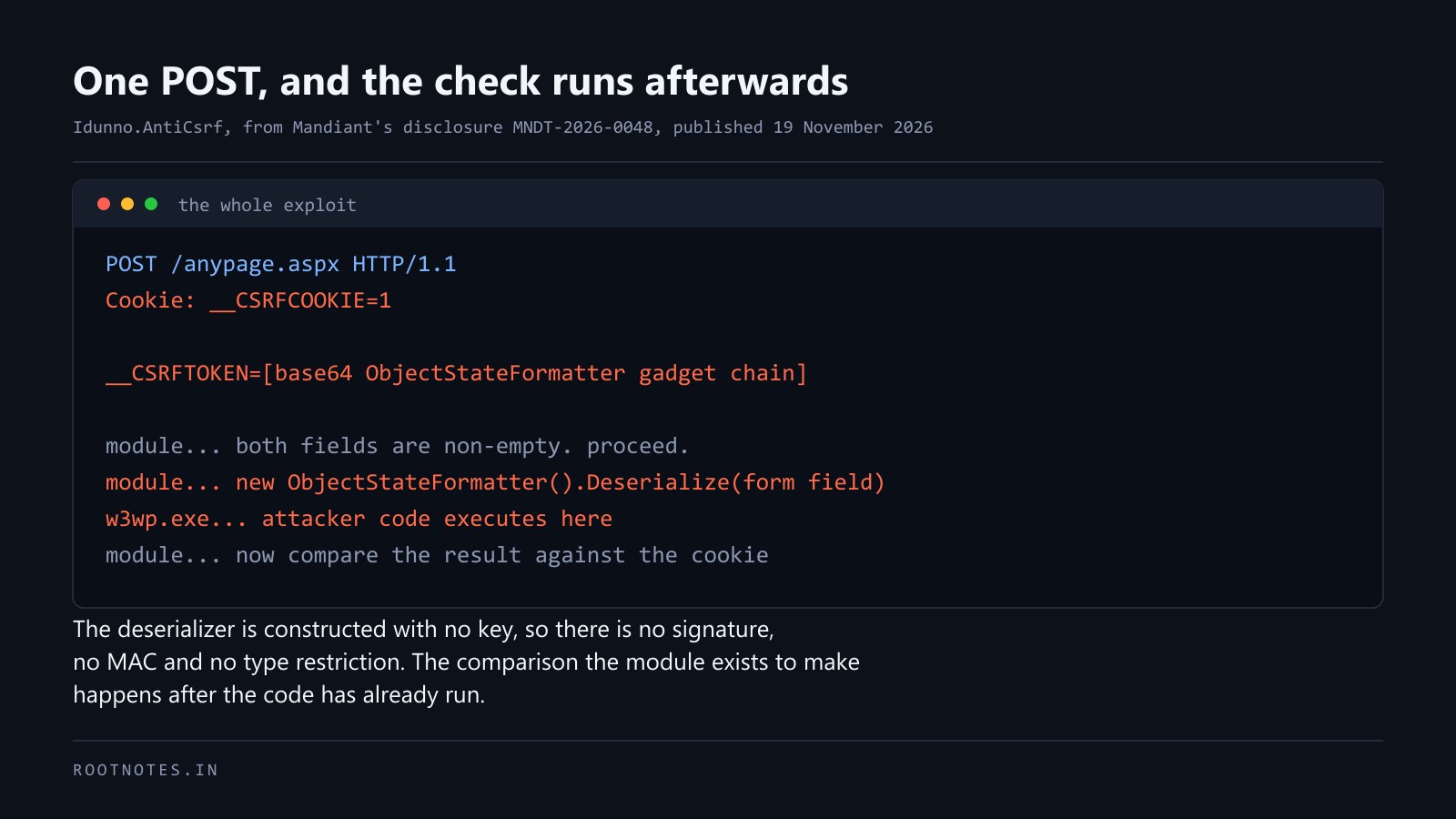
The module attaches itself to PreRequestHandlerExecute and, on an incoming POST to any page handler, checks two things: that the configured CSRF cookie is non-empty, and that the configured CSRF form field is non-empty.
Then it deserializes the form field.
Then it compares the result against the cookie.
Read that order again, because the order is the vulnerability. The module calls ObjectStateFormatter.Deserialize on attacker-supplied form data, and only afterwards performs the comparison it exists to perform. The check runs after the thing that kills you.
Unkeyed
ObjectStateFormatter is a .NET serializer. Mandiant's description is that the module constructs it with the parameterless constructor, which performs no message authentication, no signature check, no encryption, no machineKey validation, and enforces no restriction on which types may be instantiated.
So a Base64-encoded gadget chain placed in the CSRF form field executes inside Deserialize, in the IIS worker process, w3wp.exe.
The complete exploit, per Mandiant, is one HTTP POST. A cookie header setting the CSRF cookie to any non-empty value. A payload in the CSRF form field. No authentication, no valid token, no prior request.
The module never checks that the cookie is a well-formed identifier before deserializing. It checks that elsewhere, during page rendering, which is a different code path that an attacker never has to enter.
Where it runs matters more than what it is
This is the part worth slowing down for.
PreRequestHandlerExecute runs at the HttpApplication pipeline level, before the page handler and before the page lifecycle: PreInit, Init, Page_Load.
That ordering has a consequence that will catch teams who believe they are covered. Application-level session checks written inside Page_Load, the kind that redirect an anonymous visitor on the first few lines, never execute. The deserialization has already happened.
Pipeline-level authentication does run earlier. A site that authorises in configuration is protected by that configuration. A site that authorises in code is not protected at all, because its code has not run yet.
Mandiant adds one more detail that removes the obvious reassurance: the page does not need to contain a server-side form element. A page with no form on it is still a sink.
So the exposed surface is any anonymously reachable page in the application that does not opt out of the check. A login page. An error page. A health endpoint. A legacy report nobody has opened in four years.
The fix is removal
Mandiant's resolution section does not say upgrade. It says remove the library, strip its entries out of the configuration, and replace it with something maintained.
That is not a recommendation about risk appetite. It is a statement of fact about who is left. The last release is 0.9.1 Beta, the platform it was published on has been read-only since 2017, and there is nobody to accept a pull request.
This is the second time in two weeks that the answer to a live exploitation event has been deletion rather than a patch. N-able ended the N-central intrusion chain on 16 November by removing the Legacy API the chain depended on, not by fixing it. The pattern is the same and the reason is the same: patching an old surface is open-ended work, and removing it is finite.
The difference is that N-able could choose. Here there is no choice, because there is no vendor.
Finding it
Mandiant published three file hashes for Idunno.AntiCsrf.dll, including the official 2008 release build at 69,632 bytes, and a debug rebuild at 70,144. It also notes that any organisation that recompiled the source will have different hashes while keeping the same vulnerable call, and should search configuration files and the application's bin directory for the module by name instead.
That is the practical instruction. Hashes will miss the in-house rebuilds. The name will not.
Not in the catalogue
Update, 25 November 2026. CISA added CVE-2026-131914 to the catalogue on 24 November, in feed version 2026.11.24, with a remediation deadline of 27 November and a forensic-triage marker. The gap this section describes lasted about a day. One detail in the entry is worth recording: CISA's own description notes that the product could be end-of-life or end-of-service and advises users to discontinue use or move to a supported version. That is a federal deadline whose only compliant answer is removal. The original text follows.
As of 24 November, CVE-2026-131914 is not in CISA's Known Exploited Vulnerabilities catalogue.
The catalogue moved on 23 November, to version 2026.11.23 and 1,792 entries. It added two things that day, each with a three-day remediation deadline. This was not one of them.
Mandiant's CVSS 4.0 vector carries the exploit-maturity value for attacked, and scores 9.3. The assigning organisation is saying, in the vector string itself, that this is being used. The federal catalogue that would place a deadline against it has not said so.
Both of those can be true at once. A catalogue entry requires CISA's own evidentiary bar, and a vendor's observation is not automatically that. But the gap is the thing a defender actually runs into: the list most organisations use to prioritise does not currently contain the flaw whose discoverer says it is under attack.
What is not established
- Mandiant says exploitation has been observed. It does not say by whom, against how many organisations, in which sectors, or since when. There is no campaign name and no victim count.
- There is no public figure for how many applications still load this module. Nobody publishes deployment counts for a 2008 CodePlex release, which is exactly why this kind of library survives.
- The configuration setter bug Mandiant describes comes from its reading of decompiled code, not from source published by the project.
- KEV membership was checked on 24 November and changed the same day, as the update above records. The absence described in that section was a snapshot, and it is no longer current.
- Whether any specific application is exploitable depends on how it authorises requests, and that is a per-application question this piece cannot answer for you.