On 23 November 2026 CISA added CVE-2026-133968 to the Known Exploited Vulnerabilities catalogue with a remediation deadline of 26 November. Three days.
The product is MONAI Label. It is an annotation server: the thing a radiologist or a research assistant connects to from 3D Slicer or OHIF in order to label medical images, so that the labels can train a model. It sits between the people doing the labelling and the images being labelled.
The flaw is a path traversal that lets a caller write a file anywhere the server process can write.
What the endpoint does
The project's own advisory, GHSA-qc22-rmgc-vg94, describes it precisely enough to quote the mechanism.
The upload endpoint takes a caller-controlled value from the query string and uses it as the image identifier without validation. The datastore appends the file extension to that identifier, joins it onto the image directory, and writes the uploaded file to whatever path results.
The resolved path is never checked to be inside the datastore. So an identifier of the form three levels of dot-dot followed by a target directory writes the uploaded content wherever the process has permission to write. The label endpoint builds its destination the same way.
An arbitrary file write on a long-running server is remote code execution with one more step. The advisory names the steps: overwrite application code, append to an authorized_keys file, or add a cron entry.
The default is the problem
Authentication in MONAI Label is disabled by default.
That is the sentence that turns a serious bug into a catalogued one. In the shipped default configuration, any client that can reach the server can write a file. With authentication switched on, the lowest role, annotator, is still sufficient.
Nothing here requires the attacker to be an administrator, a tenant, or a customer. It requires network reach.
Two traversals, one CVE
The 0.8.6 release notes record two path traversals, not one.
The second is in the session upload endpoint, which extracted uploaded tar archives without checking member names, and used session identifiers as paths without validating them. That is the classic archive-extraction flaw, and the release notes say it has the same reachability: no authentication by default.
Only the first one has a CVE. The catalogue entry, and therefore the federal deadline, covers the datastore endpoints. The archive extraction is fixed in the same release and tracked by nothing.
Anyone triaging against the CVE alone will patch both, because there is one release. But anyone reasoning about exposure from the CVE record will be reasoning about half of what was wrong.
The advisory and the catalogue do not agree
Read the project's advisory page and the federal record side by side and they describe the same flaw with different metadata.
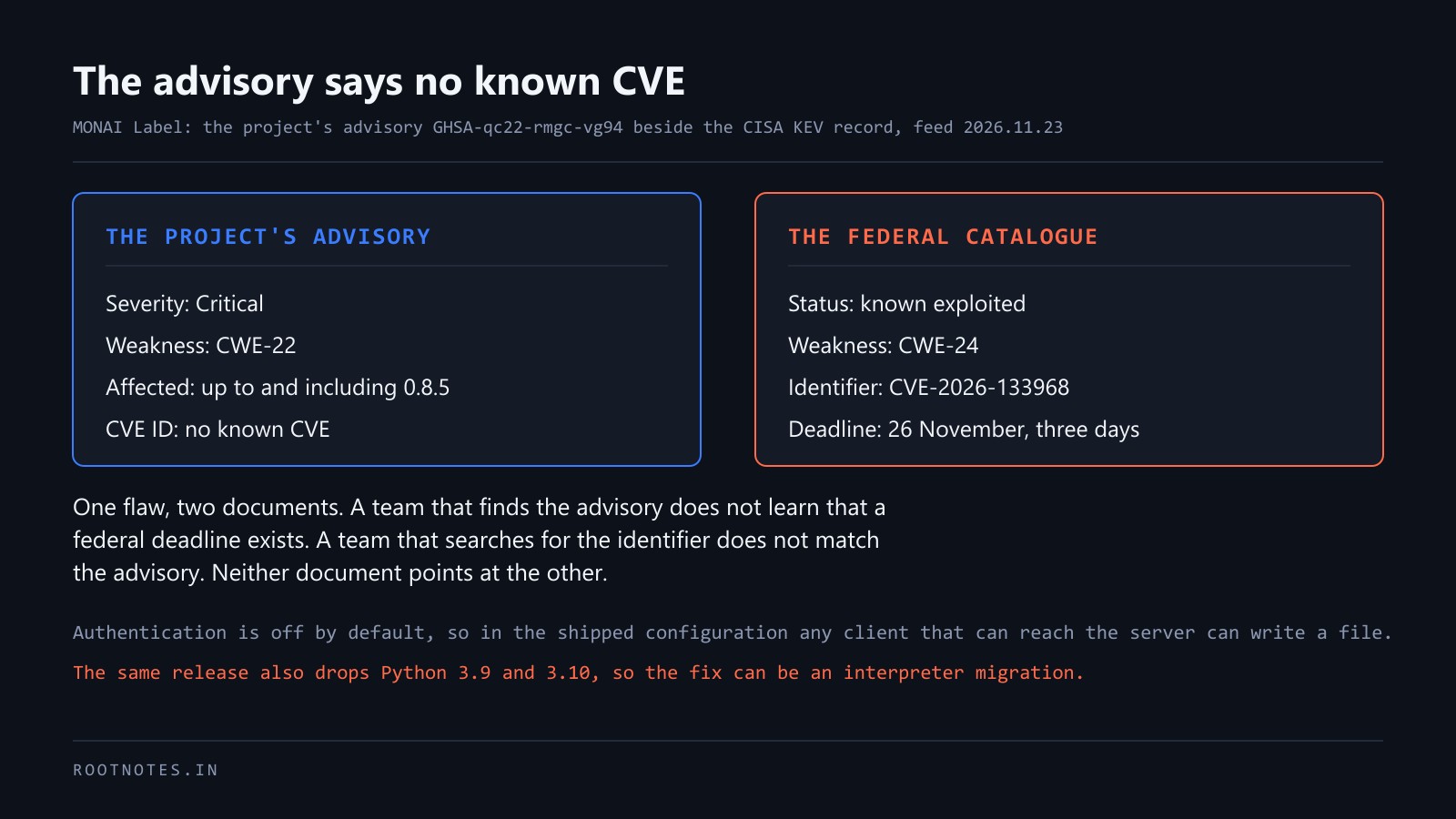
The advisory lists the weakness as CWE-22, path traversal. The catalogue lists CWE-24. Those are neighbours in the same family and the difference is close to cosmetic.
The CVE field is not cosmetic. On the advisory page, under CVE ID, it says no known CVE.
CISA has published a three-day deadline against CVE-2026-133968, and the upstream document a defender is most likely to find first does not carry that identifier at all.
This is a small administrative gap and it has a real consequence. A security team that searches its dependency inventory for the catalogued identifier will not match the advisory. A team that finds the advisory will not learn that a federal deadline exists. The two documents are describing one flaw and neither one points at the other.
The fix requires a newer Python
The security release is 0.8.6, and all versions up to and including 0.8.5 are affected.
The same release removes support for Python 3.9 and 3.10. MONAI Label 0.8.6 requires Python 3.11 or newer, and the container image moves to a newer base with a newer interpreter.
So the upgrade that satisfies a three-day deadline is not always a version bump. For a deployment pinned to an older interpreter, which is a very ordinary thing in a research environment built around other pinned scientific packages, it is an interpreter migration with a three-day clock on it.
That is worth saying plainly because it is the kind of detail that turns a scheduled task into an unscheduled one, and it is not visible from the CVE record.
Assume it was reached
The release notes carry an instruction that is easy to read past. If a 0.8.5 or older server was reachable from an untrusted network, they say, review it for unexpected file changes before returning it to service.
That is the project telling operators to treat exposure as compromise. It is the right advice for an arbitrary file write, because the primitive leaves artefacts rather than crashes, and because the catalogue entry is marked for forensic triage.
What is not established
- CISA's catalogue entry establishes that the flaw has been exploited. It does not say against whom, how many, in what sector, or whether any of it touched patient data.
- There is no public figure for how many MONAI Label servers are exposed to untrusted networks. The project ships a server that is meant to sit on a research network, and no survey of that population exists.
- Whether any clinical system was affected is unknown. MONAI Label is used in research and in clinical research workflows, and those are not the same as a hospital's production imaging estate.
- The advisory credits the original report to an external reporter and says it was first filed against a different repository. The reporting history does not establish how long the flaw was known before it was catalogued.
- The CVE field on the advisory page was read on 24 November and may be corrected after publication.