Microsoft 365 went into degradation on Thursday 12 November at 1:26 PM Eastern. At the time of writing, on Friday 13 November, Microsoft's public status page still reads Service degradation, last updated at 06:57 UTC.
The incident is tracked as MO1550821, with Exchange Online carried separately as EX1550543. Affected services reported include Outlook, Teams, SharePoint, Copilot and Defender XDR.
Everyone is covering the downtime. The sentence worth reading is this one, which Microsoft put on its public status page:
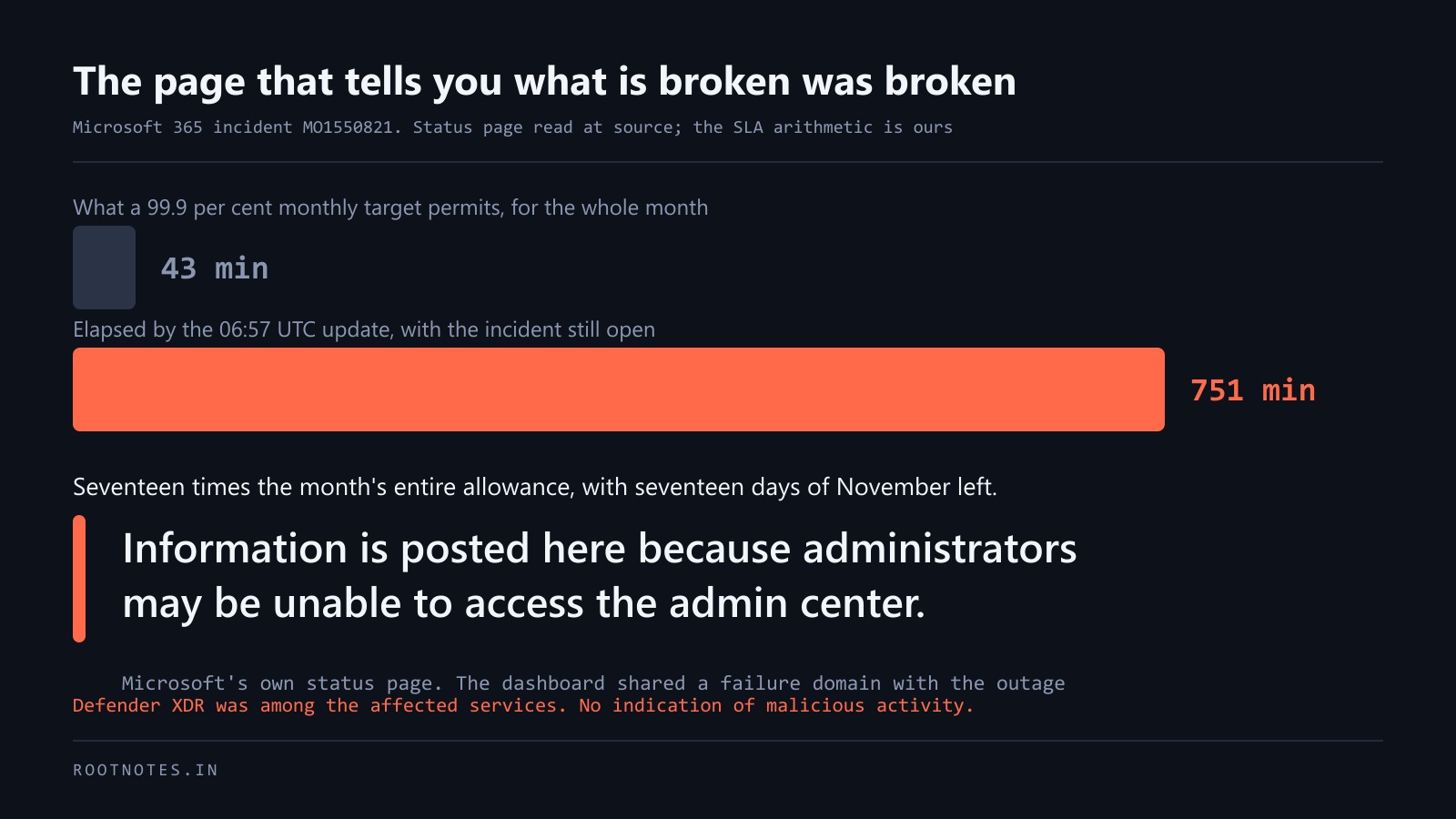
Information about this issue is posted on this page because Microsoft 365 administrators may be unable to access the admin center to get Service health information.
Read that twice.
The dashboard was downstream of the thing it monitors
The admin center is where an organisation's administrators go to find out what Microsoft is doing about an outage. It is the authoritative channel. It is where the incident numbers live, where the updates land, and where somebody under pressure goes to tell their own management when service will return.
It is also a Microsoft 365 service, running on Microsoft 365 infrastructure, behind Microsoft 365 authentication.
So when the infrastructure degraded, the tool for finding out that the infrastructure had degraded degraded with it. Microsoft had to fall back to a separate public page specifically because its customers could not reach the place it normally talks to them.
To Microsoft's credit, that fallback exists and worked, and the sentence explaining why is honest in a way vendors usually are not. Most companies would have quietly posted elsewhere and said nothing about the reason.
But the structural point stands, and it is not really about Microsoft. Your monitoring must not share a failure domain with the thing it monitors. Everybody knows this. Almost nobody has checked whether their own status channel, their alerting, their incident chat and their authentication all terminate in the same place, because checking is tedious and the answer is usually uncomfortable.
The organisations that had the worst day here are the ones whose email, chat, document store, security console and identity provider are all the same vendor. When that vendor degrades, they lose the service, the ability to coordinate about the service, and the ability to find out what is happening, in one event.
The arithmetic nobody is doing
Microsoft 365 is sold against a 99.9 per cent monthly uptime target.
Work out what that permits. A 30-day month is 43,200 minutes. One tenth of one per cent of that is 43 minutes and 12 seconds. That is the entire allowance for a calendar month.
This incident had run 12 hours and 31 minutes by the time of that 06:57 UTC update, which is 751 minutes, and it was still open.
751 divided by 43.2 is 17.4.
So by Friday morning the outage had consumed more than seventeen times the whole month's downtime budget, with seventeen days of November left to go and the incident unresolved.
We are not making a contractual claim. Service credits depend on definitions of downtime that are narrower than "I could not open Outlook", they are calculated per service rather than per user experience, and in most agreements the customer has to notice and file a claim to receive anything at all. The number above is not what Microsoft owes anyone.
It is a measure of distance. It is worth knowing that the gap between what an availability target permits and what actually happened here is not a near miss. It is more than an order of magnitude.
Why this one is measured in days
The mechanism Microsoft described explains the duration better than anything else published.
Microsoft said a process that establishes secure connections became overwhelmed, causing affected servers to stop handling requests. And then the detail that matters: restored servers can become unresponsive again once they receive traffic.
That is a self-reinforcing failure, and it is the hardest kind of outage to end. Ordinary outages have a fix and a recovery. This one has a fix that is undone by the recovery, because the instant a repaired server rejoins the pool, the backlog of waiting clients and automatic retries arrives at once and knocks it over again.
Every email client in the world retries. Every mobile app retries. Every integration retries, usually on a timer, usually without the backoff that would help. The accumulated demand of a global user base that has been failing for twelve hours is enormous, and it lands on the first server that says it is ready.
Which means recovery cannot be a matter of fixing and restoring. It has to be throttled, staged and drained, and that takes hours no matter how quickly the underlying defect is understood.
The explanation has moved three times
Worth recording, because the final post-incident report should be read against it.
The first explanation was elevated infrastructure load. Microsoft then ruled out a traffic surge. The preliminary cause became resource contention in the underlying infrastructure. Overnight, Microsoft began reverting a recent network configuration change, which it has not confirmed as the root cause.
That is not evasion; that is what diagnosis looks like in public, and a company that publishes its working will always look less certain than one that says nothing until the end. But a configuration change being reverted after the load explanation was retired is a meaningful shift in direction, and the post-incident report should explain it.
Microsoft has said there is no indication this is the result of malicious activity, and reporting notes no connection to the security updates it released on 10 November. A preliminary post-incident report is promised within two business days and a final one within five.
The part that belongs on this site
Defender XDR was among the affected services.
Extended detection and response is the platform through which a great many organisations watch for intrusion. For the duration of this incident, those organisations had degraded visibility into their own environments.
Nothing suggests anyone exploited that, and we are not implying it. The point is narrower and worth stating plainly: an availability incident in a security product is a security incident, even when nobody attacks during it. A detection platform that is unavailable is not detecting, and the window is not short here.
If your security monitoring, your email and your identity provider are one vendor, that vendor's bad day is your blind spot. That is a procurement decision, made years ago, surfacing now.
What is not established
- This is a live incident. Everything above was true at the time of writing, on 13 November, and the final post-incident report will supersede parts of it.
- The root cause. Microsoft has published a preliminary cause and has not confirmed one. The network configuration revert is a lead, not an answer.
- The duration. Our 12 hours 31 minutes is measured from the reported 1:26 PM ET start to the 06:57 UTC status update we read. It is not Microsoft's own measure of the incident, and Microsoft's official duration will be calculated differently and per service.
- The SLA arithmetic is ours and is a comparison, not a contractual position. We have not examined anyone's agreement.
- The incident identifiers, the start time, the affected service list and the post-incident commitment reach us through reporting rather than from Microsoft's own page, which carries only the degradation notice and the sentence we quoted.
- Whether the earlier Teams incident the same day is related. Microsoft has not said.