CVE-2026-124194 went into CISA's Known Exploited Vulnerabilities catalogue on 10 November 2026 with a deadline of 24 November. It is an Outlook spoofing flaw and it is being exploited.
A good deal of the coverage describes it as a zero-click zero-day. We read Microsoft's advisory. It is neither.
What Microsoft's advisory actually says
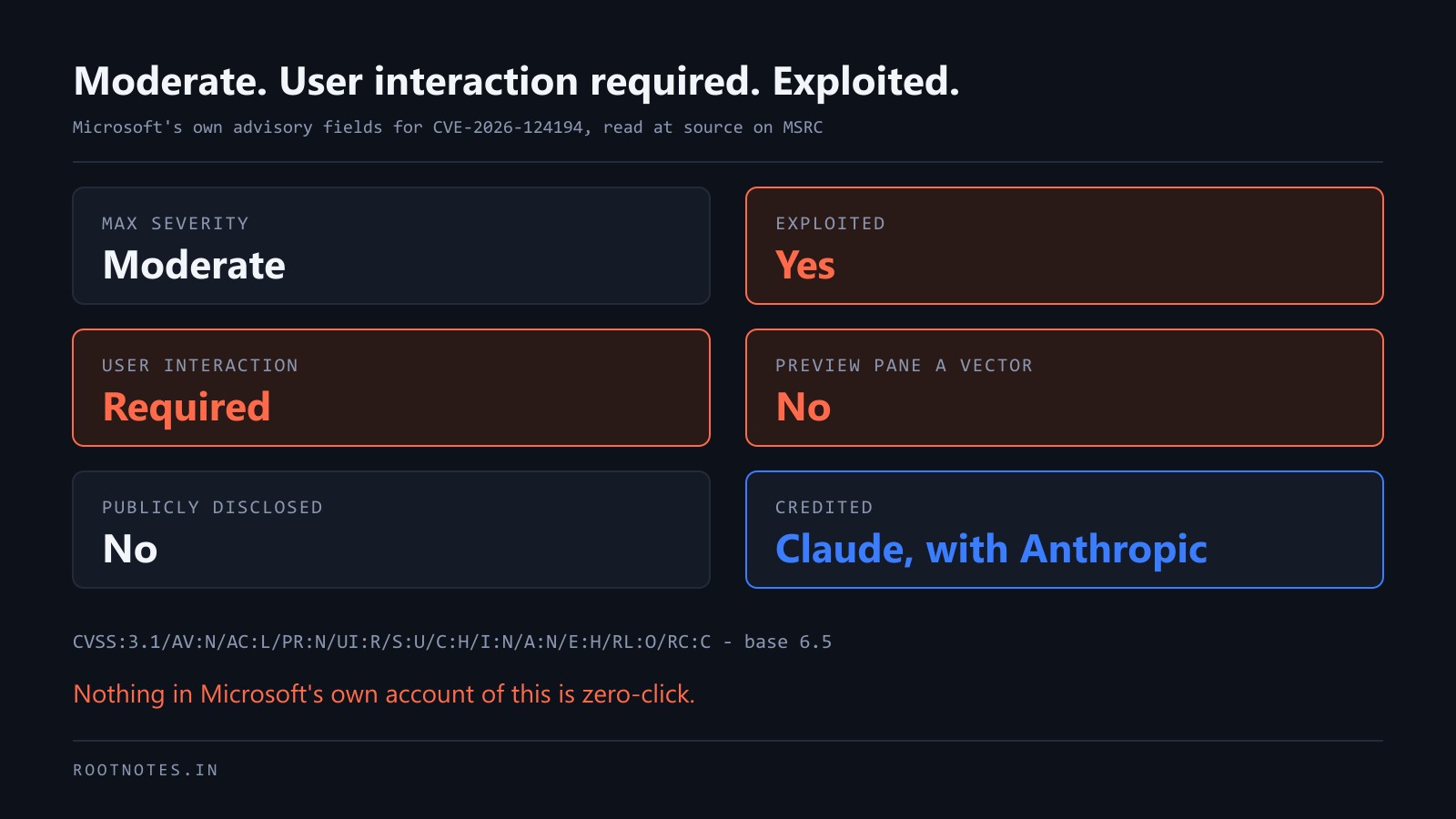
- Max severity: Moderate.
- Vector: CVSS:3.1/AV:N/AC:L/PR:N/UI:R/S:U/C:H/I:N/A:N/E:H/RL:O/RC:C. Base score 6.5, temporal 6.2.
- User Interaction: Required.
- Publicly disclosed: No. Exploited: Yes. Exploitability assessment: Exploitation Detected.
- Weakness: CWE-356, Product UI does not Warn User of Unsafe Actions.
And the advisory addresses the question directly, in its own FAQ. Asked what interaction is needed, Microsoft answers: an attacker must send a user a malicious Office file and convince them to open it.
Asked whether the Preview Pane is an attack vector, Microsoft answers: No.
That is about as unambiguous as vendor documentation gets. The Preview Pane question exists on Microsoft advisories precisely because it is the dividing line between "the user has to do something" and "merely receiving the message is enough". Microsoft was asked the zero-click question in its own document and said no.
So what does it actually do
From the FAQ: opening the crafted file causes Outlook to connect to an attacker-controlled network location without displaying the usual external-content warning, which can disclose authentication information.
Microsoft is specific about what that means. The vulnerability discloses the user's NTLMv2 hash to the attacker, who could use it to authenticate as that user.
Which explains the confidentiality rating of High on a flaw whose impact is nominally spoofing. It is not reading the user's mail. It is handing over a credential that can be relayed or cracked, and credential theft is where the real damage begins rather than ends.
The weakness classification is the honest description of the bug: the product performs an unsafe action without warning the user it is doing so. The user clicks something reasonable; the warning that should have appeared does not.
Why the distinction is worth insisting on
Calling this zero-click is not a harmless simplification. It changes what defenders do.
If a flaw is zero-click, user training is irrelevant, mail-flow filtering becomes the only control, and the urgency is maximal because nobody can avoid it by being careful. If it requires opening an attached file, then attachment filtering, user awareness and blocking outbound connections to untrusted hosts all become real mitigations, and the risk profile of an organisation that strips Office attachments at the gateway is very different from one that does not.
Those are different response plans. Getting the premise wrong produces the wrong plan.
To be clear: patch it anyway. It is being exploited, the temporal metrics say exploit code maturity is high and an official fix exists, and the catalogue deadline is real. The argument here is not that this is unimportant. It is that the reason to treat it urgently is "exploitation detected", which is sitting right there in the advisory, and nobody needed to invent a zero-click claim to justify it.
The acknowledgement nobody has noticed
Microsoft credits the finder as Benoit Sevens using Claude with Anthropic. The same name appears twice in the list with different spellings, alongside a second credit.
We have been tracking how vendors describe AI-assisted discovery, and this is the third convention we have seen in a month: Mozilla's advisory said nothing about how its flaws were found, Apache named the scanner and gave the finding its own internal identifier, and Microsoft names the researcher and the model together.
But this entry is different from the others in a way that matters. Every AI-assisted finding we have written about so far was proactive research: somebody looked, found something, reported it, and it was fixed before anyone used it.
This one is marked Exploitation Detected.
We want to be careful about what that does and does not mean. It does not mean a model found a flaw attackers were using. It does not establish any sequence between the research and the exploitation, and Microsoft's advisory gives no timeline for either. What it does mean is that a flaw credited to AI-assisted research and a flaw confirmed as exploited in the wild are, for the first time in the set we have been following, the same flaw. That is worth recording even though it proves nothing on its own.
What is not established
- The sequence. Whether the flaw was found first and exploited later, exploited first and found later, or both independently. Microsoft publishes neither date.
- What the exploitation looks like in practice. Microsoft says exploitation is detected and gives no indicators, no campaign, and no actor.
- Whether the duplicate acknowledgement entry means two separate findings or one person listed twice. The page shows the name twice with different diacritics, which looks like a data-entry artefact rather than anything meaningful.
- The affected version list. The advisory loads six product rows and anyone patching should work from those rather than from this piece.
- Why CISA's catalogue description phrases the weakness as missing user interaction for an unsafe action, which reads as though no interaction is needed, when Microsoft's vector says interaction is required. Both are describing CWE-356 correctly; the catalogue's wording is simply easy to misread, and we suspect it is where some of the zero-click coverage came from.